
What if the most dangerous threat to your business isn’t a future attack, but the "silent" breach already nesting within your network? Detect. Defend. Dominate. With the global cost of cybercrime projected to exceed $10.5 trillion in 2026, the margin for error has disappeared. You’re likely exhausted by the opaque demands of CMMC 2.0 and the information overload from generic audits that fail to provide clarity. Professional cybersecurity risk assessment services shouldn’t just deliver a static report; they must act as a blueprint for active, strategic resilience. We understand the pressure of protecting your reputation while meeting stringent CPPA requirements and avoiding the $10.22 million average cost of a U.S. data breach.
It’s time to move past the fear of the unknown. We’ll show you how to master the framework of modern risk evaluation to transform your current vulnerabilities into a fortified, breach-resistant operational strategy. This guide provides a prioritized list of high-impact vulnerabilities, a clear strategy for 24/7 threat monitoring, and the board-ready documentation you need to prove your security posture. You’ll learn to identify, isolate, and eliminate risks before they become headlines. Let’s turn your anxiety into strategic preparedness.
Key Takeaways
- Shift from reactive compliance to proactive defense by learning why modern resilience requires a holistic evaluation of your entire operational landscape.
- Master the methodology of cybersecurity risk assessment services to pinpoint high-impact vulnerabilities across both your internal and external infrastructure.
- Identify the hidden gaps in your perimeter and learn to neutralize threats that have already bypassed your first line of defense.
- Build a strategic remediation roadmap that categorizes risks by business impact, ensuring your most critical data remains fortified and inaccessible.
- Evolve your security posture from a single point-in-time evaluation into a continuous cycle of monitoring, response, and strategic improvement.
Table of Contents
-
The Anatomy of Digital Risk: Why Standard Audits Fail in 2026
-
Internal vs. External Assessments: Mapping the Full Threat Spectrum
-
From Data to Defense: Building a Strategic Remediation Roadmap
The Anatomy of Digital Risk: Why Standard Audits Fail in 2026
Traditional audits are dead. They provide a false sense of security by measuring your compliance against outdated benchmarks while ignoring the reality of modern, AI-driven exploitation. In 2026, a "check-the-box" mentality is a liability. It leaves you vulnerable to sophisticated threats that don’t care about your paperwork. A modern Information technology security assessment must be a holistic evaluation. It examines the synergy between your people, your processes, and your technology. It’s not a static report. It’s a living diagnostic of your operational health.
The 2026 threat landscape is defined by speed and automation. Attackers now deploy agentic AI to execute multi-step phishing campaigns and scan for cloud misconfigurations at machine velocity. Supply chain vulnerabilities have become the primary entry point for ransomware. You need cybersecurity risk assessment services that function as a strategic shield. Safety is not a destination you reach and then forget. It is a state of constant, vigilant motion. You must identify, isolate, and eliminate risks before they manifest into breaches. This requires a transition from reactive patching to proactive resilience.
The Invisible Attack Surface
Your perimeter has dissolved. The rise of hybrid work and unmanaged endpoints has created an invisible attack surface that most standard audits miss entirely. Shadow IT, forgotten cloud instances, and legacy devices act as open doors for intruders. This leads to "silent persistence," where attackers remain dormant within your network for months, mapping your data before they strike. Your firewall is only 10% of the modern security equation. True defense relies on total visibility, behavioral analysis, and a relentless focus on internal movement. If you can’t see it, you can’t protect it.
Compliance vs. Security: The False Sense of Safety
Don’t mistake a clean HIPAA or CMMC 2.0 report for actual safety. Compliance is the floor, not the ceiling. You can meet every regulatory requirement and still be devastated by a breach because regulations often lag behind the latest exploit kits. Many organizations fall into the trap of relying solely on automated scanning tools. While helpful, these tools lack the expert human analysis required to understand the context of a threat. A Cybersecurity Gap Analysis is the strategic bridge that spans the distance between your current vulnerabilities and a state of total operational resilience. Professional cybersecurity risk assessment services provide the human oversight necessary to interpret data and prioritize action. We move beyond the checklist to ensure your business remains a hard target.
Methodology of a High-Stakes Cybersecurity Risk Assessment
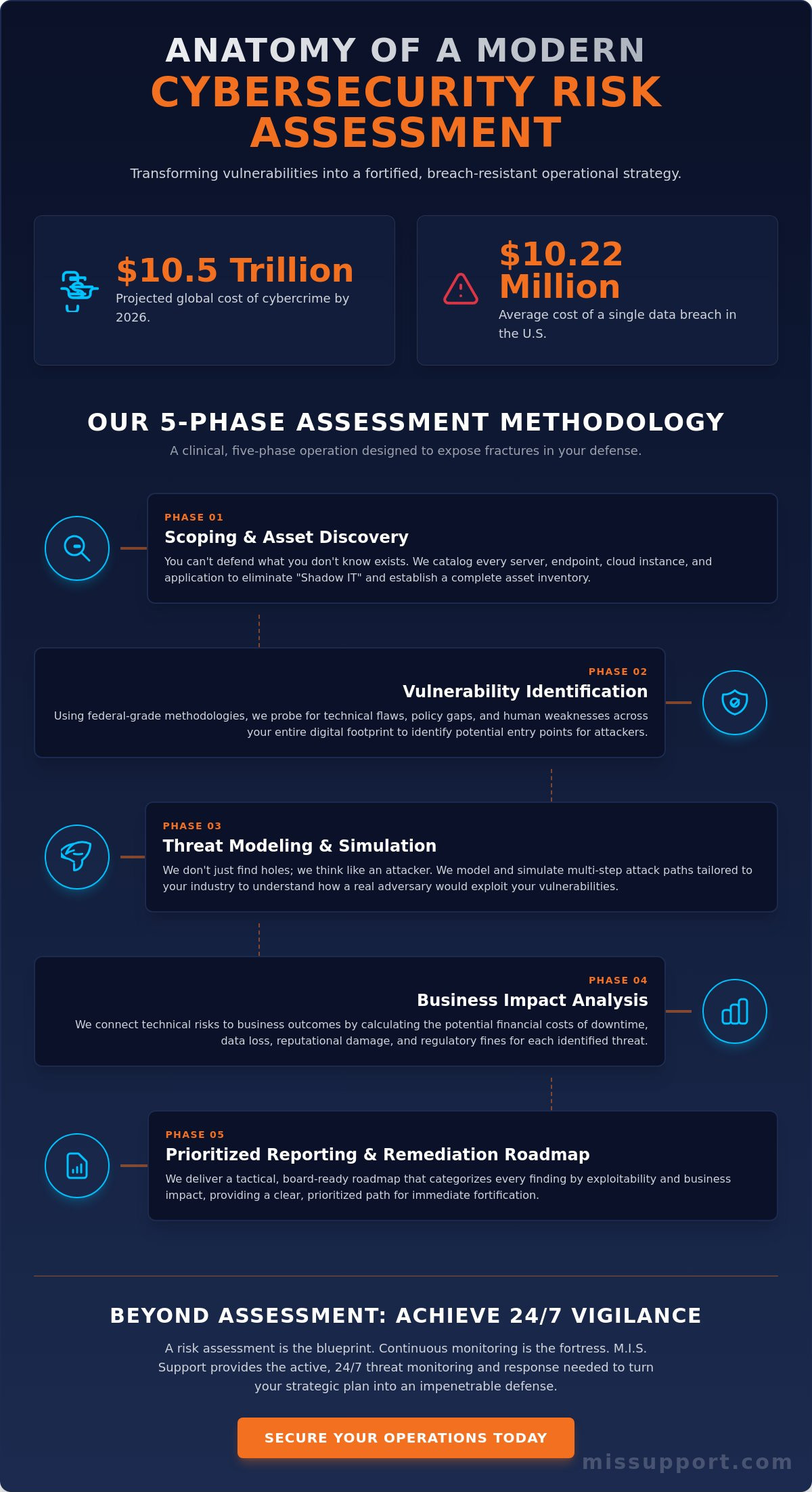
Precision is the baseline for protection. A high-stakes assessment is not a random scan; it is a clinical, five-phase operation designed to expose the fractures in your defense. We begin with Scoping and Asset Discovery. You cannot defend what you don’t know exists. This phase involves cataloging every server, endpoint, and cloud instance to ensure no "shadow IT" remains hidden. Once the perimeter is defined, we move to Vulnerability Identification. This stage involves probing for technical flaws and human weaknesses that could serve as an entry point. By utilizing methodologies similar to those found in CISA Cyber Assessments, we ensure your technical audit meets federal-grade standards for thoroughness.
The process then shifts to Threat Modeling. We don’t just find holes; we simulate how a living adversary would use them. We model multi-step attacks tailored to your specific industry, whether that’s targeting intellectual property or disrupting a supply chain. This is followed by Impact Analysis. We calculate the hard business costs of potential downtime, data loss, and regulatory fines. Finally, we deliver Prioritized Reporting. This is your tactical roadmap. It categorizes every finding by exploitability and impact, giving you a clear path for immediate fortification. Effective cybersecurity risk assessment services transform raw data into a decisive plan of action. To see how this five-phase methodology translates into real-world outcomes, explore our cyber security assessment services case study in strategic resilience and risk mitigation.
The NIST Framework: The Gold Standard for Resilience
Rigorous security requires a proven structure. MIS Support aligns assessments with the NIST Cybersecurity Framework, focusing on the five core functions: Identify, Protect, Detect, Respond, and Recover. This alignment ensures your strategy isn’t just comprehensive; it’s defensible. Insurance providers and regulators now demand framework-based evidence of security. By adopting this national standard, you demonstrate a commitment to maturity that protects your liability as much as your data. If you’re ready to move beyond basic scans, consider how our managed cybersecurity services can turn these framework insights into a permanent shield for your operations.
Probing the Human Element
Technology is rarely the only point of failure. A complete assessment must evaluate the human factor through social engineering simulations. We test your team’s ability to spot AI-generated phishing and credential harvesting attempts. Beyond testing, we analyze your internal access controls. We evaluate the "Principle of Least Privilege" to ensure no single user has more access than their role requires. This limits lateral movement and contains the "blast radius" of a potential compromise. Integrating these human-centric checks into our managed cybersecurity services ensures that your staff becomes a layer of defense rather than a point of vulnerability. Vigilance is a team effort. It requires constant training, clear protocols, and a culture of security.
Internal vs. External Assessments: Mapping the Full Threat Spectrum
Defense requires a dual perspective. External assessments probe the edge of your network, searching for the digital cracks in your armor. They identify open ports, leaked credentials, and exposed APIs that serve as invitations to attackers. But the perimeter is no longer a guaranteed sanctuary. Internal assessments evaluate the "blast radius" of a successful entry. They analyze lateral movement, privilege escalation, and data exfiltration paths. Comprehensive cybersecurity risk assessment services must map both territories to provide a complete picture of your posture. We adopt a "Zero Trust" mentality. Assume the breach. Verify every move. Secure every asset.
Cloud posture assessments are the third pillar of modern resilience. Misconfigured Azure buckets or AWS instances are low-hanging fruit for modern adversaries. In 2026, your data exists in a state of constant transit between local servers and cloud environments. We focus on securing these connections to ensure your information remains protected regardless of its physical or virtual location. This holistic approach transforms your security from a series of disconnected tools into a unified, battle-hardened shield.
Penetration Testing: The Proactive Strike
Automated scans find the known. Manual penetration testing finds the possible. While vulnerability scanning identifies missing patches, manual testing simulates the creativity and persistence of a human adversary. It is the ultimate stress test for your comprehensive network security solutions. We don’t just report a weakness; we demonstrate how it could be exploited to cripple your operations. This proactive strike allows you to fortify your defenses before a real attacker arrives. It turns theoretical risk into actionable intelligence.
Microsoft 365 and Cloud Risk Vectors
Microsoft 365 is the heart of the modern office. It is also a primary target for Business Email Compromise (BEC). Common misconfigurations in mail flow, external sharing, and global admin roles create unnecessary risk for the overextended business. We evaluate your conditional access policies and probe for MFA bypass vulnerabilities that automated tools often overlook. Securing a distributed workforce requires a delicate balance of protection and performance. We ensure your cloud environment is hardened against intrusion without sacrificing the operational speed your team demands. Our cybersecurity risk assessment services provide the clarity needed to close these gaps permanently.
From Data to Defense: Building a Strategic Remediation Roadmap
Data without action is just noise. After completing your evaluation, the real work of orchestrating resilience begins. We utilize a "Risk Matrix" to distill complex technical findings into a clear, tactical plan. This matrix categorizes every vulnerability by its ease of exploitation and its potential business impact. We don’t just list problems; we provide a hierarchy of solutions. This ensures your resources are directed where they provide the greatest return on security. Professional cybersecurity risk assessment services transform a list of fears into a structured path toward stability. Categorize. Prioritize. Execute. To apply this same level of strategic focus to your company’s overall worth, you can discover 41 Legacy for expert advisory on protecting and growing your enterprise value.
The roadmap focuses first on "Immediate Wins." These are low-cost, high-impact changes that significantly harden your perimeter. Implementing mandatory Multi-Factor Authentication (MFA), enforcing strict credential rotation, and closing redundant ports can neutralize many automated threats instantly. Beyond these quick fixes, we address structural fortification. This involves correcting deep network architecture flaws and replacing outdated hardware that can no longer support modern security protocols. This multi-layered approach ensures your defense is both broad and deep.
Prioritizing the Critical: What to Fix in the First 48 Hours
Triage is the first step in any crisis. High-risk "Critical" findings require immediate intervention to prevent an imminent breach. These are the open doors that attackers are already scanning for. Neutralizing these active vulnerabilities before they become headline-making events is our top priority. A virtual CISO provides the executive oversight needed for this rapid remediation. They bridge the gap between technical teams and the board, ensuring that critical fixes are authorized and implemented without delay. Speed is your greatest ally when the stakes are this high.
The ROI of Risk Reduction
Proactive defense is a financial imperative. For U.S. companies in 2026, the average cost of a data breach has reached $10.22 million. When you compare this to the cost of proactive risk management, the choice becomes clear. Beyond avoiding catastrophe, regular cybersecurity risk assessment services can lower your cyber insurance premiums by 15-30% by proving the adoption of robust security measures. This investment also builds invaluable client trust, positioning your brand as a secure and reliable partner. Regular assessments prevent the hidden cost of downtime by ensuring your systems remain operational and resilient against evolving threats. Secure your operational future by turning your risk data into a permanent defensive advantage.
MIS Support: Beyond Assessment to 24/7 Vigilance
A static report is merely a photograph of a moving target. While the initial cybersecurity risk assessment services provide a necessary baseline of your vulnerabilities, they are only the beginning of your journey toward true resilience. Attackers don’t operate on a business schedule; they wait for the gaps that appear between periodic audits. To survive in 2026, you must transition from point-in-time evaluations to a state of perpetual readiness. MIS Support employs a relentless lifecycle: Assess, Fortify, Monitor, and Evolve. This cycle ensures your defenses grow stronger with every attempted intrusion, turning yesterday’s threats into tomorrow’s fortification. We don’t just identify the gaps; we own the solution.
Our approach leverages advanced endpoint protection and ransomware defense to neutralize threats in real-time before they can pivot through your network. By deploying these active measures, we move beyond theoretical safety into a battle-hardened defensive posture. This isn’t just about software; it’s about strategic oversight. MIS Support acts as your vigilant guardian, ensuring that your operational integrity is never compromised by the evolving tactics of modern adversaries. We transform the anxiety of potential exposure into a disciplined state of strategic preparedness. For a detailed look at how this strategic diagnostic approach converts network fragility into operational resilience, review our evidence-based cyber security assessment services case study.
24/7 Threat Monitoring and Response
There’s a critical difference between an alert and an action. Most security tools generate endless noise that can overwhelm an overextended internal team. Our Security Operations Center (SOC) provides proactive intervention, filtering out the static to neutralize genuine threats before they can escalate into a crisis. We act as a seamless extension of your organization, providing the specialized expertise required to handle sophisticated exploits at machine speed. This tireless guardianship eliminates the fear of "after-hours" attacks. You can rest because MIS Support stays on watch, ensuring your business remains a hard target around the clock.
Disaster Recovery and Business Continuity
Resilience means more than just blocking attacks; it means ensuring your business stays operational even when a system is compromised. We integrate disaster recovery and business continuity planning into our core security framework. This ensures your data is resilient and your downtime is minimized to near-zero. Regular cybersecurity risk assessment services play a vital role here, providing the data needed to update and refine your recovery protocols as your infrastructure grows. A plan that isn’t tested against current threat models is just a wish. We ensure your recovery is a certainty. Secure your perimeter and schedule your comprehensive risk assessment today.
Orchestrate Your Strategic Defense
Resilience is a proactive choice. You’ve seen how the threat landscape of 2026 demands more than a simple checklist. It requires a deep understanding of your invisible attack surface and a commitment to continuous monitoring. By choosing professional cybersecurity risk assessment services, you transition from a state of uncertainty to one of calculated preparedness. You move beyond merely identifying gaps to closing them permanently. It’s the difference between being lucky and being ready.
True security is achieved through a combination of expert insight and tireless vigilance. MIS Support provides the clinical precision needed to expose vulnerabilities through internal and external penetration testing. We then back that data with 24/7 Threat Monitoring and Response and Virtual CISO strategic oversight. This ensures your defense is always active. For organizations looking to secure their physical leadership as well as their data, you can explore Executive Protection to mitigate high-level risks. Your business deserves the protection of an ally that never sleeps. We stand ready to act as your protective force, transforming your vulnerabilities into a fortified operational strategy.
Fortify your business with a Strategic Risk Assessment from MIS Support.
Take control of your digital destiny today. We’re ready to stand as your shield.
Frequently Asked Questions
What is included in a comprehensive cybersecurity risk assessment?
A comprehensive assessment includes asset discovery, vulnerability identification, and threat modeling across your entire infrastructure. It evaluates your people, processes, and technology to identify hidden fractures in your defense. We probe your perimeter through external penetration testing while analyzing internal lateral movement risks. This holistic approach ensures no "shadow IT" or misconfigured cloud instance remains a silent threat to your operations.
How often should my business conduct a cybersecurity risk assessment?
Conduct a full assessment annually at a minimum or immediately following significant network changes. In the high-stakes environment of 2026, relying on yearly snapshots is often insufficient for true resilience. Many organizations now integrate these evaluations into a continuous cycle of monitoring and response. Regular testing ensures your defenses evolve alongside AI-automated phishing and other sophisticated, machine-speed exploits.
What is the difference between a vulnerability scan and a risk assessment?
A scan is an automated tool that identifies known flaws; an assessment is a strategic, human-led analysis of your overall posture. Scans provide a list of symptoms, but cybersecurity risk assessment services deliver a complete diagnostic and surgical plan. We interpret the data to explain how specific vulnerabilities impact your business continuity. One is a technical snapshot; the other is a strategic blueprint.
How long does a typical cybersecurity risk assessment take to complete?
A typical assessment takes between two to six weeks depending on the complexity of your environment. Smaller organizations with centralized data may finish faster, while enterprise-level audits involving distributed offices and hybrid cloud integrations require more time. We prioritize precision over speed to ensure every endpoint is accounted for. This thoroughness provides the reliable data needed for a board-ready documentation of your risk posture.
Will a risk assessment help us meet regulatory compliance?
Yes, these assessments are the mandatory starting point for meeting CMMC 2.0, HIPAA, and CCPA requirements. They identify the specific gaps between your current security controls and the rigorous standards demanded by federal law. We provide the documentation and remediation roadmaps necessary to prove your compliance to auditors. This process transforms regulatory "red tape" into a clear, actionable strategy for operational stability.
How much does a cybersecurity risk assessment service cost?
Pricing is determined by the scope of your network, the number of endpoints, and the depth of penetration testing required. Every business has a unique risk profile that dictates the level of analysis needed for total fortification. While costs vary across the industry, the investment is always a fraction of the $10.22 million average cost of a U.S. data breach. Contact us for a tailored scope of work.
What happens after the assessment is finished?
You receive a prioritized remediation roadmap and an executive debrief to discuss critical findings. We don’t just hand you a report and walk away; we act as your battle-hardened strategist to implement solutions. We help you secure immediate wins like MFA enforcement and credential rotation. This transition moves your organization from the identification of a problem to the active implementation of a solution.
Can a risk assessment help lower our cyber insurance premiums?
Yes, insurers frequently offer lower premiums to organizations that can prove they are a "hard target." By utilizing cybersecurity risk assessment services, you demonstrate a commitment to the NIST framework and proactive defense. This reduces the insurer’s liability and often results in significant cost savings for your business. Proving your resilience is the most effective way to improve your insurability and protect your bottom line.