
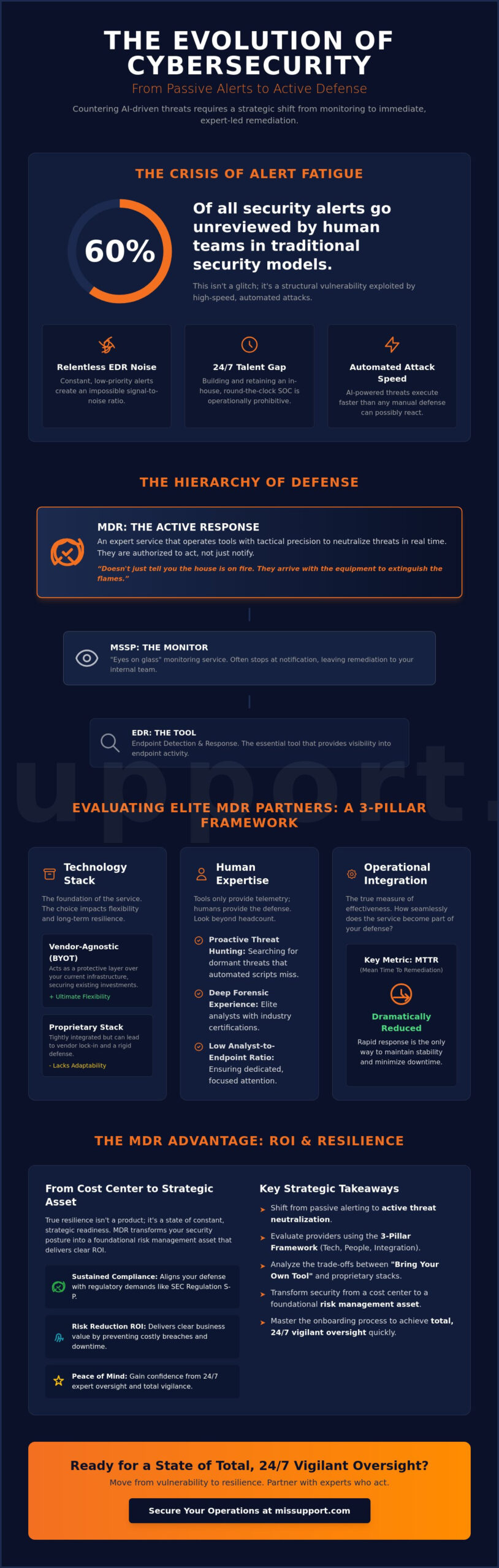
Approximately 60% of security alerts go unreviewed by human teams in traditional models. This isn’t just a technical glitch. It’s a structural vulnerability. You’re likely exhausted by the relentless noise of EDR tools and the impossible task of retaining 24/7 SOC talent. Meanwhile, AI-automated attacks now move at speeds that outpace manual defense. It’s clear that simple monitoring is no longer a viable strategy. You need managed detection and response services that prioritize decisive, human-led action over passive notifications.
We understand the gravity of these digital threats. With the June 3, 2026, SEC Regulation S-P compliance deadline now in force and new federal frameworks for AI security, the margin for error has disappeared. This guide provides a strategic framework to help you identify elite security partnerships, such as OAD Technologies, that protect your operational resilience. We’ll examine how the right provider reduces your Mean Time to Remediation (MTTR) and aligns your defense with the latest regulatory demands. This ensures you gain the peace of mind that comes from 24/7 expert oversight and a clear ROI through risk reduction.
Key Takeaways
- Shift your security posture from passive alerting to active threat neutralization to counter the speed of AI-driven attacks.
- Evaluate managed detection and response services using a tripartite framework focused on technology, human expertise, and seamless operational integration.
- Analyze the strategic trade-offs between “Bring Your Own Tool” models and proprietary software stacks to find the best fit for your infrastructure.
- Transform security from a cost center into a foundational risk management asset that delivers clear ROI and sustained compliance.
- Master the onboarding process to move quickly from a vulnerability gap assessment to a state of total, 24/7 vigilant oversight.
The Critical Role of Managed Detection and Response Services in 2026
Modern security is no longer a matter of simple observation. It’s a battle of speed and tactical precision. Managed detection and response (MDR) has evolved into a mandatory capability for organizations that cannot afford the latency of traditional monitoring. In 2026, managed detection and response services provide more than just a dashboard. They deliver a battle-hardened team authorized to intercept and neutralize threats in real time. This shift from passive alerting to active remediation is the only way to maintain operational resilience.
Traditional Endpoint Detection and Response (EDR) tools provide the visibility, but they don’t provide the hands. For organizations evaluating their technology stack, CyberOne provides a detailed comparison between Microsoft and SentinelOne to help identify the most resilient path forward. Legacy MSSPs often stop at the point of notification; this leaves your internal team to scramble during a midnight breach. This “alert-only” approach fails against AI-automated attack vectors that execute in seconds. Building an in-house 24/7 Security Operations Center (SOC) is financially and operationally prohibitive for most firms. The talent shortage remains acute. Retaining elite analysts requires an investment that often exceeds the entire IT budget of a mid-sized enterprise.
MDR vs. EDR vs. MSSP: Understanding the Hierarchy
Consider the hierarchy of defense. EDR is the essential tool; MDR is the expert service that operates that tool with tactical precision. While MSSPs offer “eyes on glass” monitoring, they frequently lack the deep forensic response capabilities required for modern managed cybersecurity services. A true MDR partner doesn’t just tell you the house is on fire. They arrive with the equipment and authority to extinguish the flames before they spread.
The ‘Agentic SOC’ and the Speed of Modern Defense
The rise of the “Agentic SOC” has redefined the baseline for protection. In this model, AI handles the massive volumes of telemetry data while human experts provide the critical judgment for complex, high-stakes cases. Mean Time to Remediation (MTTR) is the ultimate metric of MDR effectiveness in 2026. Rapid response is the only way to maintain stability in a landscape where every second of downtime threatens your bottom line.
Evaluating MDR Providers: A Strategic Comparison Framework
Selecting a security partner is a high-stakes strategic decision. The evolution of managed detection has flooded the market with providers who often prioritize software sales over actual security outcomes. You need a framework to cut through the marketing noise. To identify an elite partnership, you must evaluate managed detection and response services based on three critical pillars: Technology Stack, Human Expertise, and Operational Integration. A failure in any one of these areas leaves a gap in your structural integrity.
The first strategic hurdle is the foundation of the service. Some providers offer a “Bring Your Own Tool” (BYOT) model. This vendor-agnostic approach secures your existing investments and provides the flexibility needed for long-term operational resilience. Other providers require a proprietary software stack. While this offers tight integration, it can lead to vendor lock-in and a rigid defense that struggles to adapt to your unique environment. Proactive threat hunting remains the true differentiator. It’s the process of searching for dormant threats that automated scripts miss, and it requires a level of intuition that no algorithm can replicate. Understanding the strategic differences between endpoint tools is critical; a thorough review of EDR cyber security solutions can help you determine which platform best aligns with your infrastructure before committing to a managed service model.
Proprietary vs. Vendor-Agnostic MDR Stacks
Single-vendor ecosystems like Sophos or Palo Alto provide a streamlined experience. It’s often simpler to manage, but it lacks the adaptability of an agnostic provider. A vendor-agnostic partner acts as a protective layer over your current infrastructure. They adapt to your environment rather than forcing you to rebuild it. This flexibility is essential for maintaining a business-first edge in a shifting threat landscape. If your current setup feels fragmented, you might consider how a more unified security strategy could fortify your perimeter.
The Human Element: Threat Hunters and Incident Responders
Tools only provide the telemetry. Humans provide the defense. When vetting a SOC, look beyond the headcount. Prioritize industry certifications, deep forensic experience, and a low analyst-to-endpoint ratio. These elite analysts integrate cybersecurity incident response services directly into their monitoring workflow. They don’t just watch the perimeter; they actively hunt for anomalies and execute decisive countermeasures the moment a threat is identified.
Maximizing ROI: Implementing MDR for Long-Term Resilience
True resilience is not a product you purchase. It’s a state of constant, strategic readiness. Organizations often mistake managed detection and response services for a “plug-and-play” solution, but the reality is more nuanced. Effective implementation requires a foundational shift in how you view risk. The process begins with a rigorous cybersecurity gap assessment to map your unique attack surface. Only then can you transition into a state of full, 24/7 vigilant monitoring that protects your operational integrity.
The intelligence gathered during daily operations does more than just stop threats. It fuels higher-level strategic decisions. Telemetry from your provider should integrate directly with virtual ciso services to refine your long-term security roadmap. When presenting to the Board of Directors, this data becomes your most powerful asset. You can demonstrate clear ROI by showing the reduction in risk profiles and the speed of successful remediations. According to Gartner’s MDR market analysis, the ability to translate technical telemetry into business outcomes is what separates elite providers from basic monitoring services.
MDR as a Compliance Catalyst
Documented response procedures are the backbone of regulatory success. Modern frameworks like CMMC, HIPAA, and SOC2 demand more than just a locked door; they require proof of oversight. Every incident, from initial detection to final remediation, must leave an immutable audit trail. This level of transparency satisfies auditors and provides the structural integrity needed to survive a rigorous compliance review.
The Path to Operational Stability
Fortify Your Perimeter for the Challenges of 2026
The threat landscape in 2026 demands more than passive observation. You’ve seen that modern defense requires a fundamental shift from simple alerting to active threat neutralization. By integrating managed detection and response services, you transition from reactive firefighting to a state of strategic readiness. This approach doesn’t just block attacks; it ensures your compliance with rigorous mandates and fuels long-term risk management through expert-led oversight. It’s the difference between seeing a breach and stopping it in its tracks.
It’s time to move beyond the limitations of legacy models. You deserve a partner that acts as a tireless shield for your digital assets. Secure Your Enterprise with 24/7 Vigilant Monitoring from M.I.S. Support. Our team provides 24/7 proactive threat monitoring, expert-led incident response, and the strategic alignment your Virtual CISO needs to protect your bottom line. You don’t have to face these high-stakes risks alone. With the right guardian in place, you can focus on growth while we ensure your operational stability remains unshakable.
Frequently Asked Questions
What is the difference between Managed Detection and Response (MDR) and Managed Security Services (MSSP)?
The primary difference lies in the level of action taken. MSSPs typically focus on log management, basic monitoring, and alerting to satisfy compliance needs. In contrast, managed detection and response services provide a hands-on approach that includes proactive threat hunting and immediate remediation. While an MSSP notifies you of a potential fire, an MDR partner enters the building to extinguish it before it spreads.
How much does Managed Detection and Response typically cost for a mid-sized business?
Investment levels vary based on your specific infrastructure and risk profile. Most providers use a per-endpoint, per-user, or flat monthly retainer model. The total cost is influenced by the complexity of your environment and the level of response authority you grant the provider. It’s essential to weigh these costs against the massive financial impact of a data breach and the prohibitive expense of building a 24/7 in-house SOC.
Can MDR services replace our internal IT security team?
MDR doesn’t replace your team; it empowers them. Most internal IT departments are overextended by daily operational tasks and lack the capacity for constant threat monitoring. By offloading the heavy lifting of detection and response, your internal staff can focus on high-level strategic projects and business-critical infrastructure. It acts as a force multiplier that provides expert oversight without the need for additional full-time hires.
What happens if a threat is detected by the MDR provider after hours?
Immediate action is taken regardless of the time. Elite managed detection and response services operate on a 24/7/365 basis to counter the speed of modern cyberattacks. If a breach occurs in the middle of the night, the SOC analysts follow pre-authorized protocols to isolate compromised systems and neutralize the threat. You won’t wake up to a crisis; you’ll wake up to a detailed remediation report explaining how the threat was stopped.