
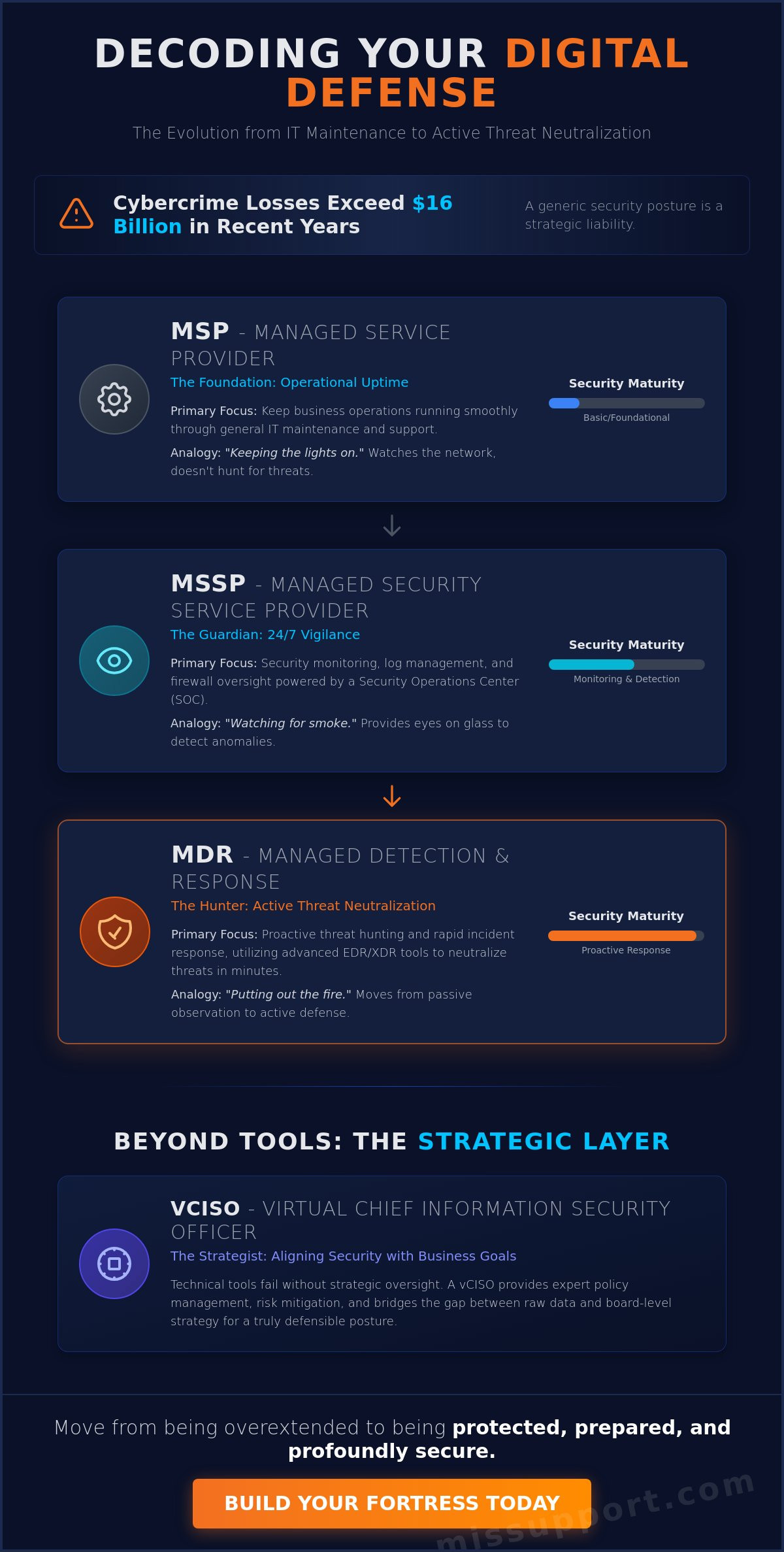
In 2026, a generic security posture isn’t just ineffective; it’s a strategic liability. With the FBI reporting cybercrime losses exceeding $16 billion in recent years, the margin for error has vanished. You’re likely facing a relentless barrage of alerts, a confusing alphabet soup of terminology, and the heavy pressure of compliance deadlines like the EU’s Cyber Resilience Act. It’s exhausting to maintain a shield when the threats never sleep.
Selecting the right managed security services is the difference between reactive chaos and disciplined defense. We understand the high stakes of digital warfare and the need for a partner that acts as a battle-hardened strategist. You deserve a clear path through the complexity that transforms your current anxiety into a state of total readiness. This isn’t about buying a product; it’s about building a fortress that stands firm against a sophisticated landscape of risk.
This comparison will navigate the landscape of modern defense models to identify the specific architecture that fortifies your unique business. We’ll break down security tiers, provide a defensible strategy for board-level approval, and show you how to achieve peace of mind through 24/7 vigilance. It’s time to move from being overextended to being protected, prepared, and profoundly secure.
Key Takeaways
- Identify the critical distinctions between MSP, MSSP, and MDR to move beyond basic IT maintenance toward specialized threat response.
- Evaluate your organization’s risk profile and internal capacity to determine if you require the constant vigilance of a 24/7 guardian.
- Navigate the complex landscape of managed security services to select a defense model that aligns with your specific industry regulations and data sensitivity.
- Shift your strategic focus from simple threat prevention to a holistic culture of operational resilience and rapid recovery.
- Strengthen your perimeter by implementing continuous vulnerability assessments and penetration testing to neutralize gaps before they are exploited.
Decoding the Security Landscape: MSP vs. MSSP vs. MDR
The evolution of digital defense is not a straight line; it’s an escalation of force. To protect your assets, you must understand the hierarchy of Managed Security Services (MSS). Many businesses start with basic IT maintenance but quickly realize that a generalist approach cannot stop a targeted breach. The transition from general IT to specialized security requires a shift in mindset, tools, and personnel. It’s a move from simple oversight to strategic fortification.
The Managed Service Provider (MSP) Baseline
The Managed Security Service Provider (MSSP) Shift
Moving to an MSSP model means transitioning from administration to vigilance. This model introduces 24/7 security event monitoring, log management, and firewall oversight. It provides the necessary eyes on glass to detect anomalies. However, there’s a critical distinction between monitoring and response. Monitoring is watching for smoke; response is putting out the fire. Standard managed security services often provide the former, but modern threats require the latter.
Modern defense relies on the Security Operations Center (SOC). This is the command post where analysts synthesize data, identify patterns, and neutralize incursions. Standard IT support often lacks the specialized tools and forensic expertise required for cybersecurity best practices. Without a dedicated SOC, your business is merely observing its own compromise. Effective defense requires three core pillars: visibility, intelligence, and decisive action. You need a partner that doesn’t just report a problem but has the authority and skill to stop it in its tracks.
Choosing Your Shield: A Framework for Strategic Security Selection
Selecting a defense model is a high-stakes decision that dictates your organization’s resilience. You cannot treat managed security services as a commodity. Instead, evaluate your specific risk profile by analyzing data sensitivity, industry regulations, and the catastrophic cost of potential downtime. If you handle protected health information or defense contracts, your baseline requirements are significantly higher than a standard retail operation. Your defense must be proportional to the threat you face.
Assess your internal capacity with brutal honesty. Determine if your current team possesses the stamina for 24/7 threat monitoring or if you require external vigilant guardians to hold the line. When Comparing MSSP and MDR, the choice often hinges on whether you need simple compliance reporting or active, aggressive incident neutralization. In a landscape of automated ransomware, “good enough” security is a liability that invites disaster. Attackers don’t negotiate; they exploit the gaps you chose to ignore. Organizations facing unsustainable internal security burdens are increasingly turning to cybersecurity as a service as a strategic alliance that provides expert-led defense without the overhead of building an in-house team.
When to Graduate to Managed Detection and Response (MDR)
Identify the signals that your business has outgrown basic monitoring. If your team is drowning in alert fatigue or if you lack visibility into endpoint behavior, it’s time for proactive threat hunting. MDR utilizes EDR and XDR tools to neutralize incursions in minutes, not days. This level of responsiveness is vital for those who cannot afford a single hour of operational paralysis. It’s a move from passive observation to active tactical defense.
Bridging the Leadership Gap with Virtual CISO Services
Technical tools will fail without strategic oversight. Security must align with business growth, which requires expert policy management and risk mitigation. Integrating virtual ciso services ensures that your technical defenses support your long-term objectives. This leadership bridges the gap between raw data and board-level strategy, providing the discipline needed to maintain a truly defensible posture. You can consult with a strategic advisor to refine your managed security services roadmap today.
Beyond Monitoring: Implementing a Culture of Resilience
Prevention is a noble goal, but resilience is the mandate. In the high-stakes environment of 2026, assuming you can stop every attack is a dangerous fallacy. True strength lies in your ability to absorb a blow, neutralize the threat, and recover with minimal disruption. You must shift your focus from rigid prevention to fluid operational resilience. This transformation requires a holistic approach that combines advanced technology with strategic human oversight. It’s about staying operational when others fail.
A robust defense requires constant testing. Implement continuous vulnerability assessments and regular penetration testing to identify structural weaknesses before attackers can exploit them. These proactive measures, integrated within your managed security services, ensure your perimeter remains fortified against evolving tactics. Additionally, you must fortify the human firewall. Ongoing security awareness training transforms your employees from potential liabilities into vigilant guardians. When human intelligence meets technical precision, your business becomes a harder target.
Positioning managed cybersecurity services as the engine of your business stability is a strategic imperative. It’s not just an IT expense; it’s the foundation of your market reputation and operational continuity. By integrating leadership through vCISO services with technical managed security services, you create a unified front that protects your digital frontier. This approach ensures that security isn’t just a department but a core business function.
The 2026 Standard: Proactive Threat Neutralization
Speed is your greatest ally. 24/7 monitoring and automated response protocols are designed to aggressively reduce Mean Time to Remediation (MTTR). Every second saved is a dollar protected. A comprehensive security suite must also include disaster recovery and business continuity planning. These elements ensure that even in a worst-case scenario, your core operations remain intact and your data remains accessible. It’s about being unbreakable, disciplined, and ready.
Next Steps: Securing Your Digital Frontier
The journey begins with a clear-eyed look at your current state. Initiate a cybersecurity gap assessment to determine your maturity level and identify urgent priorities. When you transition to a professional cybersecurity services company, expect a disciplined onboarding process. This involves deep network discovery, policy alignment, and the deployment of advanced sensor arrays. You aren’t just hiring a vendor; you’re enlisting a battle-hardened ally to stand watch over your future. For those seeking specialized European expertise in technological and defense solutions, discover Flux Group SARL to explore how they fortify digital infrastructures.
Command Your Strategic Defense
The distinction between simply maintaining a network and actively defending a business is the defining challenge of our time. You’ve seen how the evolution from basic IT support to advanced response models is necessary to survive increasingly sophisticated automated threats. Aligning your specific risk profile with the right tier of managed security services isn’t just an operational choice; it’s a fundamental commitment to your organization’s longevity and reputation.
Don’t leave your perimeter to chance or settle for a shield that’s easily pierced. You can secure your business with a comprehensive Cybersecurity Gap Assessment to identify hidden vulnerabilities before they’re exploited. Our strategic framework integrates 24/7 Threat Monitoring & Response, expert Virtual CISO leadership, and specialized compliance and risk management to ensure your defense remains absolute. You have the power to transform your security from a source of constant anxiety into a pillar of strategic stability.
You have the roadmap. Take the decisive step toward a resilient and unshakeable digital frontier today.
Frequently Asked Questions
What is the difference between an MSP and an MSSP?
Is managed detection and response (MDR) worth the investment for small businesses?
Managed Detection and Response (MDR) is essential for small businesses because it provides the proactive threat hunting that standard monitoring lacks. Smaller organizations are often targeted by automated attacks precisely because they are perceived as having weaker defenses. MDR levels the playing field by providing 24/7 access to a Security Operations Center (SOC) and advanced response tools. This investment prevents a single breach from becoming a catastrophic business failure. It’s a strategic shield for your continuity.
Can managed security services help with regulatory compliance like HIPAA or SOC2?
Yes, managed security services are specifically designed to meet and maintain the rigorous documentation and technical requirements of frameworks like HIPAA, SOC2, and the EU’s Cyber Resilience Act. Providers implement the necessary encryption, access controls, and audit logs required for certification. They act as your compliance engine, providing the continuous monitoring and reporting needed to prove your posture to auditors. This oversight reduces the risk of non-compliance penalties and strengthens your market credibility.
How do managed security services handle a ransomware attack in real-time?
Real-time ransomware defense involves immediate isolation of infected endpoints to prevent lateral movement across your network. The system detects the signature of unauthorized encryption and triggers an automated response to sever the threat’s connection. Analysts then move to neutralize the malicious code, verify the integrity of your backups, and initiate a rapid recovery protocol. This disciplined approach minimizes downtime and ensures that a potential disaster is contained before it can paralyze your operations. Understanding how managed IT security services have evolved with AI-driven defense can help you select the right response capabilities for your organization.