
If 97% of organizations have already integrated AI into their defense, why did global cybercrime losses still surge to $16.6 billion this year? This paradox proves that simply possessing the tools is insufficient. You’re likely overwhelmed by the relentless volume of security alerts and the struggle to retain specialized talent. The threat of a sophisticated ransomware attack or a zero-day exploit shouldn’t paralyze your operations. Modern managed it security services have evolved. They’re no longer an optional layer; they’re the central nervous system of enterprise resilience.
We understand the pressure of maintaining a secure perimeter when the traditional boundary has vanished. This article reveals how the shift from reactive IT to AI-driven managed security is redefining protection and operational stability in 2026. You’ll gain a clear understanding of the current trend landscape and a framework for moving toward a proactive defense. We’ll show you how to transform your security posture from a source of anxiety into a pillar of strategic strength while drastically reducing the risk of downtime. Detect. Neutralize. Fortify.
Key Takeaways
- Adopt Continuous Adaptive Protection. Move beyond static, “set and forget” firewalls to a model that constantly monitors, authenticates, and adjusts to threats in real time.
- Leverage AI-Orchestrated Defense. Learn how modern Security Operations Centers (SOCs) use automation to detect threats 50% faster and eliminate manual triage bottlenecks.
- Upgrade to Extended Detection and Response (XDR). Discover why traditional endpoint protection is no longer enough and how XDR provides the total visibility needed to stop “living-off-the-land” attacks.
- Unify Your Security Framework. See how managed it security services transition your organization from fragmented, reactive patches to a cohesive, proactive shield for all digital assets.
- Maintain Strategic Vigilance. Establish a disciplined rhythm of regular audits and gap assessments to ensure your defenses remain resilient against evolving AI-powered exploits.
The Shift Toward Continuous Adaptive Protection
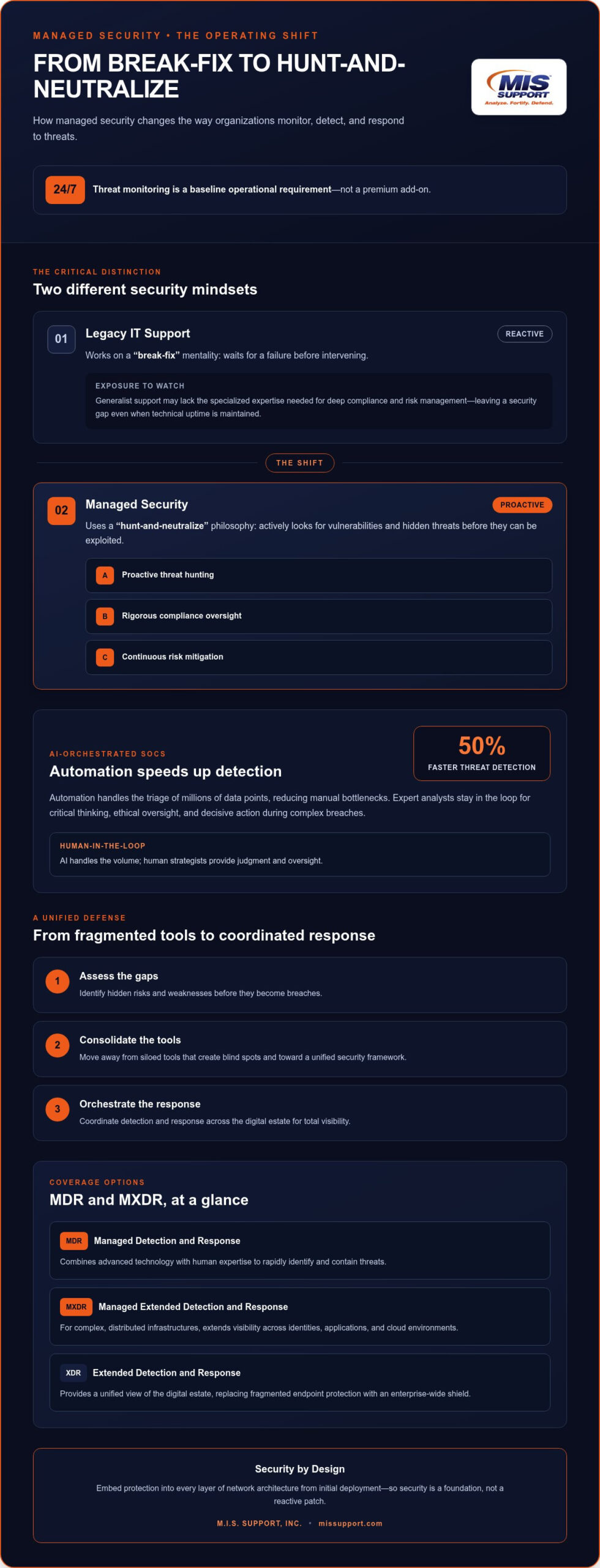
Strategic resilience requires constant vigilance. 24/7 threat monitoring is no longer a premium add-on; it’s a baseline operational requirement for any enterprise. Modern managed environments now prioritize “Security by Design.” This approach embeds protection into every layer of the network architecture from the initial deployment. It ensures that security isn’t a reactive patch but a foundational strength. By partnering with a Managed Security Service provider, organizations move from a state of constant alert fatigue to one of strategic preparedness.
Managed Security vs. Legacy IT Support
Legacy IT support operates on a “break-fix” mentality. They wait for a failure to occur before intervening. In contrast, modern managed security services employ a “hunt-and-neutralize” philosophy. They actively seek out vulnerabilities and hidden threats before they can be exploited. This distinction is critical for survival in a landscape where attackers use automated tools to probe for weaknesses every second.
Generalist IT providers often lack the specialized expertise required for deep compliance and risk management. This creates a dangerous “security gap” where technical uptime is maintained, but the organization remains exposed to sophisticated ransomware and regulatory penalties. A specialized MSSP bridges this gap by providing:
- Proactive threat hunting.
- Rigorous compliance oversight.
- Continuous risk mitigation.
This holistic approach transforms your IT infrastructure from a liability into a fortified asset. It ensures your business doesn’t just stay online, but stays defended. For organizations in New Zealand, Managed IT services Wellington offers the strategic expertise to bridge these gaps and ensure long-term resilience.
2026 Trends: AI-Driven Defense and Proactive Threat Hunting
Speed is the primary currency of defense in 2026. AI-orchestrated Security Operations Centers (SOCs) have redefined rapid incident response by automating the triage of millions of data points. This allows managed it security services to neutralize threats in seconds; a feat once thought impossible for human-only teams. This evolution is anchored by Extended Detection and Response (XDR). Unlike legacy systems, XDR provides a unified view of the entire digital estate, replacing fragmented endpoint protection with a cohesive, enterprise-wide shield.
Predictive analytics now anticipate the moves of autonomous threat actors with startling accuracy. We use these models to identify and fortify vulnerabilities before they are even discovered by adversaries. Yet, technology is only half the battle. The “human-in-the-loop” model ensures that expert analysts remain at the helm of every operation. While AI handles the volume, these battle-hardened strategists provide the critical thinking, ethical oversight, and decisive action required for complex breaches. If you are concerned about your current coverage, you might consider a comprehensive security gap assessment to identify hidden risks before they are exploited.
The Integration of MDR and MXDR
Managed Detection and Response (MDR) is now the essential trend for enterprises requiring specialized oversight. MDR is a service that combines advanced technology with human expertise to rapidly identify and contain threats. For organizations with complex, distributed infrastructures, Managed Extended Detection and Response (MXDR) provides the necessary visibility across identities, applications, and cloud environments.
Partnering with a dedicated managed security service provider ensures that these advanced capabilities are integrated into a single, resilient framework. This multi-layered approach provides the strategic preparedness needed to survive a modern threat landscape. It transforms managed it security services from a background utility into a proactive force that hunts, detects, and eliminates risks in real time.
As you evaluate your options for a strategic partner that specializes in these high-level integrations, you can learn more about Telx Computers and their comprehensive 2026 roadmap for managed technology solutions.
Building Strategic Resilience with a Managed Security Partner
Fragmented defense is a liability. In an era of autonomous threats, relying on siloed IT tools creates blind spots that attackers will inevitably exploit. Transitioning to a unified managed cybersecurity services framework is the only way to ensure total visibility. This shift requires a disciplined approach: assess the gaps, consolidate the tools, and orchestrate the response. It transforms your security from a series of reactive hurdles into a seamless, proactive shield. Organizations seeking a flexible, scalable model are increasingly turning to cybersecurity as a service to gain expert-led protection without the unsustainable burden of building an internal fortress.
Strategic resilience isn’t a destination; it’s a state of continuous improvement. Regular cybersecurity best practices audits are essential to maintain this posture. These assessments identify emerging weaknesses before they become breaches. By shifting the focus from the “IT budget” to the “Total Cost of Risk,” organizations can see the true value of managed it security services. This perspective accounts for the catastrophic costs of downtime, data loss, and reputational damage. We are Redefining Cyber Risk Management by positioning the partner as a vigilant guardian. This partnership ensures that disaster recovery and business continuity are not just plans on paper, but operational realities.
The Role of the Virtual CISO in Managed Security
Technical teams need strategic direction. Virtual ciso services provide the high-level leadership necessary to align security initiatives with business goals. A vCISO bridges the gap between technical security audits and boardroom risk management. They translate complex vulnerability data into actionable business intelligence. This battle-hardened strategist oversees critical functions: penetration testing, compliance roadmaps, and incident response simulations. They don’t just manage tools; they engineer resilience. Having an expert ally at the helm ensures that your managed it security services are always optimized, compliant, and ready for whatever the threat landscape delivers next.
Secure Your Digital Future Today
The era of passive defense is over. As we’ve discussed, the shift toward AI-driven orchestration and continuous adaptive models is now the baseline for enterprise stability. These strategies transform your posture from a collection of reactive patches into a unified, proactive shield. By committing to managed it security services, you ensure that your organization doesn’t just survive the threats of 2026 but thrives despite them. It’s time to trade uncertainty for the confidence of strategic preparedness.
Your operational integrity is too valuable to leave to chance. You need an ally that functions as a vigilant guardian and a decisive strategist. Fortify your business with M.I.S. Support, Inc.’s Managed Security Services. Our model provides the essential pillars of modern defense: 24/7 Threat Monitoring & Response, expert internal & external penetration testing, and strategic Virtual CISO leadership. We don’t just monitor your network; we engineer its resilience. Secure your perimeter. Protect your future. The threat landscape is moving fast; ensure your partner moves faster.
Frequently Asked Questions
What is the difference between an MSP and an MSSP in 2026?
An MSP focuses on operational uptime and infrastructure performance, while an MSSP is dedicated exclusively to high-stakes defense and risk mitigation. By 2026, this distinction is critical because traditional IT support often lacks the specialized tools for proactive threat hunting. Managed it security services provide the advanced monitoring, incident response, and strategic oversight required to neutralize sophisticated adversaries before they penetrate your core infrastructure.
How do managed IT security services handle AI-driven ransomware?
We neutralize AI-driven ransomware by deploying behavioral analytics and automated response protocols that outpace autonomous threat actors. Modern systems no longer rely on static file signatures; they identify anomalous patterns in real time. This allows the defense to isolate infected segments and kill malicious processes within seconds. It’s a tripartite strategy of detection, containment, and eradication that ensures your data remains encrypted only by you.
Is 24/7 threat monitoring necessary for small to mid-sized businesses?
24/7 monitoring is essential for small to mid-sized businesses because automated attackers never sleep. Smaller organizations are frequently targeted as entry points into larger supply chains or as targets for rapid ransomware deployments. Constant vigilance ensures that a midnight breach is identified and contained before your team even starts their workday. Strategic resilience requires a vigilant guardian that is always “on” to protect your operational stability.
How do managed security services help with regulatory compliance like SOC2 or HIPAA?
Managed it security services simplify compliance by providing the continuous monitoring, log management, and rigorous documentation required for SOC2 and HIPAA audits. We implement the technical controls and administrative safeguards necessary to meet these strict standards. This proactive approach transforms compliance from a yearly panic into a steady, verifiable state of security. It ensures your data remains protected and your business remains ready for high-level regulatory scrutiny.