
A technology outage is never just an IT problem when essential work depends on systems and data. Disaster recovery planning gives an organization a defined way to restore critical IT after a major disruption. NIST SP 800-34 Rev. 1 describes a disaster recovery plan as a written plan for recovering one or more information systems at an alternate facility after a major hardware or software failure or facility destruction.
Any organization that relies on technology needs a way to recover vital systems and data. Disaster recovery planning focuses on restoring IT; business continuity addresses how operations continue during and after a disruption, while incident response guides action during a security incident. This article explains what a recovery plan covers, how these plans differ, and which organizations need one, so you can identify where preparedness should begin.
Key Takeaways
- A recovery plan sets out how an organization can restore critical IT systems and data after a major disruption.
- Separate the work of restoring technology from keeping business operations running and responding to an active incident.
- Any organization that relies on technology should identify which systems and data are vital to recovery.
- Clear priorities, defined responsibilities, and regular testing help make recovery plans usable under pressure.
What is a disaster recovery plan (DRP)?
A disaster recovery plan documents how an organization restores critical systems after a major disruption. A contingency plan guides the initial response; the recovery plan focuses on bringing systems and capabilities back online.
Plan Ownership and Maintenance
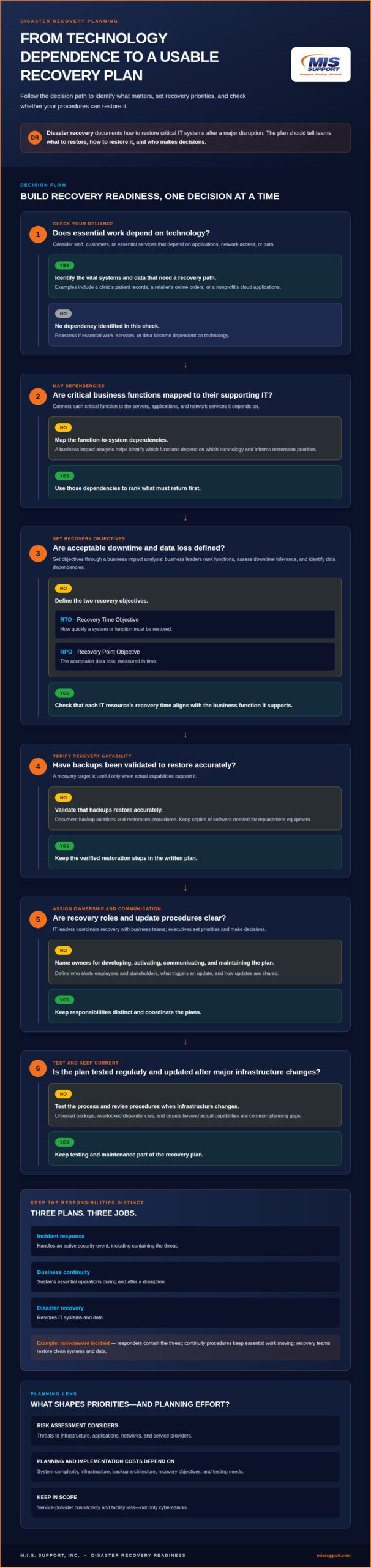
Assign named roles responsibility for developing, activating, communicating, and maintaining the plan. IT leaders coordinate recovery tasks with business teams, while executives set priorities and make decisions. Clear ownership matters because uncertainty can delay action when infrastructure or applications fail. Define who alerts employees and stakeholders, what triggers an update, and how updates are shared. Test the plan regularly and revise it after major infrastructure changes.
Plan Components and Examples
Key components include critical systems and data, recovery priorities, backup locations, restoration procedures, assigned roles, and communication protocols. Together, they tell teams what to restore, how to restore it, and who makes decisions. The National Institute of Standards and Technology lists Special Publication 800-50 as a resource for building an information technology security awareness and training program. Ready.gov’s disaster recovery plan template is 10 pages long. Digital technology expanded recovery planning in the 1970s, while internet risks broadened its scope in the 1990s.
Creating and Implementing a Plan
Build and implement a plan by identifying critical applications and data, setting recovery priorities, documenting backup and restoration procedures, assigning owners, and testing the process. These steps turn recovery goals into actions teams can follow during a disruption. A business impact analysis helps align IT restoration with essential business functions. Keep copies of software needed for replacement equipment, and validate that backups restore accurately. The 2000s brought cloud-based recovery options and automated systems, making it important to keep procedures aligned with current infrastructure.
Disaster recovery versus business continuity and incident response
Each plan addresses a different phase of disruption. Coordinating them helps an organization protect critical services and restore them in the right order.
Disaster Recovery and Related Plans
Incident response handles an active event, business continuity sustains operations, and disaster recovery restores IT systems. During a ransomware incident, for example, responders contain the threat, continuity procedures keep essential work moving, and recovery teams restore clean systems and data. Distinct responsibilities prevent confusion; linking the plans helps teams act in sequence and share information.
Risk, Impact, and System Priorities
A risk assessment considers threats to infrastructure, applications, networks, and service providers; a business impact analysis identifies which functions depend on them. Together, they establish restoration priorities and acceptable disruption. Planning and implementation costs depend on system complexity, infrastructure, backup architecture, recovery objectives, and testing needs. Common gaps include untested backups, overlooked dependencies, and recovery targets that exceed actual capabilities.
Business Continuity Alignment
Recovery plans should support the business continuity plan, not operate as a separate strategy. Map each critical business function to its supporting servers, applications, and network services, then align IT restoration with the function’s recovery objective. This coordination helps teams keep essential work moving while systems return. Organizations can align these efforts through disaster recovery and business continuity planning.
Recovery Objectives
The recovery time objective (RTO) is how quickly a system or function must be restored; the recovery point objective (RPO) defines acceptable data loss in time. Set both through a business impact analysis: business leaders rank critical functions, assess downtime tolerance, and identify data dependencies. Then confirm that recovery capabilities support those objectives. Each IT resource’s recovery time should align with the business function that depends on it.
Organizations that need disaster recovery planning
Any organization that depends on technology needs a way to restore vital systems and data. Hardware failure can interrupt a small firm’s customer records, just as a server outage can halt a larger enterprise’s operations. The deciding factor is reliance: if staff, customers, or essential services depend on applications or network access, document how recovery will work.
A clinic may need patient records, a retailer may process online orders, and a nonprofit may coordinate services through cloud applications. Their restoration priorities differ, but each needs to identify critical systems, back up data, and assign recovery roles. Account for service-provider connectivity and facility loss, not just cyberattacks. Review the plan regularly and after major infrastructure changes so its procedures reflect the systems the organization actually uses.
When evaluating recovery planning support, compare the proposed work with your business priorities, system dependencies, recovery objectives, and backup restoration needs. Look for a clear approach to testing, ownership, and updating procedures as infrastructure changes. These criteria help show whether the work addresses your actual exposure rather than merely documenting generic steps.
In the United States, disaster recovery plans are not generally required, and there are currently no funding incentives for them. Organizations still need to consider how a disruption could affect vital operations and data.
Start by documenting the systems your organization cannot operate without, then identify the recovery gaps that could prolong an outage. Strengthen your recovery readiness with planning aligned to your business operations.
M.I.S. Support: Managed Cybersecurity Services
M.I.S. Support, Inc. helps organizations strengthen cyber defenses that support recovery readiness. Turn to its Managed Cybersecurity Services when security responsibilities, threat visibility, or recovery priorities need a more coordinated approach.
Its 24/7 Threat Monitoring & Response helps organizations address detected threats, while Internal & External Penetration Testing examines security from different perspectives. Cybersecurity Gap Assessments can identify areas where current safeguards and processes need attention. These services complement recovery planning by helping teams understand and address security weaknesses that could complicate a disruption or restoration effort.
Contact M.I.S. Support, Inc. to discuss how its cybersecurity services can support your organization’s recovery readiness.
Make recovery readiness an operating priority
Treat disaster recovery planning as an ongoing operating discipline, not a document that sits untouched after approval. As systems, vendors, and business priorities change, revisit the assumptions behind your recovery strategy and involve decision-makers. Consistent oversight makes preparedness part of how your organization manages risk, rather than a task reserved for an emergency.
M.I.S. Support, Inc. offers Managed Cybersecurity Services, 24/7 Threat Monitoring & Response, and Internal & External Penetration Testing. These capabilities can help organizations strengthen security around the systems their recovery strategy depends on. If you’re ready to discuss the next step for your organization, contact M.I.S. Support, Inc.. Build readiness deliberately, and your team can move forward with a clearer view of its priorities.
Frequently Asked Questions
What is disaster recovery planning and why is it important?
Disaster recovery planning gives teams a coordinated way to restore essential technology after a disruption and limit cascading operational impact. Its value depends on accounting for real-world dependencies. For example, restoring a sales database before its identity service may leave staff unable to sign in. A sound approach considers dependencies, data integrity, and decision authority, not just system availability.
How do you conduct a business impact analysis and risk assessment?
Start by listing essential business activities, then trace the applications, information, facilities, and external services each depends on. Assess how equipment failure, cyber incidents, or a supplier outage could affect those dependencies. Rank the consequences, identify priority functions, and document the assumptions behind those rankings. This gives decision-makers a practical basis for recovery decisions.
How often should a disaster recovery plan be tested and updated?
Test regularly and repeat tests after major infrastructure changes so procedures reflect the current environment. One schedule described in disaster recovery guidance includes quarterly tabletop exercises, biannual partial failover tests, and annual full simulations. Use each exercise to uncover unclear ownership or failed restoration steps, then update the plan and confirm that backup data can be restored accurately.
What are common disaster recovery strategies for on-premises, cloud, and hybrid systems?
On-premises environments can use backup and restoration procedures or replication to recover systems and data. Cloud strategies can use cloud-based recovery resources, while hybrid plans coordinate recovery across local infrastructure and cloud services. Hot recovery sites can restore systems fastest but cost more; cold sites cost less but require more setup. Choose an approach based on system priorities and recovery objectives.