
Alerts don’t reveal every threat. Managed threat hunting pairs security technology with human-led investigation to find suspicious activity automated tools may miss, validate potential threats, and guide a response. A managed threat hunting team examines behavior and evidence across systems for signs of compromise, not just triggered alarms.
This proactive approach matters when attackers evade familiar detection rules or blend into normal activity. This article explains how managed threat hunting works, how threat intelligence can guide investigations, and what to assess when choosing security support. You’ll also learn how hunting fits alongside monitoring, incident response, and other security measures so you can identify the support your organization needs.
Key Takeaways
- Understand how analysts plan hunts, investigate unusual activity, and escalate validated threats.
- See how threat intelligence helps shape proactive searches for activity that automated tools may miss.
- Assess a provider’s expertise, visibility across your environment, security-tool integration, and response approach.
- Explore how M.I.S. Support’s threat monitoring and related security services can strengthen your organization’s defenses.
What is managed threat hunting?
Analysts use managed threat hunting to search for suspicious activity automated alerts may miss. They examine security evidence, investigate anomalies, and escalate validated threats for response.
Planning, Detection, Investigation, and Response
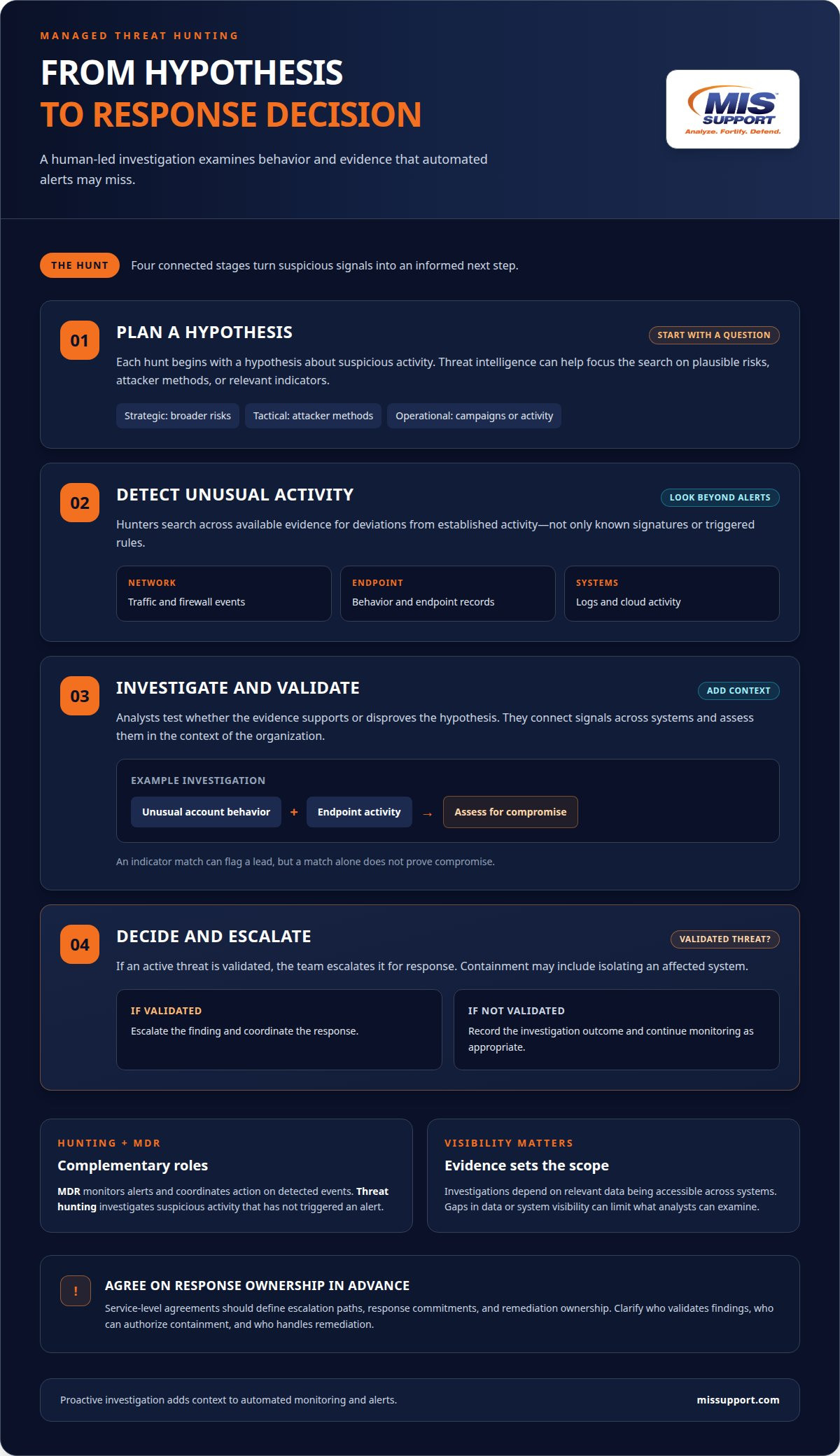
Each hunt starts with a hypothesis, then moves through detection, investigation, and a response decision. Hunters examine network traffic, endpoint behavior, and system logs for evidence supporting or disproving that hypothesis. If they validate an active threat, they escalate it and may trigger containment, such as isolating an affected system. Service-level agreements should define escalation paths, response commitments, and remediation ownership.
Hunting Alongside Managed Detection and Response
Managed detection and response, or MDR, monitors alerts and coordinates action on detected events. Threat hunting adds investigation of suspicious activity that hasn’t triggered an alert. For example, analysts may connect unusual account behavior with endpoint activity to determine whether the combined signals suggest compromise. Understanding this distinction helps organizations see how proactive investigation complements alert-driven monitoring.
Proactive and Behavioral Threat Detection
Behavioral analysis looks for deviations from established activity instead of relying only on known signatures or automated rules. An analyst might investigate unexpected use of administrative tools or unusual movement between systems. This can help uncover threats that rule-based detection overlooks. Automated tools remain valuable for monitoring and alerts; investigation adds context and tests whether an anomaly signals a real threat.
Benefits and Limitations
This approach gives organizations access to specialized cybersecurity support without building an internal hunting team. Analysts can also review historical data for signs of earlier activity. Hunting can support compliance efforts through monitoring records and remediation evidence, but it doesn’t establish compliance by itself. Findings depend on available data and system visibility, so gaps can limit investigations. Agree on escalation and remediation responsibilities in advance. Hackify partners with existing IT teams, combining cybersecurity expertise with network support rather than replacing those teams.
Proactive security strategies and threat intelligence
Threat intelligence turns information about adversaries into focused security investigations. Analysts use it to prioritize hidden risks, guide continuous monitoring, and strengthen an organization’s security posture.
Strategic, Tactical, and Operational Intelligence
Strategic intelligence explains broader risks, tactical intelligence describes attacker methods, and operational intelligence concerns specific campaigns or activity. Together, these perspectives help analysts decide what deserves attention and how to investigate it. For example, an organization facing a particular industry threat can use relevant tactics and indicators to shape a hunt instead of treating every alert as equally urgent. This directs expertise toward plausible risks.
Continuous monitoring helps teams apply threat intelligence as conditions change. A threat intelligence platform can organize indicators, such as malicious IP addresses or file hashes, for analysts and automated tools. Automation can match indicators against incoming security data and flag potential leads. Analysts then assess the context, because a match alone does not prove compromise. This supports faster prioritization, while human review keeps investigations grounded in the organization’s environment. M.I.S. Support, Inc.’s monitoring is automated and continuous, not a human being constantly watching a screen.
Telemetry, Logs, and Threat Intelligence
Telemetry and logs provide evidence analysts can compare with threat intelligence. Endpoint records, firewall events, and cloud activity can show whether a known indicator appears in the environment or behavior fits an emerging threat pattern. For instance, a suspicious connection may be more significant when logs also show unusual account activity. Effective investigations depend on relevant data being accessible across systems; gaps can leave activity outside the analyst’s view.
When continuous visibility and incident response need closer alignment, 24/7 threat monitoring and response can help connect security signals with a coordinated response.
Choosing a managed threat hunting provider
Choose a provider whose analysts can investigate across your network, endpoints, and cloud services. For managed threat hunting to fit your environment, align data access, escalation contacts, incident-response roles, and remediation ownership during onboarding.
Provider Selection Considerations
A capable provider combines human expertise, suitable security tools, and investigations tailored to your environment. This matters because attackers can use different techniques across identity, endpoint, and network systems. Assess how analysts address visibility gaps, integrate with existing tools, and explain findings in actionable terms.
Clarify what happens when hunters identify a potential incident. For example, define who validates the finding, who can authorize containment, and who handles remediation. Agree on escalation paths and response commitments in the service agreement. During onboarding, the provider maps relevant systems and data sources, arranges appropriate access, and aligns investigations with your internal response team. These decisions help shape how managed threat hunting supports your operations.
Service Cost
The cost of threat hunting in the United States depends on the service scope, so pricing is provided after a quote request. Key factors include the environments covered, available security data, investigation frequency, and whether response support is included. Broader visibility across cloud, endpoint, and network systems can affect the work required. A breach can be far more costly than investing in robust protection.
Use a proposal to connect cost with defined coverage, reporting, escalation, and remediation responsibilities. A service focused on selected systems differs from one spanning a wider security environment. Clear scope shows what analysts will investigate and how findings move into incident response. Hackify provides three reporting levels: Technical, Executive, and Attestation Letter.
To align investigation coverage with your environment, discuss your security needs.
M.I.S. Support: 24/7 Threat Monitoring & Response
M.I.S. Support provides 24/7 Threat Monitoring & Response for organizations that need ongoing oversight of security alerts and a coordinated response. Managed Cybersecurity Services can support teams seeking broader security management. Internal & External Penetration Testing and Cybersecurity Gap Assessments can help identify weaknesses and gaps that need attention.
These services may fit when security signals need consistent monitoring, existing defenses need assessment, or your team wants clearer insight into its exposure. Monitoring focuses on security events and response; testing and assessments examine weaknesses and gaps. The right starting point depends on whether your priority is ongoing oversight, evaluating defenses, or both.
Contact M.I.S. Support to discuss your organization’s security needs.
Make the Next Move Deliberate
Threat hunting works best as part of a security program that learns from each investigation. Connect findings to decisions: which risks need attention, where visibility should improve, and how response responsibilities fit your operations. That turns managed threat hunting from an isolated activity into a more informed approach to resilience. Hackify combines continuous monitoring, threat detection, and compliance-ready reporting to support this work.
The right support should align with your environment and priorities, not add complexity for its own sake. A focused conversation with MISSUPPORT can help clarify where your current security approach needs stronger oversight and what questions to resolve before moving forward.
Contact M.I.S. Support to discuss a practical next step for your organization. Build from clear priorities, strengthen your readiness, and move forward with confidence.
Frequently Asked Questions
What skills do threat hunters need?
Threat hunters need analytical judgment, knowledge of networks and endpoints, and the ability to interpret security evidence. They must distinguish suspicious activity from legitimate business behavior, then explain findings clearly to technical and business teams. For example, recognizing that a command-line tool has a valid administrative use helps an analyst assess context before escalating its activity as a threat.
What is managed threat hunting and how does it work?
Managed threat hunting is a service in which external security analysts search an organization’s environment for threats that routine alerts haven’t surfaced. In a managed threat hunting engagement, analysts can examine available security data, test a hypothesis about attacker behavior, validate suspicious findings, and communicate relevant next steps. The investigation’s focus depends on the organization’s environment, priorities, and accessible data.
What services are included in managed threat hunting?
Services commonly include threat-led investigations, analysis of available security data, validation of suspicious activity, escalation of findings, and recommendations for next steps. Reports can describe incident scope, likely attack source, and suggested remediation. Scope varies by engagement, so understand which systems and data sources are covered, how findings are communicated, and who is responsible for remediation. Hackify’s reporting is available at Technical, Executive, and Attestation Letter levels.
How does managed threat hunting differ from MDR and traditional SOC services?
Managed detection and response (MDR) centers on monitoring alerts and coordinating response, while threat hunting actively investigates potential threats that haven’t generated alerts. A traditional security operations center (SOC) may rely heavily on established detections and operational processes. Hunting adds hypothesis-driven analysis, helping an organization examine whether activity outside existing alert patterns signals a real threat.
How do managed threat hunting providers detect and investigate threats?
Providers analyze security data and logs, then compare observed activity with threat intelligence and expected behavior. An investigation might connect authentication events, endpoint records, and network traffic to assess whether separate signals form a coherent pattern. Analysts validate leads before escalating them, helping distinguish actionable evidence from harmless anomalies and giving the organization a clearer basis for response decisions. To discuss managed threat hunting and cybersecurity support for your organization, contact MISSUPPORT.