
A familiar MDR name isn’t automatically the strongest fit. Rapid7 managed detection alternatives for commercial businesses should be compared by the security layers they monitor and the actions their analysts can take. MDR combines continuous monitoring with alert investigation and response, helping organizations detect and contain threats across endpoint, network, and cloud environments.
If you’re weighing options, the real challenge is finding coverage that matches your environment, not just comparing feature lists. This guide explains how MDR differs from endpoint detection and response, where coverage can leave gaps, and which practical criteria can help you choose a suitable alternative.
You’ll also find a comparison of commonly evaluated providers and a guide to narrowing your shortlist. The goal is to clarify what protection includes, how response works, and what to ask before you commit.
Key Takeaways
- Compare MDR coverage across endpoint, cloud, identity, email, and network systems to spot visibility gaps that a device-focused tool may miss.
- Look beyond alerting: assess how analysts investigate threats, distinguish false positives, and coordinate response actions.
- Use an evidence-first proof of concept to compare detection-to-containment performance and the operational impact of alerts.
- When your evaluation extends to recovery readiness, M.I.S. Support’s disaster recovery and business continuity planning can help connect security response with business continuity.
Coverage across endpoint, cloud, identity, email, and network
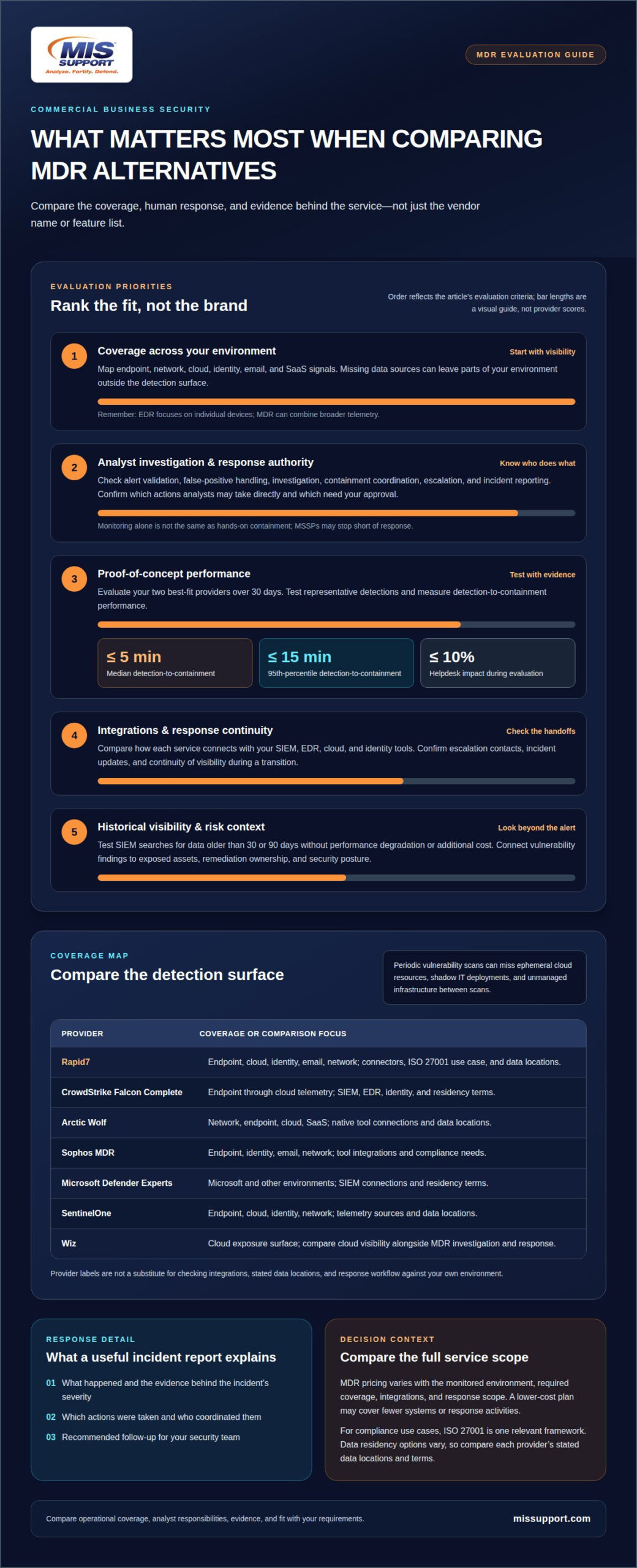
Coverage is a map of data sources, not a vendor label. MDR can combine endpoint, network, and cloud telemetry, while EDR focuses on individual devices. Check whether a service monitors identity events, email signals, SaaS activity, and cloud environments alongside endpoint alerts. Missing data sources can leave parts of your environment outside the detection surface.
A shortlist of rapid7 managed detection alternatives for commercial businesses is useful only when it reflects your environment. Periodic vulnerability scans can miss ephemeral cloud resources, shadow IT deployments, and unmanaged infrastructure between scans. Wiz is an agentless, cloud-native platform; compare its cloud exposure visibility with an MDR service’s investigation and response capabilities.
Providers differ in how they connect with common business SIEM, EDR, cloud, and identity tools. Providers can be compared by data-source coverage and response workflow. For US compliance use cases, ISO 27001 is one relevant framework. Data residency options vary; compare each provider’s stated data locations and terms. For rapid7 managed detection alternatives for commercial businesses, use those details to assess fit rather than relying on vendor names alone.
| Provider | Coverage to map | Integration and compliance focus |
|---|---|---|
| Rapid7 | Endpoint, cloud, identity, email, network | Connectors, ISO 27001 use case, data locations |
| CrowdStrike Falcon Complete | Endpoint through cloud telemetry | SIEM, EDR, identity, residency terms |
| Arctic Wolf | Network, endpoint, cloud, SaaS | Native tool connections and data locations |
| Sophos MDR | Endpoint, identity, email, network | Tool integrations and compliance needs |
| Microsoft Defender Experts | Microsoft and other environments | SIEM connections and residency terms |
| SentinelOne | Endpoint, cloud, identity, network | Telemetry sources and data locations |
| Wiz | Cloud exposure surface | Cloud visibility alongside MDR response |
Choose a provider whose integrations preserve visibility and response continuity during a transition.
What is MDR (Managed Detection and Response)?
MDR combines security monitoring with investigation and response. Its value depends on how effectively a provider validates potential threats and supports incident containment.
Detection and Analysis
MDR teams analyze security telemetry and investigate alerts to determine whether activity signals an attack. Analysts validate alerts, rule out false positives, and assess severity before recommending or coordinating action. AI can assist with alert triage, data correlation, and initial containment, while analysts apply context and judgment. Unlike basic alerting, MDR connects detection to investigation and response instead of simply forwarding notifications for internal teams to interpret.
Continuous SOC Monitoring
MDR services provide 24/7 monitoring, so suspicious activity can be reviewed beyond normal business hours. During an incident, analysts can coordinate actions such as isolating an infected system or removing malicious files. Compare the provider’s monitoring and response process, not just its alert volume. A useful report should explain the incident, the evidence behind its severity, actions taken, and recommended follow-up, giving security teams operational context.
For Rapid7, assess the stated detection and response scope against those same steps: alert validation, investigation, containment coordination, and incident reporting. The label alone doesn’t show which actions analysts perform or how the service fits your existing security operations. A clear division of responsibilities helps internal teams understand when they act and when the MDR team leads.
MDR pricing varies with the monitored environment, required coverage, integrations, and response scope. Compare each proposal’s telemetry sources, investigation, containment support, and reporting. A lower-cost plan may cover fewer systems or response activities, so assess operational coverage against your needs rather than relying on the headline price.
Criteria for choosing an alternative
Start with your organization’s exposure, not a feature checklist. Map telemetry sources, analyst responsibilities, vulnerability findings, and remediation steps. Strong visibility helps analysts add context to signals, prioritize risk, and connect detection with practical action. For compliance use cases, ISO 27001 is one relevant framework to consider alongside your organization’s requirements.
When assessing rapid7 managed detection alternatives for commercial businesses, compare service-level terms for alert acknowledgement, investigation, containment authority, escalation contacts, and incident updates. Confirm which response actions analysts can take directly and which require your approval. MSSPs typically provide monitoring but stop short of hands-on response, so distinguish monitoring commitments from containment responsibilities in each agreement.
Use an evidence-first proof of concept with your two best-fit providers, lasting 30 days. Test representative detections and measure detection-to-containment performance: the median should be no more than 5 minutes, and the 95th percentile no more than 15 minutes. Track alert volume and keep helpdesk impact at or below 10% during the evaluation.
Test SIEM search across retention windows that include data older than 30 or 90 days, without performance degradation or additional cost. This supports investigations requiring historical context. Include vulnerability prioritization: determine how findings connect to exposed assets, remediation ownership, and security posture. These measures help compare rapid7 managed detection alternatives for commercial businesses against your operational needs.
Weigh integration, response authority, historical visibility, and escalation clarity. Discuss your MDR response requirements to define priorities before selecting an alternative.
M.I.S. Support: Disaster Recovery & Business Continuity Planning
M.I.S. Support helps organizations connect security decisions with recovery readiness through Disaster Recovery & Business Continuity Planning. Consider this service when evaluating MDR reveals a broader need to prepare teams to maintain or restore operations after a disruptive incident.
For a coordinated security approach, Managed Cybersecurity Services and 24/7 Threat Monitoring & Response address ongoing monitoring and response, while Internal & External Penetration Testing can help identify weaknesses that need attention. Together, these services can inform how an organization strengthens its defenses and plans for disruption. They complement MDR evaluation by extending the focus beyond alert handling to operational resilience.
Contact M.I.S. Support to discuss your security and continuity priorities.
Turn Your MDR Review Into a Resilience Plan
Choosing among alternatives to Rapid7 managed detection for commercial businesses is a chance to shape more than alert handling. Use your evaluation to define how security decisions connect with business continuity, threat investigation, and ongoing exposure reduction. That alignment gives security leaders a practical foundation for strengthening defenses as systems and risks change.
M.I.S. Support offers Managed Cybersecurity Services, 24/7 Threat Monitoring & Response, and Internal & External Penetration Testing. These services can support organizations refining their security operations, testing defenses, or seeking ongoing monitoring and response.
Take the next step by outlining your priorities and the gaps you want to address. Contact M.I.S. Support to discuss a security approach that fits your organization. A clear plan can help you move forward with confidence.
Frequently Asked Questions
How does MDR work?
MDR turns security signals into investigation and coordinated action. For example, analysts can review an unusual sign-in alongside related system activity to distinguish a compromised account from routine use. After an incident, review the provider’s findings and recommendations to understand what happened and identify improvements to monitoring, access controls, or response procedures.
What are the pricing models and typical costs of managed detection and response services?
MDR pricing depends on the systems monitored, integration complexity, response scope, and reporting needs. Providers package these elements differently, so compare what each recurring charge covers rather than relying on a headline figure. Request a quote based on your environment, coverage requirements, and service scope.
How can a commercial business evaluate, select, and migrate to an MDR provider?
Shortlist providers based on your security priorities, then plan a controlled transition. Assign owners for integrations, access permissions, alert routing, and incident communications before migration begins. Keep existing monitoring active until the new service receives the expected signals and teams understand escalation procedures. Document the handoff, test representative alerts, and review early findings to address operational gaps promptly.
How do Rapid7 MDR alternatives compare on 24/7 monitoring, threat hunting, and incident response?
Compare providers’ monitored data sources, analyst responsibilities, and response authority. MDR services provide 24/7 monitoring; analysts investigate and validate alerts, assess severity, and can coordinate actions such as isolating infected systems or removing malicious files.