
The strongest alternative may not be the platform with the longest feature list. Managed endpoint protection combines endpoint security tools with monitoring and response, but providers differ in how much work remains with your team. When comparing SentinelOne Vigilance alternatives for managed endpoint protection, focus on coverage, response responsibilities, and operational fit. The right option should match how your team works.
A managed service should do more than generate alerts. Your team needs to know who monitors activity, investigates threats, and acts when an endpoint is at risk. The right division of responsibility depends on your staff, environment, and capacity for hands-on security work.
This comparison examines SentinelOne Vigilance alternatives for managed endpoint protection through monitoring coverage, evaluation criteria, and fit for MSPs, lean IT teams, SMBs, and enterprises. Use the practical criteria to narrow your options to the level of oversight your organization needs.
Key Takeaways
- Compare endpoint protection options by who monitors, investigates, and responds, not just by the tools they include.
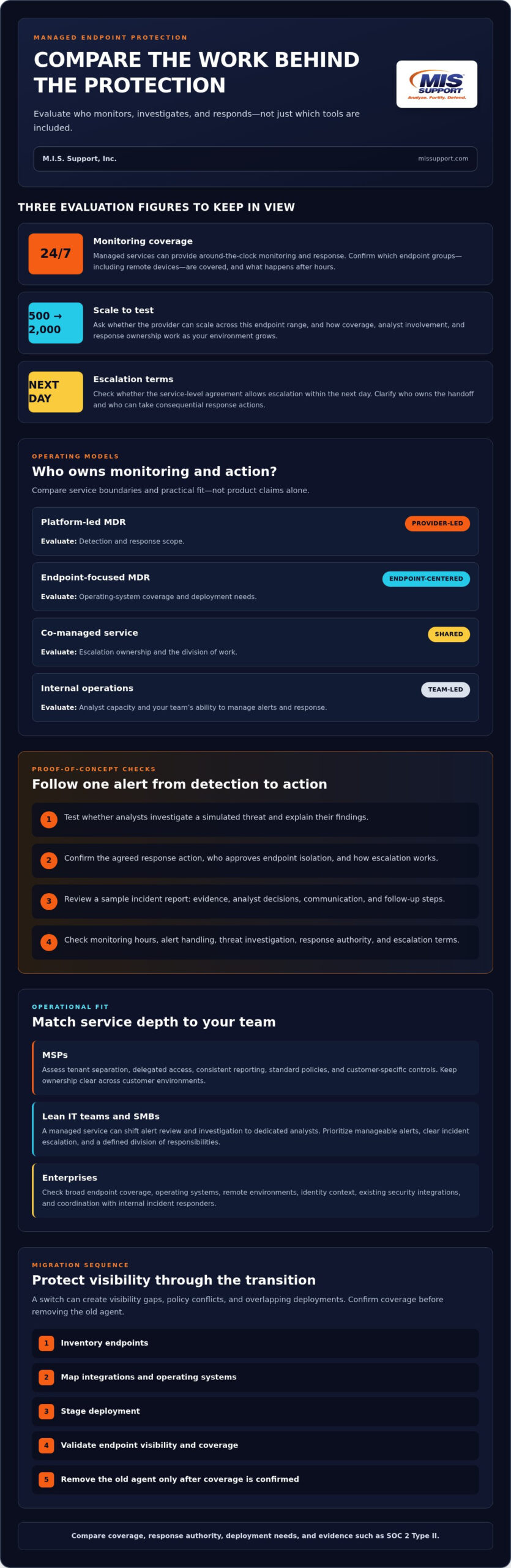
- Assess whether a provider can scale from 500 to 2,000 endpoints, and examine its SOC 2 Type II credentials and escalation terms.
- Match the service model to your team: MSPs, lean IT teams, SMBs, and enterprises have different needs for control and operational support.
- Use monitoring coverage and response responsibilities to identify where managed cybersecurity support could strengthen your defenses.
Evaluation criteria for managed endpoint protection
Compare monitoring ownership, response authority, deployment needs, and evidence such as SOC 2 Type II.
The right alternative depends on whether you need platform-led MDR, endpoint-focused monitoring, or co-managed operations. Compare service boundaries and practical fit, not product claims alone.
Evaluation and Contracting Comparisons
Separate reviewer experience from contract terms when evaluating providers. Compare visibility, analyst investigation, response actions, and renewal flexibility. For MDR and endpoint detection, assess alert handling and threat investigation alongside the endpoint solution’s controls. Deployment, integrations, and supported operating systems vary by provider, so map requirements against your device inventory. The National Institute of Standards and Technology notes that some solutions integrate with MDM/UEM tools, indirectly connecting with ICAM.
| Option | Monitoring and action | Evaluation criteria |
|---|---|---|
| Platform-led MDR | Provider-led | Detection and response scope |
| Endpoint-focused MDR | Endpoint-centered | OS coverage and deployment |
| Co-managed service | Shared | Escalation ownership |
| Internal operations | Team-led | Analyst capacity |
Compare these models against your response ownership and environment.
Reasons to Evaluate Alternatives
Consider alternatives when SentinelOne Vigilance no longer fits your endpoint mix, desired analyst involvement, integration needs, or contract priorities. A switch can create visibility gaps, policy conflicts, and overlapping deployments, so plan controls and handoffs before transitioning. Review MITRE ATT&CK Managed Services Evaluation results for tested detection and response capabilities, then compare them with your own threat scenarios.
Proof-of-Concept Evaluation Questions
During a proof of concept, test whether analysts investigate a simulated threat, explain their findings, and take the agreed action. Ask how escalation works, whether the service can scale from 500 to 2,000 endpoints, and whether its service-level agreement allows escalation within the next day. For migration, inventory endpoints, map integrations and operating systems, stage deployment, validate visibility, then remove the old agent after coverage is confirmed.
Around-the-clock endpoint monitoring
Managed endpoint protection services can provide 24/7 monitoring and response coverage. That means alerts can be reviewed beyond normal business hours, when an unattended endpoint may still generate signs of a threat. Compare the actual coverage: monitoring hours, analyst involvement, incident escalation, and who can take response action.
Monitoring begins with endpoint agents collecting security signals. Analysts may review detections, investigate suspicious activity, and distinguish likely threats from false positives. Ask how the service connects an alert to an incident, what context it provides, and how it communicates decisions to your team. Clear ownership helps keep alerts from going unresolved.
Threat hunting adds a proactive layer. Rather than waiting for a detection, analysts search endpoint data for patterns that may indicate suspicious activity. Hunting investigates relevant signals, while monitoring handles incoming alerts. Ask what data supports hunting and how findings lead to action.
- Coverage: Confirm which endpoint groups receive 24/7 monitoring, including remote devices.
- Response: Clarify who can isolate an endpoint and who approves consequential actions.
- Reporting: Establish how analysts describe incidents, evidence, and follow-up steps.
Endpoint security also depends on agent health and usable visibility. A device without functioning coverage can create a blind spot, while noisy detections can distract analysts. During evaluation, review sample incident reports and trace one alert from detection through investigation and response. Teams comparing continuous endpoint monitoring can use that walkthrough to assess whether the service’s process fits their operations.
Customer fit for MSPs, lean IT teams, SMBs, and enterprises
The right fit depends on who owns alerts, response, and daily security operations. Compare each provider’s capabilities with your staffing model, endpoint coverage, and identity environment.
Small and Midsize Business Fit
For an SMB with a lean IT team, managed endpoint protection can shift alert review and investigation to dedicated analysts. The key difference is operational depth: a straightforward service may suit a team that needs clear incident escalation, while a more configurable solution may require internal time to tune policies and review findings. Define responsibilities before choosing.
MSPs have different requirements. They must coordinate response across customer environments without blurring ownership or exposing one organization’s data to another. Evaluate tenant separation, delegated access, consistent reporting, and the ability to apply standard policies while retaining customer-specific controls. Smaller IT teams should prioritize manageable alerts and a clear path from detection to action.
Enterprise Fit
An enterprise may need broad endpoint coverage across business units, operating systems, and remote work environments. Evaluate identity context, integrations with existing security operations, and how analysts coordinate with internal incident responders. Native capabilities can reduce tool handoffs, but integration quality and response ownership matter more than feature count.
Large organizations also need consistent escalation and reporting across teams. Compare how providers handle alerts affecting different departments, document investigations, and align response procedures with established incident workflows. An MSP may prioritize multi-customer administration; an enterprise typically needs detailed coordination across its own security and IT operations.
Use a simple decision rule: match service depth to internal capacity, then verify coverage and response ownership against real workflows. Plan endpoint response coverage around your team’s operational needs.
M.I.S. Support: Managed Cybersecurity Services
M.I.S. Support, Inc. helps organizations strengthen endpoint security through Managed Cybersecurity Services and 24/7 Threat Monitoring & Response. Turn to this support when your team needs help reviewing alerts, investigating threats, or coordinating response beyond its internal capacity.
Cybersecurity Gap Assessments can identify security gaps and areas for focused improvement. Internal & External Penetration Testing can help assess defenses by testing them against potential attack paths. Together, these services give your organization a clearer view of exposure, response needs, and security priorities.
For a discussion about your organization’s endpoint protection needs, contact M.I.S. Support, Inc..
Set Your Security Model in Motion
The next decision is operational: define who owns the security work after deployment. Assign responsibility for alert review, investigation, escalation, and recovery before a new service becomes part of daily operations. Clear ownership helps your team respond purposefully instead of improvising under pressure.
Use your shortlist of SentinelOne Vigilance alternatives for managed endpoint protection to choose a model that matches your team’s capacity and preferred level of control. Document the handoff between internal staff and external analysts, including how incident findings inform future security decisions.
M.I.S. Support offers Managed Cybersecurity Services, 24/7 Threat Monitoring & Response, and Internal & External Penetration Testing. These services can support organizations strengthening oversight or testing defensive gaps. Contact M.I.S. Support to discuss your security priorities and next steps.
A deliberate decision gives your team a stronger foundation for what comes next.
Frequently Asked Questions
What is Managed Endpoint Protection?
Managed endpoint protection combines security software on devices with an external service that helps monitor and manage endpoint threats. For example, a company can protect employee laptops while assigning alert review and incident handling to a managed security team. When comparing SentinelOne Vigilance alternatives for managed endpoint protection, consider which devices are covered and how responsibilities are divided with internal IT.
Which alternatives offer 24/7 monitoring, threat hunting, and incident response?
Managed endpoint protection services can provide 24/7 monitoring and response, with threat hunting included in some service models. Compare whether analysts proactively investigate suspicious activity, what endpoint signals they review, and which response actions they’re authorized to take. For a distributed workforce, confirm that remote laptops receive the same monitoring attention as devices connected to the office network.
What contract terms, minimum device counts, and service-level agreements do providers offer?
Contract terms and minimum device counts differ by provider and service scope. In a comparison of SentinelOne Vigilance alternatives for managed endpoint protection, examine coverage changes, renewal and termination terms, escalation responsibilities, and service-level agreement definitions. Use the ability to scale from 500 to 2,000 endpoints, SOC 2 Type II, and stated timeframes such as investigation within 15 minutes or escalation within the next day as evaluation benchmarks.
How do SentinelOne Vigilance alternatives compare on MDR and endpoint detection features?
Compare whether monitoring is provider-led, endpoint-centered, shared, or team-led, and clarify who investigates alerts and can take response actions. Assess detection and response scope alongside endpoint controls and your team’s capacity.
How do managed endpoint protection providers compare on deployment, integrations, and supported operating systems?
Deployment, integrations, and supported operating systems vary by provider, so map your requirements against your device inventory. Check whether integrations meet your needs, including possible MDM/UEM connections that indirectly connect with ICAM.