
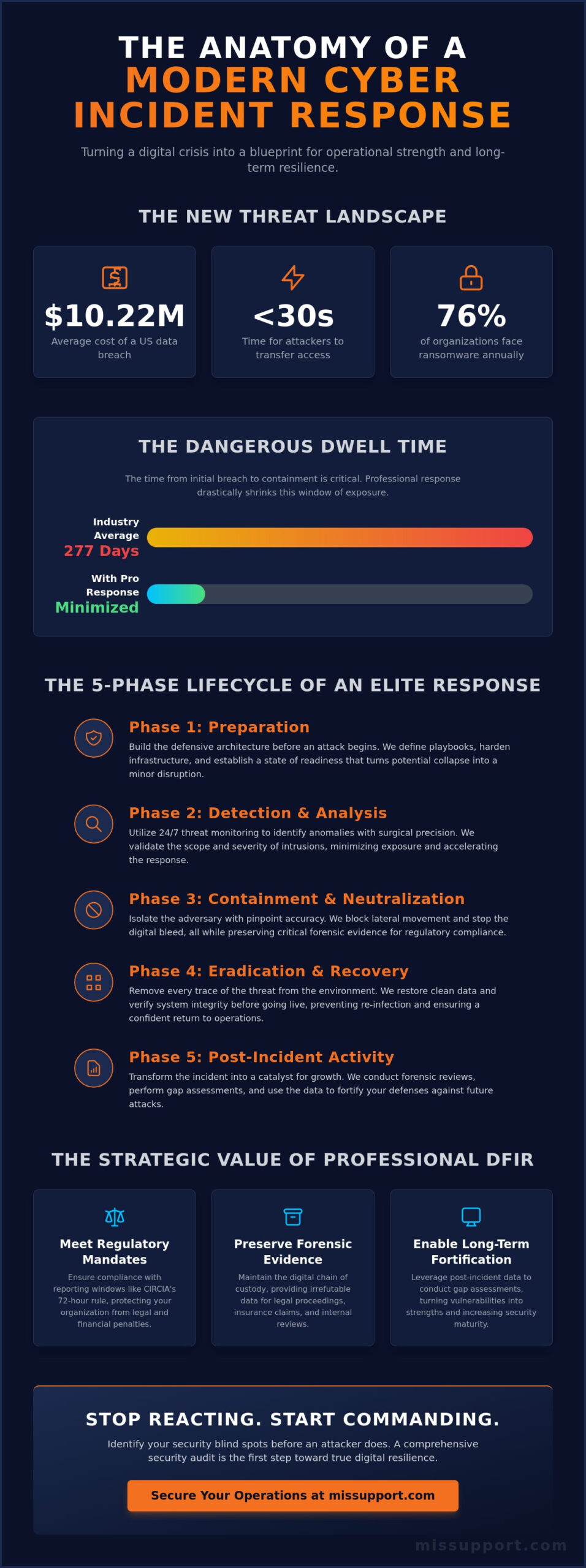
The average cost of a data breach in the United States has reached a record $10.22 million. With attackers now capable of transferring access between criminal groups in under 30 seconds, the luxury of a slow reaction has vanished. You likely feel the weight of this reality every time a new AI-automated threat makes headlines. It’s natural to worry about catastrophic data loss or the crushing weight of regulatory reporting deadlines. Modern cybersecurity incident response services act as your frontline defense, turning a potential disaster into a controlled, strategic recovery.
We understand the anxiety that comes with managing a landscape where 76% of organizations face ransomware annually. This article will help you master the mechanics of incident response and transform digital vulnerabilities into a blueprint for operational strength. We’ll explore the response lifecycle, explain how to choose a partner for 24/7 vigilance, and provide a clear roadmap to security maturity. It’s time to stop reacting to threats and start commanding your digital environment. Preparation. Precision. Protection.
Key Takeaways
- Move beyond reactive “IT cleanup” by adopting a structured, intelligence-led methodology. Treat security as a strategic pillar rather than an afterthought.
- Fortify your defensive architecture during the preparation phase. Readiness is the difference between a minor disruption and a total collapse.
- Deploy 24/7 threat monitoring to identify anomalies with surgical precision. Rapid detection minimizes exposure and accelerates containment.
- Engage professional cybersecurity incident response services to transform a digital crisis into a strategic blueprint for long-term resilience.
- Execute post-incident gap assessments to turn vulnerabilities into strengths. Use every breach as a catalyst for improved security maturity and operational growth.
The Anatomy of Modern Incident Response Services
Cybersecurity incident response services provide a rigorous, structured methodology for managing the fallout of a digital breach. It’s not merely a technical fix. It’s a comprehensive framework designed to contain threats, eradicate intruders, and restore operations with surgical precision. Many organizations mistake reactive IT cleanup for a true response. Cleanup is a desperate scramble to fix what’s broken. Professional, intelligence-led response is a calculated counter-offensive that anticipates the adversary’s next move. In 2026, the threat landscape has shifted. Attackers now use AI to automate reconnaissance and compress the attack lifecycle. This reality demands 24/7 specialized vigilance. We act as your vigilant guardian, providing the tireless, disciplined oversight required to protect your assets in a high-stakes environment.
Why Traditional Defense is No Longer Enough
The “Assume Breach” mentality is the modern standard for resilience. Robust firewalls are necessary, but they’re no longer absolute. Threat actors frequently bypass perimeters using AI-generated phishing or stolen credentials. Once inside, they dwell. Research shows it takes organizations an average of 277 days to identify and contain a security incident. Utilizing managed cybersecurity services drastically reduces this dangerous window. We focus on internal visibility. We monitor, detect, and neutralize. By shrinking dwell time, we prevent a minor intrusion from becoming a catastrophic failure.
The Strategic Value of Professional DFIR
Digital Forensics and Incident Response (DFIR) serves as the backbone of operational recovery. It goes beyond stopping the immediate bleeding; it preserves the digital chain of custody. A well-executed incident response plan ensures that forensic evidence is gathered systematically. This data is critical for meeting modern regulatory mandates. For instance, CIRCIA now requires many entities to report incidents within a 72-hour window. Forensic integrity protects your organization from legal liabilities, satisfies insurance requirements, and provides the raw data needed for long-term fortification. We don’t just close the door. We analyze how it was opened.
The 5-Phase Lifecycle of an Elite Response Team
An elite response doesn’t happen by accident. It’s the result of a disciplined, five-phase framework that transforms chaos into a calculated defense. High-tier cybersecurity incident response services move through these stages with relentless focus. They don’t just react; they command the situation. This methodology ensures that every action taken serves the dual purpose of immediate protection and long-term resilience.
- Phase 1: Preparation. We build the defensive architecture. We define playbooks. We harden the infrastructure before an attack ever begins.
- Phase 2: Detection and Analysis. We utilize 24/7 threat monitoring. We identify anomalies. We validate the scope and severity of the intrusion.
- Phase 3: Containment and Neutralization. We isolate the adversary. We block lateral movement. We stop the digital bleed.
- Phase 4: Eradication and Recovery. We remove every trace of the threat. We restore clean data. We verify system integrity before going live.
- Phase 5: Post-Incident Activity. We conduct forensic reviews. We identify structural gaps. We update the perimeter to prevent a repeat.
Neutralizing the Adversary with Precision
Containment is a delicate operation. Experts must stop the spread of an attack without destroying the forensic evidence required for regulatory compliance. We use advanced endpoint protection and EDR cyber security tools to identify “Patient Zero” quickly. This pinpoint accuracy allows us to isolate infected segments while keeping the rest of your business operational. If you’re concerned about your current readiness, consider a comprehensive security audit to identify potential blind spots before an attacker does.
Restoring Operations with Confidence
Transforming Crisis into Resilience: The Post-Incident Blueprint
The aftermath of a breach is often viewed through the lens of repair. This is a strategic error. The period following a security event is actually the most critical window for organizational growth. It’s the moment when theoretical risks become documented realities. Professional cybersecurity incident response services don’t just stop the bleeding; they provide the diagnostic data needed for long-term fortification. By conducting thorough cybersecurity gap assessments, we transform a digital crisis into a prioritized roadmap for resilience.
Managing this transition requires more than technical skill; it requires executive-level oversight. Our virtual CISO services provide the strategic leadership necessary to navigate the complexities of post-incident recovery. We bridge the gap between technical remediation and business continuity. We ensure that your security posture doesn’t just return to its previous state but evolves to meet the next generation of threats. This is how you build a culture of preparedness.
The Security Maturity Leap
Every incident exposes structural weaknesses in network infrastructure. Whether it’s a misconfigured firewall or an unpatched endpoint, these vulnerabilities are the entry points for adversaries. A well-managed response identifies these flaws with surgical precision. However, technology is only half the battle. The human element remains a primary attack vector, with identity-based techniques accounting for 65% of initial access in recent investigations. We integrate security awareness training into the recovery process. We empower your team. We turn your employees from liabilities into the first line of defense.
Choosing a Battle-Hardened Strategist
The right partner provides more than a service; they provide a shield. When evaluating cybersecurity incident response services, look for a provider that offers managed detection and response services with 24/7 threat monitoring, deep forensic expertise, and high-level strategic consulting. M.I.S. Support, Inc. operates at a national scale, offering superior resilience frameworks that smaller firms can’t match. We are observant. We are decisive. We are always on. Our team acts as a battle-hardened ally for those who are overextended.
The choice is clear. You can wait for the next emergency to react, or you can build a proactive partnership today. Let’s transform your vulnerabilities into a blueprint for operational strength. Secure your future. Fortify your perimeter. Contact us to begin your journey toward true digital resilience.
Command Your Digital Resilience
Security is not a destination but a continuous state of readiness. We’ve detailed how a structured methodology turns the pressure of a breach into the foundation of a stronger organization. From the precision of containment to the strategic foresight of post-incident activity, your path to resilience is clear. Utilizing professional cybersecurity incident response services ensures that your defense is as dynamic as the threats you face. You deserve a partner that acts as a tireless guardian, providing the discipline and expertise needed to protect your digital integrity.
Stop reacting to the landscape and start commanding it. Fortify your organization with M.I.S. Support, Inc. incident response expertise. We provide 24/7 Threat Monitoring & Response, expert Penetration Testing, and strategic Virtual CISO leadership to keep your assets shielded around the clock. We are observant, decisive, and ready to act. Let’s build a proactive alliance that secures your future. Your journey toward true operational strength begins now.
Defensive Intel: Frequently Asked Questions
What is the difference between incident response and disaster recovery?
Incident response focuses on identifying, containing, and eradicating an active threat within your environment. It’s the tactical battle to stop an intruder and preserve forensic evidence. Disaster recovery is the logistical process of restoring your technical infrastructure and data after an event has caused an operational outage. While incident response stops the “bleed,” disaster recovery brings the systems back to life. If you are evaluating data center resilience as part of your recovery planning, learn more about 3EX Hosting and their enterprise-grade colocation services. Both are essential pillars of a resilient security posture.
How fast should a cybersecurity incident response team react?
Reaction time must be measured in minutes because modern threat actors can transfer access between criminal groups in under 30 seconds. This rapid escalation allows attackers to move from initial entry to full-scale ransomware deployment with terrifying speed. Professional cybersecurity incident response services prioritize immediate containment to prevent lateral movement. If your team doesn’t respond within the first hour of detection, the complexity and cost of remediation increase exponentially.
Does my business need an incident response plan if we use cloud services like Microsoft 365?
What are the most common types of cybersecurity incidents in 2026?
Ransomware remains the most prevalent threat, appearing in 44% of all breaches this year. Exploits are currently the leading initial infection vector, accounting for 32% of incidents, followed by identity-based techniques like social engineering and voice phishing. These attacks frequently target backup repositories to prevent recovery, making mature managed detection and response services a requirement for survival. Organizations in North America remain the primary focus, representing 29% of all global response cases.