
A disruption tests the plan, not the paperwork. The practical answer to how to build a business continuity plan is to identify essential operations, prepare people and resources to keep them running, and document how the organization will respond. The Federal Emergency Management Agency’s Ready.gov describes a six-step process for building a plan.
It’s understandable to focus first on the disruption itself. But a usable plan also needs clear roles, reliable emergency communications, and records people can act on under pressure. This guide explains what a business continuity plan does, which organizations need one, how to plan communications, and what to document. You’ll find a structured way to turn potential disruption into practical, coordinated action.
Key Takeaways
- Identify the business functions that must continue during a disruption, then rank recovery priorities by their impact.
- Assign responsibility for contacting employees, customers, service providers, and regulators, with clear backup coverage.
- Document key risks, dependencies, response actions, and the people responsible for carrying them out.
- Review and test the plan regularly so it stays useful as your operations, systems, and risks change.
What is a business continuity plan, and who needs one?
- Define the plan’s purpose. A business continuity plan explains how an organization will maintain critical business and IT operations during a disruption or disaster. Any organization that depends on employees, suppliers, facilities, or digital systems can use one to protect essential services and coordinate a response.
- Identify and rank risks. List plausible threats, from a cyber incident to a facility outage, then assess each risk’s likelihood and severity. Record potential effects on staff, operations, assets, and facilities in a risk matrix. Assign criticality scores so the response team can prioritize risks with the greatest potential impact.
- Analyze business impact and recovery priorities. A business impact analysis should cover every business area, including Finance, Operations, Trading, and Human Resources. Identify essential functions and the resources each needs. Set maximum allowable downtime: for example, invoicing might tolerate 24 hours, while phones might tolerate three hours. These are examples, not universal targets.
- Check applicable requirements and plan costs. Requirements depend on the organization and its industry; FINRA member firms must maintain business continuity plans under Rule 4370. Planning and maintenance costs depend on staff time, operational complexity, critical systems, backup arrangements, and the effort needed to test and update the plan.
- Document practical strategies. Include recovery steps for critical systems, employee responsibilities, customer updates, supplier contacts, and backup coverage for key roles. Small businesses can prioritize essential services, maintain usable data backups, establish alternate work procedures, and test their response. For mission-driven organizations looking to strengthen capacity and shift from immediate survival to long-term resilience, nonprofitsolutionsmatter.org provides helpful strategic support. Review dependencies and recovery targets whenever operations change.
Emergency communications
Knowing how to build a business continuity plan means preparing people to communicate clearly when routine channels fail. Test the plan annually with a tabletop or simulation exercise, then update it as operations and risks change. Check quarterly that backup tools and systems work.
-
Establish Crisis Communication Procedures
Define who leads the response, approves updates, and contacts employees, investors, service providers, and regulators. Create a command-and-control matrix with primary and backup contacts for essential functions. During a disruption, use it to coordinate decisions and share verified information. Check contact details and communication channels during plan reviews, and avoid relying on one person or system to coordinate every message. A clear approach to how to build a business continuity plan assigns these duties before a crisis.
-
Plan Customer Communications
Choose how customers will receive updates if normal operations or communication systems fail. Prepare messages that explain service impacts, available alternatives, and where customers can find updates. If the business doesn’t provide 24-hour service, specify how customers can reach it outside normal hours—in critical sectors like UK care, providers often turn to partners such as Contesto for out-of-hours management and operational support. Avoid unverified claims or conflicting updates that could erode trust. Teams learning how to build a business continuity plan should also consider how delayed or unclear messages may affect customer confidence.
- Review communication policies, resources, and dependencies during planning. Confirm employees can access current contact records and use agreed channels, including backup methods if primary systems are unavailable. Check that communication responsibilities align with the business impact analysis and essential functions. For coordinated business continuity planning, connect response procedures with recovery priorities.
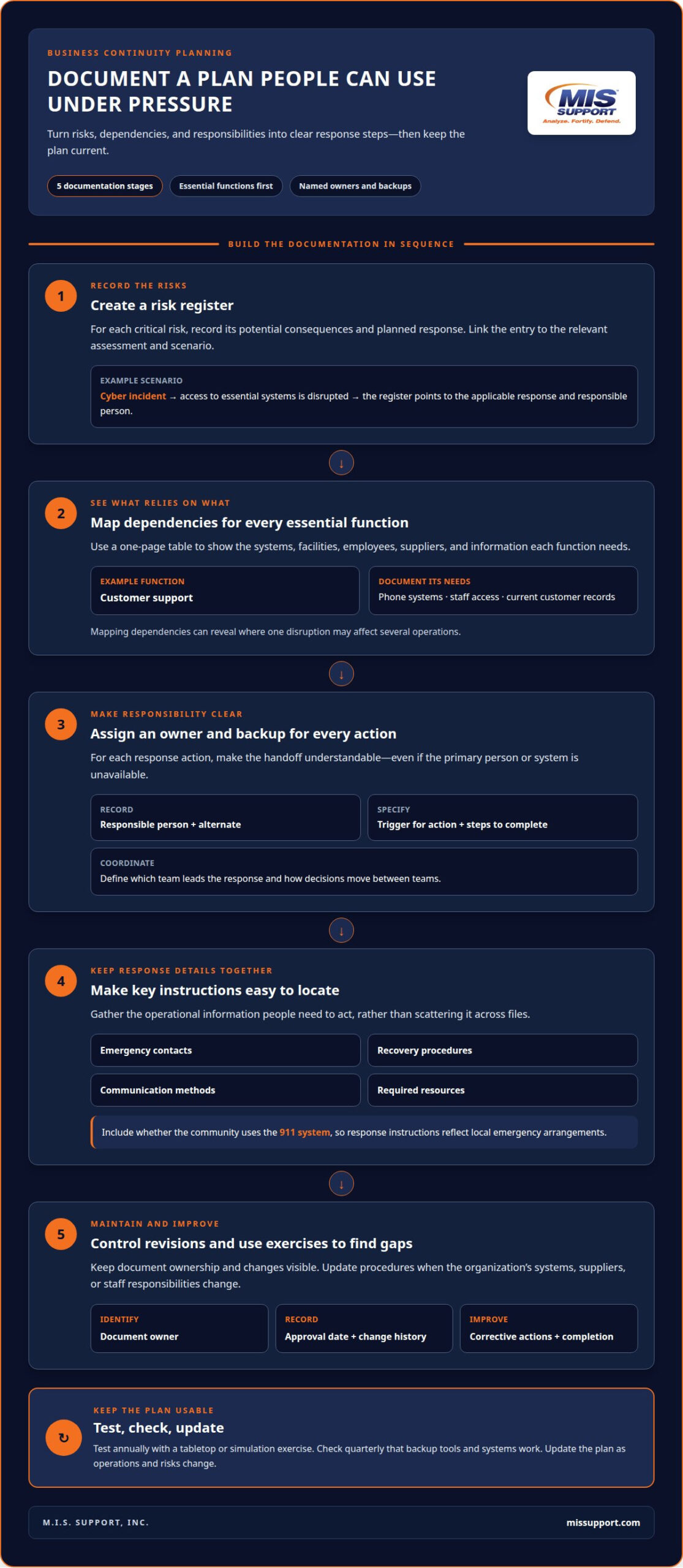
Documenting business continuity planning
- Create a risk register that records each critical risk, its potential consequences, and the planned response. Link each entry to the relevant risk assessment and scenario, such as a cyber incident that disrupts access to essential systems. This record helps the organization determine which action applies during a crisis and who is responsible for it.
- Map dependencies in a one-page table. For each essential function, document the systems, facilities, employees, suppliers, and information it depends on. Customer support, for example, may rely on phone systems, staff access, and current customer records. Mapping dependencies reveals where one disruption could affect several operations.
- Assign an owner and backup for every action. Record the responsible person, their alternate, the trigger for action, and the steps to complete. Define which team leads the response and how decisions move between teams. Avoid instructions that depend on a single employee or an unavailable system.
- Keep operational details together: emergency contacts, recovery procedures, communication methods, and required resources. Include whether the community uses the 911 system, so response instructions reflect local emergency arrangements. Supporting resources can help organize planning materials.
- Control document revisions. Add an owner, approval date, and change record, then update contact details and procedures when systems, suppliers, or staff responsibilities change. Use scenarios in exercises to identify unclear steps, assign corrective actions, and record when they are completed. A plan employees can locate and follow is more useful than scattered files.
For help developing and documenting a continuity plan, get business continuity planning support.
M.I.S. Support: Disaster Recovery & Business Continuity Planning
M.I.S. Support provides Disaster Recovery & Business Continuity Planning for organizations that need to turn documented priorities into coordinated recovery procedures. Consider this support when critical systems, staff responsibilities, or recovery steps are difficult to align, or when a plan needs to reflect cyber risks alongside operational disruption.
For organizations seeking to strengthen the security side of continuity, M.I.S. Support also offers Managed Cybersecurity Services, 24/7 Threat Monitoring & Response, and Internal & External Penetration Testing. These offerings address related needs, from monitoring threats to assessing security weaknesses that could interrupt operations. The right next step depends on the gaps your plan needs to address. Contact M.I.S. Support to discuss your business continuity planning needs.
Make Readiness Part of Daily Operations
A continuity plan becomes stronger when readiness is treated as an operating discipline, not a file kept for emergencies. Knowing how to build a business continuity plan is the starting point; keeping it relevant means considering resilience when making decisions about systems, suppliers, and changing business priorities. Assign ownership for future reviews, and make sure updates follow meaningful operational changes. This helps preparedness evolve with the organization instead of falling behind.
M.I.S. Support, Inc. can help organizations strengthen continuity through Disaster Recovery & Business Continuity Planning. Its related cybersecurity services can also support businesses working to reduce digital risks that may interrupt operations. The next step is to turn planning priorities into a coordinated approach suited to your environment.
Contact M.I.S. Support, Inc. to discuss your business continuity planning. A deliberate next step can help your organization build readiness with greater confidence.
Frequently Asked Questions
What are essential services?
Essential services are the functions an organization must preserve to meet core obligations and sustain operations. A medical practice might prioritize appointment scheduling, patient record access, and urgent communications; a retailer might focus on order processing and payment handling. Classify each function by its users, required resources, and the consequences of unavailability, then use those distinctions to guide recovery decisions.
What is a business continuity plan and what should it include?
A business continuity plan is a working set of instructions for keeping priority activities operating during disruption. Alongside response and recovery procedures, include activation criteria, employee role descriptions, contact methods, supplier dependencies, and instructions for accessing essential records. For example, specify where an authorized manager can find a current vendor contact if the usual office systems are inaccessible.
What are the steps to create a business continuity plan?
Start by choosing an executive owner and a cross-functional planning group. Gather input from employees who understand daily workflows, then map how critical work gets done and where it can fail. Draft response procedures, assign decision-making authority, and walk through a realistic scenario with the people expected to act. Record gaps found during the exercise and assign owners to resolve them.
How do you conduct a business impact analysis (BIA)?
Interview function owners to understand what each activity supports, what resources it relies on, and what happens when it stops. Compare impacts such as missed customer commitments, interrupted payments, or delayed internal decisions. Then identify dependencies between functions. For example, a delay in purchasing may affect inventory and customer fulfillment, extending the impact beyond the purchasing team.
How do you identify and assess business continuity risks?
Build scenarios around threats that could interrupt your specific work, such as a supplier failure, unavailable facility, or compromised account. For each scenario, identify affected people, processes, information, and equipment. Assess likelihood and potential severity using consistent criteria across departments. This makes risk comparisons more useful than a list of threats without context.