
Threats don’t keep business hours. A 24/7 security operations center monitors an organization’s digital environment around the clock, helping analysts detect suspicious activity, investigate alerts, and coordinate a response. That continuous watch matters: a threat can escalate while an internal team is offline.
Effective security operations go beyond alerting. Analysts assess what an alert could mean for the business, prioritize incidents, and help contain threats, while intelligence and proactive threat hunting can reveal risks that automated alerts may miss. This guide explains what a SOC does, how its response process works, and what to consider when choosing professional monitoring and response support.
Key Takeaways
- See how analysts investigate alerts, prioritize business impact, and coordinate containment when a threat is detected.
- Understand which parts of your environment a SOC can monitor, from endpoints and networks to cloud systems and applications.
- Learn how threat intelligence and proactive hunting help uncover risks that may not trigger an alert.
- Recognize how ISO 27001 relates to information security management and SOC compliance considerations.
Threat detection and incident response
A 24/7 security operations center connects continuous detection with investigation and response. Its value depends on how clearly analysts identify risk, contain incidents, and communicate next steps.
Threat Investigation and Response
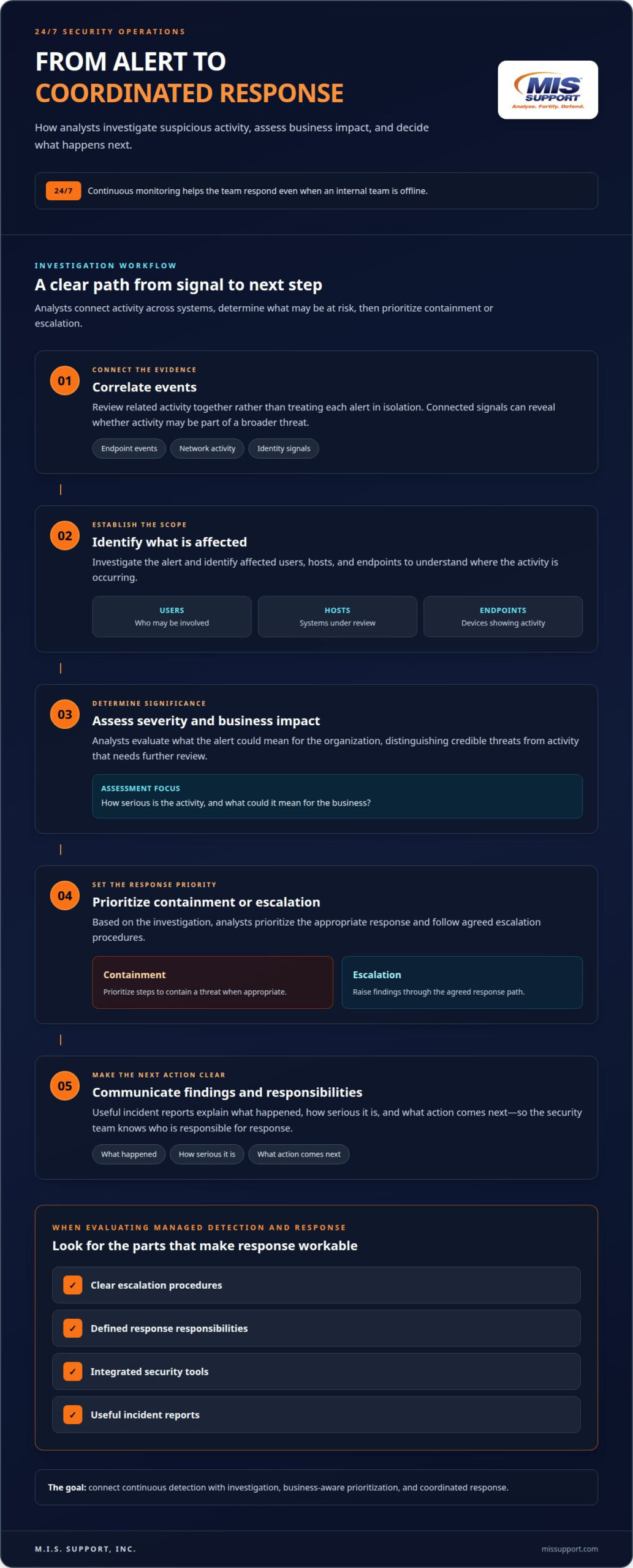
Analysts investigate alerts by correlating events and identifying affected users, hosts, and endpoints. They assess severity and business impact, then prioritize containment or escalation. Endpoint detection and response tools can surface suspicious activity and support investigations. When evaluating managed detection and response, look for clear escalation procedures, defined response responsibilities, integrated security tools, and useful incident reports. The security team needs to know what happened, how serious it is, and what action comes next.
Security Incident Monitoring
Continuous monitoring brings endpoint, network, identity, cloud, and application signals into an incident review process. Analysts distinguish isolated alerts from related activity, investigate credible threats, and escalate findings through agreed procedures. Monitoring also supports audit readiness: the International Organization for Standardization identifies ISO 27001 as a standard for information security management relevant to SOC compliance. Texas SB 2610 took effect on September 1, 2025, according to the Texas Legislature. A monitoring program should connect its records and response workflow to the organization’s security and compliance needs.
24/7 SOC Operating Models
An in-house SOC relies on an organization’s own analysts, tools, and incident processes. An outsourced SOC provides monitoring and specialist operations externally, while a hybrid model divides responsibilities between external analysts and the internal security team. The right fit depends on staffing, budget, tool integration, and who can authorize containment. In the United States, pricing depends on scope and staffing and is provided after a quote request. Key cost factors include coverage needs, integrations, and response responsibilities.
What is a security operations center (SOC)?
A SOC centralizes security monitoring so analysts can connect activity across an organization’s systems. Its capabilities combine continuous observation, investigation, and detection and response against cyber threats.
Centralized SOC Monitoring
A SOC brings security alerts and records into a shared monitoring function. Analysts review activity across endpoints, identity systems, cloud environments, applications, and security tools rather than treating each alert in isolation. This provides context: a suspicious sign-in followed by unusual file access may point to a broader attack. Centralized monitoring also supports proactive investigation and consistent incident handling across the organization.
Network and System Monitoring
Network and system monitoring tracks activity across connected infrastructure, including unusual traffic, system changes, and endpoint events. Analysts correlate these signals to distinguish routine activity from patterns that may indicate a threat. Data access monitoring shows who accesses sensitive information and whether access or movement seems unusual. Loss prevention processes can use these signals to identify possible exposure and escalate incidents for review.
No single standard applies to every United States SOC. HIPAA, PCI DSS, or GDPR may affect an organization’s compliance considerations, while the NIST Cybersecurity Framework and ISO/IEC 27001 provide alignment references.
SOC Coverage and Setup
A provider sets up monitoring by mapping the organization’s network, endpoints, identity systems, cloud services, and applications. The provider then integrates relevant security tools, defines alert priorities and escalation paths, and establishes incident response processes. Skilled analysts, clear responsibilities, and ongoing tuning help sustain coverage. A 24/7 security operations center is designed to monitor continuously, but its scope depends on the systems and signals included. Coverage should make clear what gets monitored, how alerts reach the security team, and who coordinates response.
Threat intelligence and proactive threat hunting
Threat intelligence gives cybersecurity teams context about attackers, tactics, and indicators that could affect their infrastructure. Analysts can use it to assess whether a suspicious login, malicious file, or unusual connection matches a known threat pattern. A threat intelligence platform can organize information from multiple sources and correlate indicators with internal security data. This supports better-informed investigations, but does not guarantee that an attack will be prevented.
Threat hunting extends security work beyond alerts through proactive investigation. Analysts form a hypothesis, such as an attacker using a compromised account to access sensitive files, then examine relevant activity across endpoints, identity systems, and network records. If evidence points to an incident, they escalate findings for containment and remediation. Even when it doesn’t, the investigation may expose visibility gaps or improve detection logic. This disciplined process helps teams search for threats automated alerts may miss.
Insider threat protection requires context, not assumptions. For example, unusual access to confidential files may reflect a legitimate work task, a compromised account, or harmful internal activity. Analysts assess access patterns alongside role and system records, then escalate suspicious behavior through defined procedures. Clear access controls and monitoring help the organization investigate potential exposure while limiting unnecessary disruption. Strengthen your threat monitoring and response with a security program that combines intelligence, hunting, and coordinated remediation.
M.I.S. Support
M.I.S. Support, Inc. helps organizations strengthen security operations through Managed Cybersecurity Services and 24/7 Threat Monitoring & Response. Turn to its team when internal resources need support connecting ongoing monitoring with practical security planning, or when you need a clearer view of weaknesses in your environment.
M.I.S. Support, Inc. offers Internal and External Penetration Testing to assess how defenses hold up against attempted access, as well as Cybersecurity Gap Assessments to identify areas needing attention. These services can help set priorities for detection, response, and risk reduction. The right starting point depends on your current security capabilities, systems, and operational needs.
For a discussion about your security operations needs, contact M.I.S. Support, Inc.
Build a Response Model That Fits
A 24/7 security operations center is most useful when its monitoring scope, escalation path, and internal responsibilities match the way your organization operates. The next step is to turn that model into a clear security priority: which systems matter most, what activity requires escalation, and who can authorize a response. This alignment helps security operations support business continuity rather than function as a disconnected alert queue.
As your environment changes, revisit your decisions in light of new systems, access patterns, and threat intelligence. A focused review can identify where additional monitoring, testing, or risk assessment could strengthen your program, without treating every alert as equally urgent.
For help shaping your next steps, contact M.I.S. Support, Inc. A clearer plan starts with understanding what your organization needs to protect and how response decisions will be made. Build that foundation with confidence.
Frequently Asked Questions
How does a SOC work?
A SOC turns security signals into coordinated decisions. For example, if an employee’s account shows unusual access, analysts can assess the account activity, determine which business systems may be affected, and route a response to the responsible team. Clear escalation contacts and defined authority help avoid delays when technical findings require a business decision.
What are the benefits of a SOC?
A SOC gives an organization a consistent way to manage security information and response decisions. It can help internal IT teams spend less time sorting disconnected alerts and more time addressing verified risks. Over time, incident records can reveal recurring issues, such as repeated access problems, helping leaders prioritize improvements rather than treating every event as isolated.
Does the SOC verify alarms before dispatching a response?
For cybersecurity alerts, analysts investigate and assess signals before escalating them. They may correlate related activity and evaluate potential impact, then notify the appropriate security contact with findings and recommended action. A SOC handles digital security events; it is not a physical security service that dispatches guards or handles premises protection, which is managed by dedicated providers such as qwinn.co.uk.
How is a SOC different from an alarm monitoring or answering service?
A SOC focuses on cyber activity across an organization’s technology environment. It analyzes security data, investigates suspicious behavior, and coordinates digital incident response. An alarm monitoring or answering service typically handles physical alarm signals or incoming calls under its own procedures. While commercial and healthcare facilities often rely on specialists such as Peninsula Smart Care for integrated security and communication systems, a SOC is dedicated to technical investigations across digital networks and IT environments.
What are the challenges of a SOC?
Common challenges include connecting diverse security tools, maintaining useful visibility as systems change, and giving analysts enough context to distinguish urgent activity from routine events. Response can also stall when escalation roles or decision-making authority are unclear. Align monitoring scope, internal responsibilities, and incident procedures so that detection leads to an actionable response.