
Compliance starts with the data you handle. Businesses that process, store, or transmit payment card information must comply with PCI DSS. For SMBs, compliance requirements also depend on where customers are located, what personal data the business processes, and which systems and vendors handle it. The risk is not just a missed control. It is a plan that overlooks how information actually moves through the business.
PCI DSS v4.0.1 sets out 12 core security requirements, while GDPR duties may apply when an organization processes EU residents’ personal data. This guide shows you how to map your data and systems, assess gaps, and turn the relevant requirements into a practical compliance plan. You’ll learn where PCI DSS and GDPR obligations overlap, how to assign owners and priorities, and how to keep controls and records aligned as your operations change.
Key Takeaways
- Map where payment card data flows so you can identify which systems and processes fall within PCI DSS scope.
- Build privacy processes around the personal data you handle, including a clear response plan for potential breaches.
- Turn risk assessment findings into prioritized actions, assigned owners, and a plan that keeps pace with operational changes.
- Use security testing and ongoing monitoring to uncover weaknesses and strengthen your compliance program over time.
PCI DSS requirements for businesses handling payment card data
Federal and state obligations depend on the information a business handles and its activities. Businesses that process, store, or transmit payment card information must comply with PCI DSS. HIPAA applies to businesses handling protected health information or providing services to healthcare entities. State privacy laws, including VCDPA and CPA, may also apply. Compliance requirements for SMBs therefore vary by industry, location, data, and customers.
- Map card-data flows. Record where payment information enters, moves, and is stored. PCI DSS v4.0.1 sets out 12 core security requirements, and its compliance deadline was March 31, 2025. Include connected services and employee access when defining scope.
- Identify other duties. FTC scrutiny may concern consumer-data protections, including safeguards such as encryption and multi-factor authentication. Healthcare businesses and vendors handling protected health information must account for HIPAA safeguards. Retailers handling card data need PCI DSS controls.
- Classify financial activities. A person engaged in money transmission as a business is an MSB regardless of transaction amount. For specified MSB activities, the threshold is more than $1,000 per person per day in one or more transactions. Document the services performed.
- Account for each worker. Employees, contractors, and remote workers may use different devices and systems. Document access permissions and responsibilities, then align procedures with actual practices.
- Plan resources and evidence. Compliance costs depend on scope, systems, software, testing, and professional support. Treat compliance requirements for SMBs as an ongoing process: retain control records and incident procedures, then review them as operations change.
GDPR duties for organizations processing EU residents’ data
- Map personal data and purposes. Identify what information your organization collects from EU residents, where it is stored, and who can access it. Explain collection purposes in clear privacy policies, and document permission before collecting or sharing personal information where consent is used.
- Prepare for access requests. Set a process for receiving requests and locating the person’s information across relevant systems. Assign responsibility for coordinating searches and recording responses, so requests don’t stall between departments or vendors.
- Set data protection ownership. Determine whether your organization needs a designated data protection officer, based on its processing activities and responsibilities. Even when that role isn’t required, assign an accountable person to maintain policies, coordinate requests, and keep practices aligned with data protection standards.
- Connect privacy and payment controls. If your organization also processes, stores, or transmits cardholder data, PCI DSS applies to those activities. Keep payment-system access and security evidence distinct from broader privacy documentation, while coordinating both frameworks in one compliance plan.
- Prepare an incident response process. The European Union requires covered organizations to report data breaches within 72 hours. Define how employees escalate suspected incidents, preserve relevant records, and support timely assessment. A clear incident response plan helps turn policy into practiced action.
- Understand the financial exposure. The European Union states that more severe GDPR violations can result in fines of up to 4% of the previous financial year’s global revenue or €20 million, whichever is greater. Review access, retention, and disclosure practices regularly to protect personal data and identify gaps early.
The European Union’s General Data Protection Regulation (GDPR) is designed to enhance privacy rights and encourage businesses to protect consumers’ personal information. Sensitive data should be encrypted both at rest and in transit. Clearly disclose data collection practices and intended uses to customers, and regularly review privacy policies to keep them aligned with current regulatory requirements.
Risk assessments and compliance planning
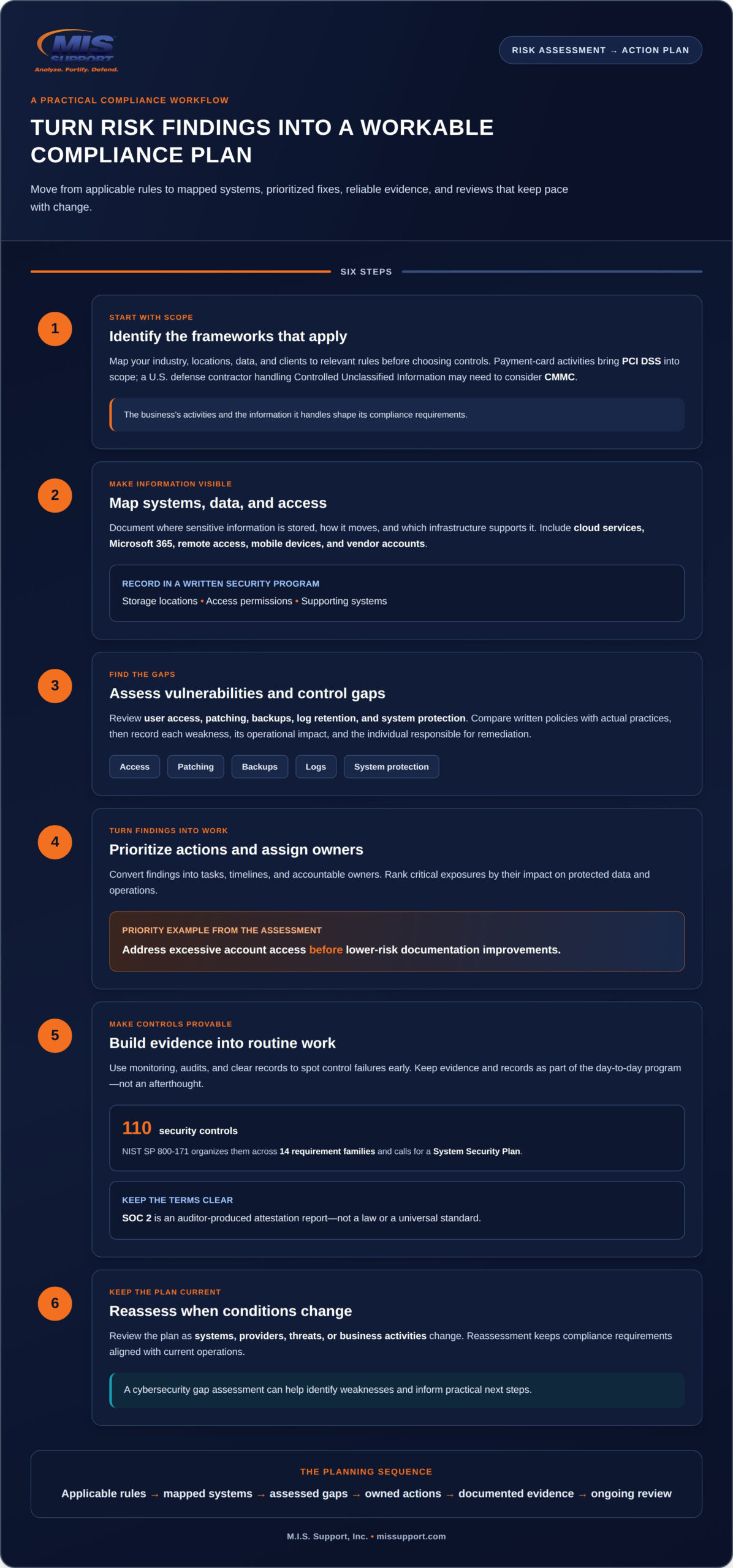
- Identify applicable frameworks. Map your industry, locations, data, and clients to relevant rules before choosing controls. A U.S. defense contractor handling Controlled Unclassified Information may need to consider CMMC, while payment-card activities bring PCI DSS into scope. These factors shape compliance requirements for SMBs.
- Map systems and data. Document where sensitive information is stored, how it moves, and which infrastructure supports it. Include cloud services, Microsoft 365, remote access, mobile devices, and vendor accounts. A written security program should record storage locations and access permissions.
- Assess vulnerabilities and control gaps. Review user access, patching, backups, log retention, and system protection. Compare written policies with actual practices. Record each weakness, its operational impact, and the individual responsible for remediation.
- Prioritize actions and ownership. Convert findings into tasks, timelines, and accountable owners. Rank critical exposures by their impact on protected data and operations. Address excessive account access before lower-risk documentation improvements.
- Build evidence into routine work. Use monitoring, audits, and clear records to spot control failures early. NIST SP 800-171 includes 110 security controls across 14 requirement families and calls for a System Security Plan. SOC 2 is an auditor-produced attestation report, not a law or universal standard.
- Reassess when conditions change. Review your plan as systems, providers, threats, or business activities change. This keeps compliance requirements for SMBs aligned with current operations. A cybersecurity gap assessment can identify weaknesses and inform practical next steps.
A compliance strategy should begin by identifying which regulations apply based on the business’s industry, data, locations, and clients, then assessing vulnerabilities and risks in its IT infrastructure. CMMC Level 1 requires annual self-assessments through the Supplier Performance Risk System portal.
ISO 27001 is a formal standard for an information security management system that uses policies, risk management, controls, and continual improvement. Automated compliance management systems are tools for automating risk assessments, policy management, and reporting. A compliance plan should also specify steps, timelines, and responsible parties.
M.I.S. Support: Compliance & Risk Management
M.I.S. Support, Inc. helps organizations turn compliance findings into practical security priorities through Compliance & Risk Management. This is a useful next step when PCI DSS or GDPR obligations intersect with complex systems, unclear ownership, or unresolved control gaps. The work connects regulatory requirements to the data, processes, and safeguards that need attention.
For broader cybersecurity needs, Managed Cybersecurity Services can support an organization’s security program. Internal & External Penetration Testing can help uncover weaknesses in systems and networks, while 24/7 Threat Monitoring & Response focuses on detecting and responding to threats. These services address different parts of risk management, so the right starting point depends on the compliance requirements for smb and the gaps identified in the assessment.
To discuss your compliance and security priorities, contact M.I.S. Support, Inc.
Make compliance part of everyday operations
A durable approach to compliance requirements for SMBs starts with clear ownership. Assign someone to track decisions, maintain current evidence, and coordinate changes across teams. Then connect each planned control to a real process, such as onboarding an employee, changing system access, or responding to a security alert. This makes compliance an operational discipline, not a document prepared only for an assessment.
M.I.S. Support can help turn that approach into practical security work through Managed Cybersecurity Services, 24/7 Threat Monitoring & Response, and Internal & External Penetration Testing. Use these capabilities to strengthen oversight, detect threats, and identify weaknesses as your needs evolve. Contact M.I.S. Support to discuss your next step and build a more prepared security program.
Frequently Asked Questions
What are the penalties and risks for SMB compliance violations?
Consequences can include regulatory penalties, required corrective actions, investigations, and disruption to business operations. For example, failure to meet U.S. money services business registration requirements may bring a civil penalty of up to $5,000 for each violation; criminal penalties may include imprisonment for up to 5 years. A security failure can also damage customer confidence and complicate business relationships.
How can a small business build a compliance program and track deadlines?
Start with a compliance calendar that names each obligation, its due date, and the person responsible for completing it. Record renewal dates, assessment milestones, staff training, and policy reviews in one shared system. Assign a backup owner, retain evidence of completed tasks, and update the calendar when services, vendors, data practices, or customer locations change. This turns deadlines into accountable operational tasks.