
Outsourced cybersecurity for business isn’t automatically cheaper than building an in-house team. Compare the full cost of hiring and maintaining security staff with the coverage and capabilities an outsourced service provides. The right choice depends on your organization’s security needs and the resources it already has.
Budget matters: salaries are easy to see, while the cost of continuous security coverage can be harder to assess. But price alone won’t tell you whether threats are monitored consistently or whether your team can respond when an alert appears.
This comparison explains the trade-offs between in-house, outsourced, and hybrid approaches. You’ll learn what affects costs, how continuous monitoring and response fit into each model, and which provider capabilities and service terms matter when you assess your options.
Key Takeaways
- Compare the full cost of staffing and maintaining in-house coverage with the outsourced service scope, and consider how predictable pricing fits your budget.
- Define responsibilities, reporting, communication channels, and response expectations to reduce oversight gaps and provider dependency.
- Assess how continuous monitoring connects to incident response, including who reviews alerts and who takes action.
- When resilience planning is the priority, M.I.S. Support’s Disaster Recovery & Business Continuity Planning can help prepare your organization to maintain or restore operations.
Who Should Outsource Cyber Security Services?
Outsourcing can suit an organization that needs specialist security coverage without building every capability internally. Compare staffing costs, service scope, and response responsibilities before choosing a model.
In-House Security Operations Costs
An internal team provides direct oversight, but costs extend beyond salaries. Recruiting, training, security tools, and maintaining coverage all require budget and management time. For example, an organization handling alerts internally must assign responsibility for investigation and response. Outsourced cybersecurity shifts defined responsibilities to a security provider, while in-house operations keep expertise and decisions closer to the organization.
MSSPs, MSPs, and Virtual CISOs
A managed security service provider (MSSP) focuses on services such as monitoring and threat response. A managed service provider (MSP) generally manages broader IT operations, while a virtual chief information security officer (vCISO) provides security leadership and strategic guidance. These roles can overlap, so define the deliverables in the agreement. An organization needing operational monitoring has different requirements from one seeking executive-level security planning.
U.S. requirements depend on an organization’s industry, data, location, and contracts. Healthcare organizations, for example, may need to address HIPAA requirements. Define the provider’s access, responsibilities, and reporting duties in the agreement.
Outsourced services can include threat monitoring, incident response, penetration testing, vulnerability assessments, and compliance support. A business can choose a defined scope rather than transferring every security function to one provider.
Onboarding typically starts by agreeing on scope and responsibilities, then sharing relevant system and risk information. The provider can establish access, communication channels, and reporting procedures so internal teams know how alerts and incidents will be handled.
| Option | Cost structure | Oversight | Coverage |
|---|---|---|---|
| In-house | Staff, tools, training | Direct | Managed internally |
| Outsourced | Varies by service scope; flat-rate pricing can support monthly predictability | Shared through defined reporting | Provided within the agreement |
| Hybrid | Internal and contracted resources | Internal team retains control | Responsibilities are divided |
Choose the model that aligns service scope and budget with the level of internal control your organization needs.
What should I look for in an outsourced cybersecurity provider?
Choose a provider that understands your operations, defines its responsibilities, and reports clearly. Continuous monitoring matters, as do oversight and a workable response when an incident occurs.
Provider Legitimacy and References
Assess a provider’s fit by reviewing its relevant experience, documented security practices, and references from organizations with similar needs. Ask how it handles detection, communication, and incidents. A polished proposal alone cannot show how a provider performs under pressure. Confirm that its incident response plan, data encryption, and access controls suit the sensitivity of the information it will handle.
Oversight and Provider Dependency Risks
Outsourcing can reduce visibility if reporting and decision-making responsibilities remain vague. Set communication channels, require regular reports, and retain internal expertise to oversee the work. The contract should define scope, responsibilities, escalation paths, and response expectations in its service-level agreement. Put any guarantees in writing. Keep access to essential records and processes so the organization can maintain continuity if the relationship changes.
A provider’s understanding of your business matters. Share business goals, critical systems, operating processes, and data breach concerns during onboarding. With that context, a security provider can align monitoring and response with business priorities instead of treating every alert alike. Confirm relevant compliance experience when your organization has specific audit needs.
Measure performance against agreed service levels and regular reports. Track response times, detection and escalation, incident handling, and whether recommended remediation is completed. Review trends with the provider, then adjust priorities as risks or business processes change.
A cybersecurity gap assessment can help identify oversight needs and clarify where external support fits.
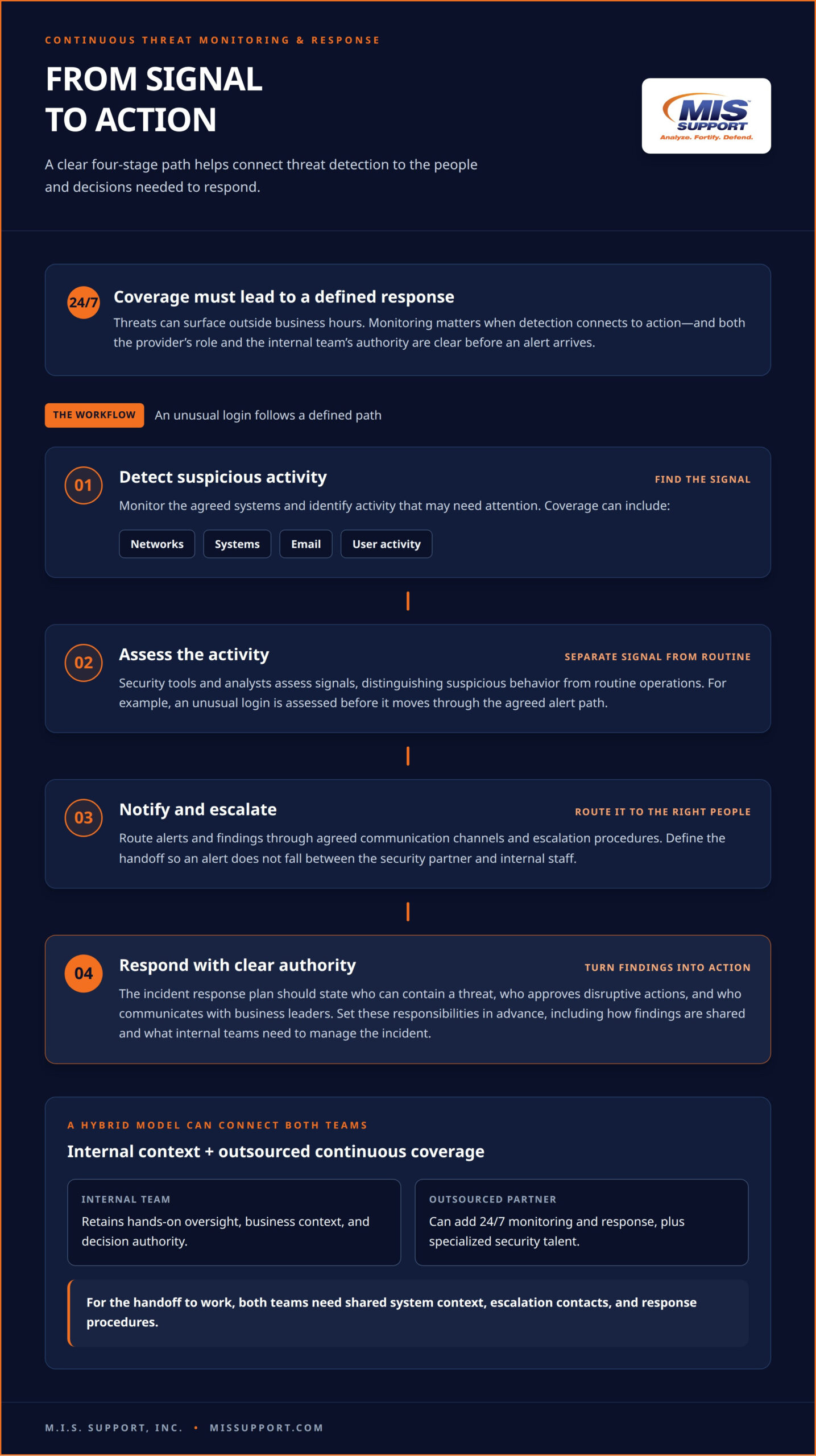
Continuous threat monitoring and response
Threats can surface outside business hours, so monitoring must connect detection to action. Outsourced cybersecurity can provide continuous monitoring, while an internal team retains business context and decision authority. Make those roles clear before an alert arrives.
Monitoring can cover networks, systems, email, and user activity. Security tools and analysts assess signals, distinguish suspicious behavior from routine operations, and escalate incidents under agreed procedures. For example, an unusual login should follow a defined path: detection, assessment, notification, and response. Clear handoffs prevent an alert from falling between the security partner and internal staff.
Incident response requires more than alert delivery. The plan should identify who can contain a threat, who approves disruptive actions, and who communicates with business leaders. Define these responsibilities in advance, including how the provider shares findings and what internal teams need to manage the incident. The response process should fit the organization’s operating priorities.
A small internal team can combine hands-on oversight with outsourced 24/7 monitoring and response. This hybrid approach keeps internal knowledge close while adding continuous coverage and specialized security talent. It works best when both teams share system context, escalation contacts, and response procedures.
- Detection: Identify suspicious activity across agreed systems.
- Escalation: Route alerts to the people responsible for decisions.
- Response: Coordinate containment and follow-up actions.
To strengthen continuous coverage, explore threat monitoring and response options that align with your operations.
M.I.S. Support: Disaster Recovery & Business Continuity Planning
M.I.S. Support helps organizations prepare for disruption through Disaster Recovery & Business Continuity Planning. Consider this service when your business needs a clearer path to maintain or restore operations after a cyber incident. Monitoring and response help identify threats; continuity planning addresses how the organization proceeds when systems or services are affected.
M.I.S. Support also offers Managed Cybersecurity Services, 24/7 Threat Monitoring & Response, and Internal & External Penetration Testing. These services address different parts of security: ongoing oversight, threat response, and testing that can reveal weaknesses. The right next step depends on whether your priority is resilience planning, active monitoring, or understanding exposure.
Contact M.I.S. Support to discuss Disaster Recovery & Business Continuity Planning for your organization.
Set Your Security Plan in Motion
Make the next decision about ownership. Decide which security responsibilities stay with your internal team, where external coverage fits, and how both sides will coordinate as conditions change. A clear operating model turns security priorities into accountable actions instead of leaving response roles unclear.
Outsourced cybersecurity for a business works best when its scope supports real operational needs. M.I.S. Support, Inc. offers Managed Cybersecurity Services, 24/7 Threat Monitoring & Response, and Internal & External Penetration Testing. These services can support ongoing defense, monitoring, and evaluation of security weaknesses.
Contact M.I.S. Support, Inc. today to discuss the security approach that fits your organization.
Build a plan with clear responsibilities and a stronger path forward.
Frequently Asked Questions
Is outsourcing cybersecurity really cheaper than hiring in-house?
It can be, but the comparison depends on what each option covers. Compare equivalent responsibilities, including staffing, tools, training, monitoring, and incident response. Include internal management time and expertise your team will still need. For example, a quote covering monitoring alone shouldn’t be compared with an in-house team responsible for broader security operations.
Do SMBs need to worry about outsourcing cybersecurity?
Yes. Business size doesn’t eliminate the need to protect sensitive information, customer records, and essential operations. An SMB can start with the security functions its staff cannot consistently handle, rather than outsourcing every responsibility. For example, a company with a small IT team might seek specialist help with security testing while keeping business decisions and system knowledge in-house.
Final Thoughts: Should You Outsource Cybersecurity?
Outsource when your organization needs capabilities or coverage its current team can’t provide effectively. Keep internal ownership of risk priorities, business decisions, and provider oversight. A hybrid approach can suit organizations that want external expertise while preserving direct control. Map critical systems to responsible people, then identify where specialist support closes the clearest gap.
What are the main risks of outsourcing cybersecurity?
Key risks include exposing sensitive information through provider access, receiving work that doesn’t match business priorities, and relying on processes your team doesn’t understand. For example, a provider may need access to systems containing customer data. Limit access to the agreed scope, document how information is handled, and plan how operations will continue if the relationship ends.
What are the pros and cons of outsourcing cybersecurity?
Outsourcing can add specialized expertise and capabilities without requiring every function to sit inside the organization. It can also help an internal team focus on core operations. The trade-offs include less direct control over some security tasks, reliance on another organization, and the need to coordinate decisions. A defined scope and active internal oversight help balance these factors.