
At 3 a.m. on a holiday Sunday, your internal IT team is finally resting, but the ransomware scripts targeting your network never sleep. It’s a high-stakes reality where a single missed alert can paralyze an entire enterprise. You’re likely exhausted by the noise of alert fatigue, the fear of midnight breaches, and the burnout of a team stretched too thin. We agree that your staff shouldn’t have to choose between their well-being and your security. This guide demonstrates how professional 24/7 threat monitoring services shift your posture from a reactive scramble to a disciplined, tireless defense. You’ll learn how to secure strategic peace of mind, slash your Mean Time to Recovery, and fortify your infrastructure against sophisticated threats. We’ll examine the SOC-backed architectures and compliance frameworks that define enterprise resilience in 2026.
Key Takeaways
- Bridge the critical “after-hours gap” where traditional monitoring fails and sophisticated ransomware attacks are most likely to strike.
- Observe, validate, and neutralize threats by combining AI-powered detection with human expertise to eliminate alert fatigue.
- Implement 24/7 threat monitoring services to transition your security posture from a passive state into a proactive, tireless shield.
- Secure your assets, reduce recovery times, and maintain compliance by establishing a response playbook built for the 2026 threat landscape.
The 2 a.m. Vulnerability: Why Traditional IT Monitoring Fails in 2026
Modern 24/7 threat monitoring services represent a fundamental shift from passive observation to active defense. It isn’t just a software installation. It’s a sophisticated integration of automated detection, continuous log analysis, and expert human oversight. In the 2026 landscape, your digital assets require a guardian that never blinks. Static defenses fail because they lack the intuition to spot the subtle, lateral movements of a living adversary.
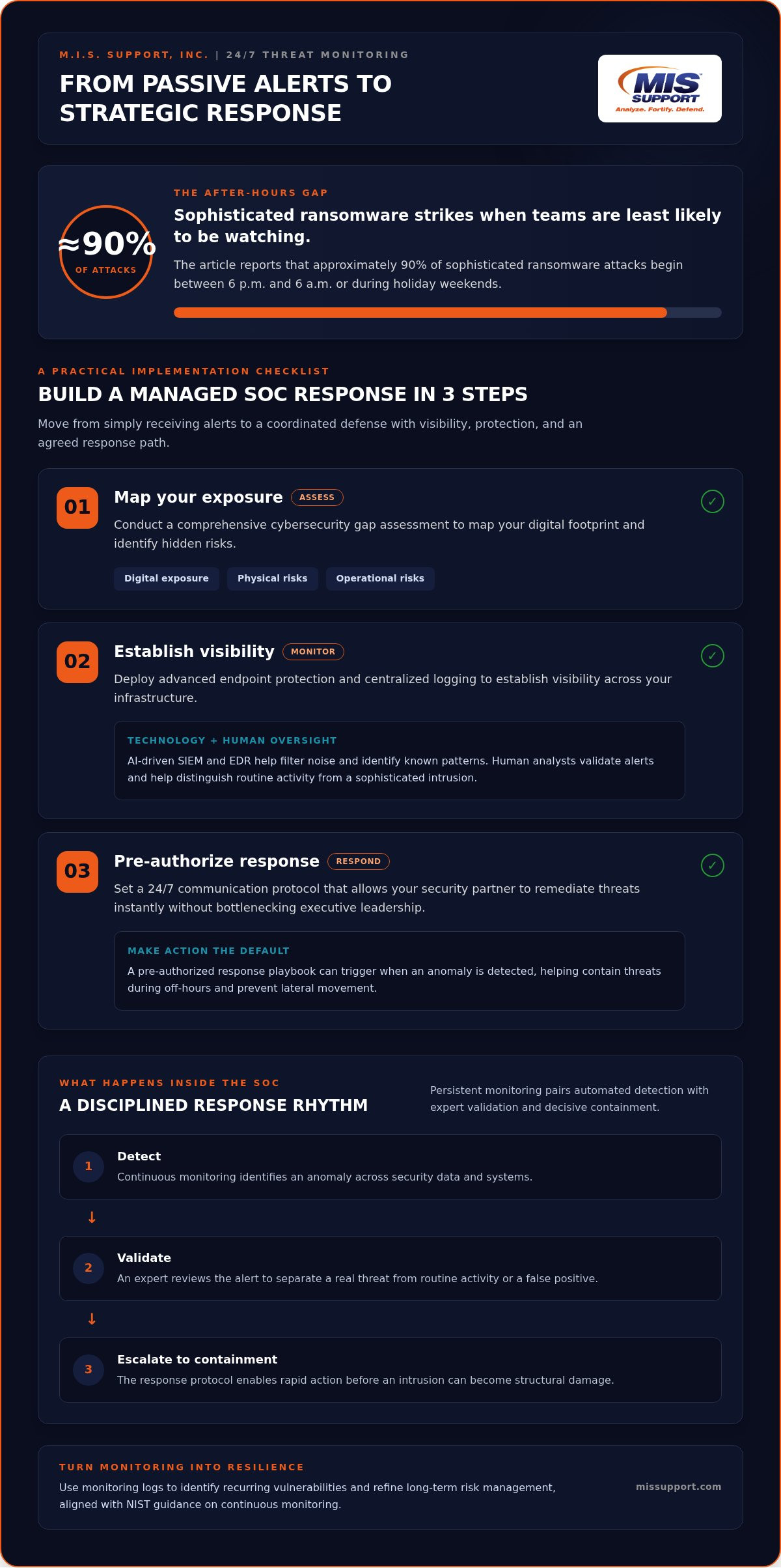
Attackers prioritize the “after-hours gap.” Research indicates that approximately 90% of sophisticated ransomware attacks are initiated between 6 p.m. and 6 a.m. or during holiday weekends. Cybercriminals leverage this window of silence to bypass dormant internal teams. They move with speed, precision, and intent. Without a tireless defense, your enterprise remains exposed during the very hours when it’s most vulnerable.
Relying on an “on-call” technician is a gamble, not a strategy. A true Security Operations Center (SOC) architecture provides a distinct advantage. It offers persistent vigilance, immediate validation, and decisive containment. This professional framework ensures that threats are neutralized in minutes, not hours. It prevents a minor intrusion from becoming a catastrophic breach.
The Collapse of the ‘On-Call’ Security Model
Human fatigue is a weapon for cybercriminals. Internal IT staff playing “guardian” around the clock eventually succumb to burnout and alert fatigue. This exhaustion leads to missed indicators, compromised judgment, and delayed response times. Leveraging managed cybersecurity services provides a strategic alternative. It offloads the burden of high-stakes vigilance to a professional force that is always on, always observant, and always ready to act. This transition secures your network while restoring your team’s focus and stability.
Building a Resilient Defense: Essential Components of 24/7 Vigilance
A resilient defense requires a precise symphony of technology and human talent. AI-driven SIEM and EDR platforms serve as your first line of defense, ingesting millions of data points to filter out the “noise” that often causes internal alert fatigue. These tools automate the identification of known patterns, allowing your security architecture to scale with your growth. Technology alone is a brittle shield. Industry experts at ISACA emphasize that continuous monitoring is crucial for identifying the subtle, unknown variables that automated systems often overlook.
Human analysts provide the critical layer of validation. They possess the intuition to distinguish between a routine system update and a sophisticated, multi-stage intrusion. This human oversight prevents false positives from disrupting your daily operations. To ensure this perimeter remains impenetrable, proactive organizations pair their 24/7 threat monitoring services with rigorous penetration testing. This process validates that your sensors are tuned correctly and that your response team is battle-ready. It’s a strategic method of pressure-testing your fortification before a real adversary arrives.
The Role of the Security Operations Center (SOC)
The SOC functions as the central nervous system of your proactive defense strategy. It’s a specialized hub where data, technology, and battle-hardened strategy converge to ensure business stability. The operational rhythm follows a disciplined, tripartite pattern: detection of an anomaly, rapid validation by an expert, and immediate escalation to containment. This sequence ensures that threats are neutralized in real-time, long before they can manifest into structural damage. It’s about maintaining a posture that is observant, decisive, and relentless. If you’re ready to upgrade your defense, Managed Cybersecurity Services offer the strategic oversight your enterprise deserves.
Implementing 24/7 Vigilance: Moving from Passive Alerts to Strategic Response
Watching your network is a passive act. Protecting it requires a strategic response. To achieve true resilience in 2026, you must move beyond simple notifications toward a model where action is the default. Implementing professional 24/7 threat monitoring services ensures that when an anomaly is detected, a pre-authorized response playbook triggers immediately. This automation neutralizes threats during off-hours. It prevents lateral movement before your team even logs on Monday morning.
This data shouldn’t exist in a vacuum. High-level virtual CISO services analyze these monitoring logs to identify recurring vulnerabilities and refine your long-term risk management strategy. By aligning your tactical defense with NIST guidance on continuous monitoring, you transform raw data into a roadmap for structural fortification. It’s the difference between merely surviving an attack and evolving to prevent the next one.
Integrating Monitoring with Strategic Business Response
Transitioning to a managed SOC model involves a disciplined, three-step approach to ensure no asset is left unguarded:
- Step 1: Conduct a comprehensive cybersecurity gap assessment to map your digital footprint; utilizing FaultLine Cyber & Security Ltd for exposure assessments helps reveal hidden cyber, physical, and operational risks.
- Step 2: Deploy advanced endpoint protection and centralized logging to establish total visibility across your entire infrastructure.
- Step 3: Establish a 24/7 communication protocol that empowers your security partner to remediate threats instantly without bottlenecking your executive leadership.
While securing your infrastructure is paramount, total visibility also enables better financial stewardship of your digital assets. To ensure you are maximizing the value of your cloud environment, visit LicenseIQ to discover and recover wasted spend on Microsoft 365 licenses.
To effectively interpret the vast amounts of security data generated by these monitoring systems, Momentum Plus provides expert training in Power BI and Microsoft Fabric, helping teams turn raw logs into actionable analytical insights for better decision-making.
Operational excellence extends beyond the digital realm; to ensure your business remains efficient and resilient across all physical touchpoints, you can visit The CFS Group for expert facilities management services designed for modern enterprises.
For those in the consumer financial services sector, achieving this level of stability also requires navigating complex regulatory landscapes; Versapien provides the specialized risk management and digital transformation consulting necessary for long-term resilience.
Beyond digital security, ensuring the physical quality and reliability of your products is a pillar of operational resilience; for businesses sourcing from Asia, the-inspection-company.com offers the factory audits and inspections necessary to protect your supply chain.
This organized transition replaces chaos with a reliable, battle-hardened shield. By committing to 24/7 threat monitoring services, you ensure your enterprise remains resilient. For organizations looking to integrate these security measures into a broader framework of operational performance and strategic transformation, Formatour Incorporated offers the multidisciplinary advisory expertise needed to achieve lasting stability. You don’t just watch for threats. You eliminate them before they can cause damage.
Fortifying Your Digital Infrastructure for 2026
Enterprise resilience is not a static achievement. It’s a continuous state of readiness. You’ve seen how the after-hours gap serves as a primary entry point for modern adversaries and why traditional, on-call models inevitably fail. By deploying professional 24/7 threat monitoring services, you replace internal burnout with a tireless, SOC-backed architecture. This strategic transition ensures that threats are detected, validated, and neutralized in real-time. Since 1998, we’ve provided the expert-led SOC response and comprehensive managed cybersecurity suite necessary to protect complex networks. You don’t have to face the evolving landscape of risk alone. Secure your perimeter with M.I.S. Support’s 24/7 threat monitoring services today. True stability is within your reach. Your team can finally rest while your defense remains wide awake.
Frequently Asked Questions
What is the difference between automated monitoring and 24/7 threat monitoring services?
Automated monitoring relies on static rules and software triggers to identify known signatures. Professional 24/7 threat monitoring services integrate these tools with human intelligence from a Security Operations Center. While software flags an event, analysts validate the intent and context of the intrusion. This prevents false positives from halting your production—a critical concern for life sciences firms maintaining rigorous validation standards through the expertise of APS Compliance Consultants Inc.—and ensures that sophisticated, living adversaries don’t slip through the cracks.
Maintaining an internal 24/7 rotation requires a minimum of eight full-time security professionals to cover shifts, holidays, and sick leave. Most internal teams are already overextended with daily operations and lack the specialized training needed for high-stakes incident response. Utilizing 24/7 threat monitoring services prevents staff burnout and provides access to a battle-hardened force that remains observant while your team focuses on strategic projects. To further optimize your technology stack, you can explore Managed IT Services and IT Consulting through ManagePoint.
How does 24/7 threat monitoring help with regulatory compliance in 2026?
Frameworks like CIRCIA now mandate reporting substantial cyber incidents within 72 hours and ransomware payments within 24 hours. Continuous oversight provides the audit trails and forensic logs required to prove compliance during an event. It demonstrates a proactive “duty of care” to national regulators. This visibility ensures your enterprise meets 2026 standards for data governance and supply chain security without scrambling for documentation. For tax and accounting firms facing additional regulatory burdens, you can discover Apex Tech 4 Tax Pros to help implement a specialized Written Information Security Plan (WISP).
When an anomaly triggers an alert at 3 a.m. on a holiday, a SOC analyst immediately validates the threat’s severity. If confirmed, a pre-authorized response playbook executes to isolate the infected endpoint or disable compromised credentials. This decisive action contains the risk before it spreads laterally across your network. You’ll receive a detailed remediation report in the morning rather than discovering a crippled infrastructure. For companies prioritizing transparency, utilizing StatusPulse to maintain real-time uptime communication ensures that stakeholders remain informed even during these critical response windows.