
Global cybercrime losses are projected to reach $10.8 trillion this year. If you’re constantly bracing for the next ransomware strike, you aren’t alone. Most enterprise leaders are currently overwhelmed by the 2026 CCPA updates and the NIST SP 800-172 Revision 3 requirements released on May 13, 2026. Relying on an overstretched in-house team for 24/7 monitoring is a gamble you can’t afford to lose. Integrating expert managed cybersecurity services isn’t just about outsourcing; it’s about fortifying your foundation. It’s about shifting from a state of constant anxiety to one of strategic preparedness.
You know that reactive firefighting drains your budget and your focus. It’s time to move beyond survival. This guide reveals how to transform your digital defense from a reactive cost center into a proactive shield that secures your growth and compliance. We’ll explore a framework for total operational resilience, covering 24/7 threat response, AI-driven risk mitigation, and the decisive role of a virtual CISO in your 2026 strategy. You’ll discover how to achieve predictable security costs and the steady confidence that comes from professional, vigilant oversight.
Key Takeaways
- Shift from a “break-fix” mentality to a vigilant guardian model that prioritizes 24/7 proactive oversight and threat hunting.
- Identify the essential pillars of enterprise resilience, including SOC-led threat monitoring and multi-layered endpoint protection.
- Learn why standard IT providers shouldn’t grade their own security homework and how specialized managed cybersecurity services provide objective defense.
- Navigate the complex 2026 regulatory landscape by treating compliance as a baseline rather than the ceiling of your security strategy.
- Follow a structured implementation roadmap that begins with a gap assessment to align your security posture with business growth.
Defining Managed Cybersecurity Services: Beyond Basic IT Support
Cybersecurity is no longer a peripheral IT checkbox. It’s a core survival strategy. For the modern enterprise, managed cybersecurity services represent a fundamental shift from passive maintenance to active, 24/7 oversight. This model doesn’t wait for a system to fail or a database to be breached. Instead, it employs a “vigilant guardian” approach, constantly scanning for anomalies, hunting for hidden threats, and fortifying digital perimeters. To understand the value, one must first look at What are Managed Security Services? and how they differ from traditional support.
The old “break-fix” mentality is a dangerous relic. It assumes that if the lights are on, the network is safe. In 2026, this reactive posture is a massive liability. With the global average cost of a data breach reaching $4.4 million, “good enough” IT is an open invitation to disaster. Cybersecurity as a Service (CSaaS) provides a scalable business model that replaces guesswork with precision. It transforms security from a fluctuating capital expense into a predictable operational necessity, ensuring your growth isn’t derailed by a single exploit. If you’re evaluating your current provider against modern standards, our secure managed IT services buying guide for 2026 outlines exactly what proactive defense and predictable IT spending should look like.
The Evolution from MSP to MSSP
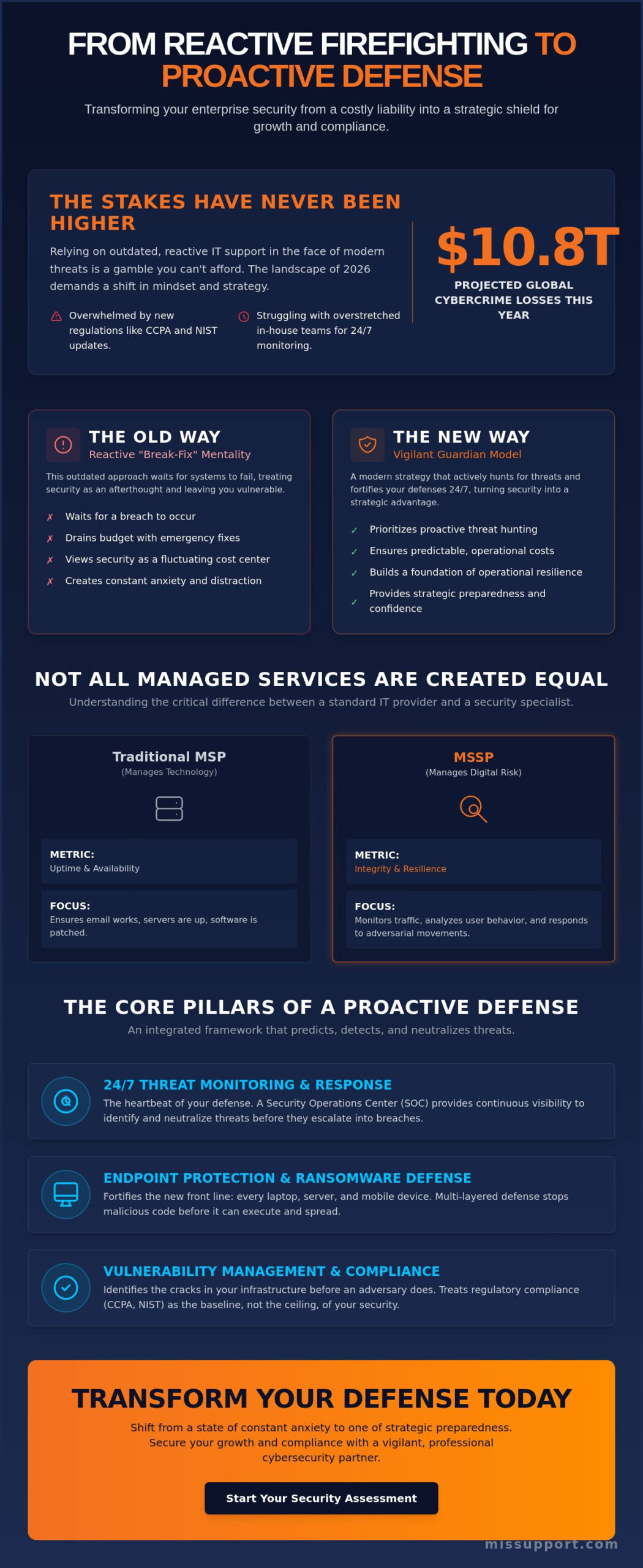
Traditional Managed Service Providers (MSPs) focus on availability. They ensure your email works, your servers stay up, and your software is patched. Their metric is uptime. Managed Security Service Providers (MSSPs) focus on integrity. They monitor traffic patterns, analyze user behavior, and respond to adversarial movements. The shift is clear: MSPs manage technology, while MSSPs manage digital risk. The MSSP serves as a strategic shield for national enterprises, safeguarding the integrity of digital infrastructure against sophisticated global threats. This distinction is critical for leaders who need more than just a functioning network; they need a resilient one. To see how different defense models compare in practice, our strategic comparison of managed security services defense models in 2026 breaks down the key differences that determine whether your organization is truly protected.
The Business Case for Outsourced Vigilance
Building an in-house Security Operations Center (SOC) is often cost-prohibitive. The talent gap for qualified security analysts remains wide, making recruitment and retention a constant struggle. Beyond the personnel costs, there is the 24/7 reality of the threat landscape. Hackers don’t work 9-to-5. They exploit the quiet hours of the night and the distractions of holiday weekends. Outsourcing your vigilance ensures that your defense is always “on.”
- Expertise on Demand: Access specialized knowledge in threat hunting and incident response without the overhead of a full-time executive team.
- Enterprise-Grade Tools: Leverage advanced technology like Microsoft Defender XDR to gain deep visibility across identities, endpoints, and cloud apps.
- Operational Peace of Mind: Transfer the burden of constant monitoring to a partner that is disciplined, tireless, and battle-hardened.
By integrating managed cybersecurity services, you aren’t just buying software. You’re securing a partnership that acts as a protective force, allowing your internal teams to focus on innovation while we focus on the frontline.
This commitment to specialized protection is a principle shared by experts in other fields, such as Indiana Home Safety & Mobility, which focuses on enhancing physical safety and accessibility for residential and commercial properties.
The Core Pillars of a Proactive Defense Strategy
Defense isn’t a static wall. It’s a living system. Effective managed cybersecurity services require a synchronized framework that operates in unison to predict, detect, and neutralize threats. While many firms view security as a series of disconnected software licenses, true resilience comes from an integrated strategy. This approach transforms your security posture from a reactive burden into a battle-hardened shield.
24/7 Threat Monitoring and Response serves as the heartbeat of this system. It centralizes data within a Security Operations Center (SOC) to identify threats before they escalate into full-scale breaches. According to Gartner’s Market Guide for Managed Security Services, the ability to provide continuous visibility across hybrid environments is a defining trait of modern security leaders. Without this constant oversight, your organization remains blind to the subtle movements of sophisticated adversaries.
Endpoint Protection and Ransomware Defense fortify the individual devices that now act as your network’s front line. In a world of remote work and mobile access, the perimeter has shifted to the device in your hand. Vulnerability Management ensures you identify the cracks in your infrastructure before an adversary does. It’s about remediation, not just reporting. Finally, Security Awareness Training hardens the human element. Your employees shouldn’t be your weakest link. They should be your first line of alert, trained to recognize and report threats in real time.
Managed Detection and Response (MDR)
MDR goes beyond passive alerts. It’s an active hunt. By utilizing Security Information and Event Management (SIEM), analysts gain a holistic view of your digital footprint. This allows for the correlation of data from disparate sources to spot complex attack patterns that individual tools might miss. You can explore how this proactive oversight works in our Managed Detection and Response Guide. It’s the difference between hearing an alarm and having a team already on-site to stop the intruder.
Penetration Testing and Gap Assessments
Regular “war games” are the only way to validate your defenses. Automated scans are useful, but they don’t think like a human attacker. Expert penetration testing uncovers the creative paths hackers use to bypass traditional controls. Pairing these tests with Penetration Testing Pillar insights provides a clear roadmap for fortification. If you’re unsure where your current defenses stand, a Network Security Audit is the logical first step toward clarity. It identifies exactly where your shield is thin before it’s put to the ultimate test.
Evaluating Managed Security Service Providers vs. Standard MSPs
Standard IT support and specialized security are two different disciplines. While your Managed Service Provider (MSP) ensures your network is functional, they are often not equipped to handle the high-stakes pressure of a sophisticated cyberattack. There is also an inherent conflict of interest. An IT provider should not always grade their own security homework. If their configuration error leads to a vulnerability, they have little incentive to highlight that risk during a routine audit. True defense requires an objective, third-party perspective.
Depth of expertise is the primary differentiator. General IT teams excel at maintaining uptime and resolving user issues. However, managed cybersecurity services demand specialized certifications and deep forensic knowledge. Think of it as the difference between a general practitioner and a trauma surgeon. When a ransomware incident occurs, you don’t need someone who can fix a printer; you need a specialist who can isolate a threat and preserve forensic evidence under fire. Understanding how to vet providers on these criteria is precisely what our guide to selecting secure managed IT services aligned with NIST CSF 2.0 standards was designed to help you do.
Response times and Service Level Agreements (SLAs) must reflect the 24/7 nature of modern risk. Ask what happens at 3:00 AM on a Sunday. A standard MSP might have an on-call technician, but a dedicated security partner provides a fully staffed Security Operations Center (SOC) ready to initiate incident response protocols immediately. This level of readiness transforms your security posture from a best-effort attempt into a guaranteed shield. Before committing to any provider, reviewing a comprehensive comparison of managed security services and their defense models will help you ask the right questions and identify which approach best fits your organization’s risk profile.
The Role of the Virtual CISO (vCISO)
Strategic oversight is often the missing piece in enterprise defense. National organizations require executive-level security leadership, but hiring a full-time Chief Information Security Officer (CISO) is often cost-prohibitive. Virtual CISO services bridge this gap. They act as the strategic architect of your security roadmap, translating technical risks into boardroom priorities. A vCISO ensures your defenses align with business goals, providing high-level guidance without the burden of a full-time executive salary.
Key Questions to Ask a Potential Cybersecurity Partner
Don’t settle for vague promises. Demand transparency. A reliable partner should be able to provide clear answers regarding their operational structure and history of success. Use these questions to vet your next guardian:
- Where is your SOC located? Ensure they have a dedicated, staffed center that operates 24/7/365.
- What is your specific protocol for ransomware? They should have a documented, step-by-step incident response plan ready for immediate execution.
- Which regulatory frameworks do you support? Verify their experience with the NIST SP 800-172 Revision 3 updates and the 2026 CCPA requirements.
- How do you handle threat hunting? Distinguish between those who wait for alerts and those who proactively search for anomalies.
Choosing the right partner is a decisive move. It’s the difference between hoping you’re secure and knowing you are. By prioritizing specialized expertise and strategic leadership, you secure your organization’s future in an increasingly volatile digital landscape.
Bridging the Gap Between Regulatory Compliance and Operational Risk
Compliance is a safety rail. It isn’t the shield itself. Many organizations fall into the trap of believing that checking a box for an auditor means their data is safe. In reality, being compliant only means you’ve met a minimum legal standard. It doesn’t mean you’re secure against a determined adversary. By integrating managed cybersecurity services, you move beyond mere checkboxes to build a resilient infrastructure that survives real-world pressure. This strategic shift transforms compliance from a bureaucratic burden into a byproduct of superior security.
The landscape of 2026 is defined by intense regulatory scrutiny. New requirements for the CCPA took effect this year, introducing mandatory cyber-risk audits and stricter rules for sensitive data consent. Additionally, the NIST SP 800-172 Revision 3 update, released on May 13, 2026, has fundamentally shifted the focus toward cyber resiliency and supply chain security. Navigating these evolving laws requires a partner who understands that risk management is about prioritizing threats based on business impact, not just technical severity. We help you simplify the audit process, reduce liability, and maintain a posture of constant readiness. Reviewing the latest cybersecurity best practices for 2026 is an essential step in ensuring your compliance strategy reflects the full scope of today’s threat landscape.
NIST and SOC2 Frameworks: The Gold Standards
These frameworks act as the blueprints for your digital fortress. They provide the roadmap for structural integrity by defining clear controls for access management and network segmentation. Conducting regular Cybersecurity Gap Assessments is the only way to identify where your current posture falls short of these national standards. Compliance is an ongoing process of vigilance, not a one-time event. It requires a disciplined cycle of assessment, remediation, and monitoring to ensure your defenses remain impenetrable as threats evolve.
Disaster Recovery and Business Continuity
A backup is just data on a shelf. It’s useless without a proven recovery plan. In the event of a breach, every second of downtime translates to lost revenue and eroded trust. Our “Vigilant Guardian” approach focuses on minimizing that window. We integrate security into the very fabric of your business operations, ensuring that your disaster recovery protocols are tested, documented, and ready for immediate execution. This level of preparation ensures that even if a crisis occurs, your organization remains operational and resilient.
Don’t leave your regulatory standing to chance. Align your compliance with actual operational risk by scheduling a Cybersecurity Gap Assessment today to identify and close your most critical vulnerabilities.
Transitioning to a Managed Cybersecurity Model: Your Implementation Roadmap
Moving from a reactive posture to a proactive defense isn’t an overnight change. It’s a strategic migration. While many organizations feel overwhelmed by the complexity of modern threats, a structured implementation roadmap provides the clarity needed to build a resilient shield. This transition replaces fragmented tools with a cohesive, battle-hardened strategy. By integrating managed cybersecurity services, you ensure that every digital asset is accounted for, monitored, and defended.
A successful implementation follows a disciplined, logical progression. It moves from the identification of risk to the active maintenance of safety. Follow these five steps to secure your enterprise:
- Step 1: Conduct a Comprehensive Security Assessment. You can’t defend what you don’t see. This phase identifies immediate vulnerabilities, hidden backdoors, and configuration gaps within your current infrastructure.
- Step 2: Establish a Strategic Roadmap with your vCISO. Security must align with business goals. Your virtual CISO services partner acts as the architect, ensuring your defense budget is spent where it has the most significant impact on resilience.
- Step 3: Deploy Advanced Monitoring and Endpoint Protection. Fortify the perimeter. This step involves rolling out enterprise-grade tools across the entire network to secure every device and user identity.
- Step 4: Implement 24/7 SOC Oversight. True protection is tireless. By activating continuous monitoring, you ensure that anomalies are detected and neutralized in real time, regardless of the hour.
- Step 5: Continuously Refine and Test. The threat landscape never stands still. Regular penetration testing and audits keep your defenses sharp and your compliance standing intact.
Why M.I.S. Support is the Battle-Hardened Choice
We don’t just provide software. We act as a protective force that is always “on.” Our approach focuses on the pillars of modern business stability: 24/7 threat monitoring and proactive response. We specialize in Microsoft 365 security and cloud resilience, ensuring your most critical data remains accessible to you and invisible to adversaries. M.I.S. Support is the vigilant guardian your organization needs to maintain operational integrity in a volatile world. We take the burden of risk off your shoulders, allowing you to focus on growth while we focus on the frontline.
Taking the First Step Toward Resilience
The “it won’t happen to us” mindset is the precursor to a breach. In 2026, the question isn’t if an attack will occur, but how prepared you’ll be when it does. Delaying your defense only gives adversaries more time to find the cracks in your foundation. This principle applies to any critical asset; just as a thorough home inspection Indianapolis is essential to verify the integrity of a physical building, a digital assessment is critical to verify your network’s resilience. You don’t need to overhaul everything at once. Start with a low-friction Security Gap Assessment to gain immediate clarity on your risk profile. It’s time to stop reacting to threats and start commanding your digital environment.
Secure your organization with a Managed Cybersecurity partnership today.
Fortify Your Foundation for Lasting Resilience
Resilience is not a destination. It’s a state of constant readiness. You’ve seen how a proactive defense strategy replaces anxiety with action. By prioritizing specialized managed cybersecurity services, you move beyond basic IT maintenance. You gain a partner that understands the high stakes of 2026. This means shifting from simple compliance to true operational risk management. It means securing your endpoints, hardening your human firewall, and ensuring your roadmap is guided by executive-level strategy.
Stop waiting for the next alert. Take command of your digital environment now. Partner with the Vigilant Guardians at M.I.S. Support to Secure Your Growth. Our team provides 24/7 Threat Monitoring & Response, Virtual CISO Strategic Consulting, and Expert Penetration Testing & Risk Assessments. We act as your tireless protective force, shielding your stability while you focus on innovation. You don’t have to face the landscape of risk alone. Secure your legacy and lead your industry with confidence.
Frequently Asked Questions
What are managed cybersecurity services and how do they differ from IT support?
Managed cybersecurity services provide proactive, specialized defense focused on threat detection and risk mitigation. While standard IT support ensures your systems are operational and patched, cybersecurity services use a “vigilant guardian” approach to hunt for adversaries. This involves continuous monitoring and rapid incident response rather than just fixing hardware or software issues. It’s the difference between maintaining a building and employing an elite security force to protect its contents.
Is it better to have in-house cybersecurity or use a managed service provider?
For most organizations, partnering with a provider is more effective due to the severe cybersecurity talent gap. Building a 24/7 in-house Security Operations Center (SOC) requires significant capital and a team of specialists that are difficult to recruit and retain. A managed provider offers immediate access to battle-hardened strategists and enterprise-grade tools. This ensures your defense is always “on,” providing a level of vigilance that few internal teams can sustain alone.
How much do managed cybersecurity services typically cost for a mid-sized business?
Costs for these services vary based on the size of your network, the number of users, and the depth of required compliance oversight. Most providers utilize a predictable monthly model that allows for better budget planning compared to the fluctuating costs of reactive firefighting. While specific rates depend on your unique risk profile, investing in managed cybersecurity services is a strategic move that typically reduces the total cost of digital risk and potential breach recovery.
What is the difference between an MSP and an MSSP?
The primary difference lies in the objective: MSPs manage technology availability, while MSSPs manage digital integrity and risk. An MSP focuses on uptime, helpdesk support, and general network health. An MSSP focuses on threat hunting, vulnerability management, and incident response. While an MSP keeps your lights on, an MSSP ensures no one is lurking in the shadows to turn them off or steal your data.
Can managed cybersecurity services help my business meet NIST or HIPAA compliance?
Yes, these services are designed to bridge the gap between technical reality and regulatory requirements like NIST SP 800-172 or HIPAA. We use Cybersecurity Gap Assessments to identify exactly where your current posture fails to meet national standards. By implementing continuous monitoring and documented risk management, we help you simplify the audit process. We ensure your compliance is a byproduct of superior security rather than a stressful, one-time annual event.
What happens if our business experiences a cyberattack while under managed protection?
Immediate incident response protocols are activated to isolate the threat and minimize operational impact. Our team works to contain the breach, preserve forensic evidence, and initiate disaster recovery plans to restore business continuity. We don’t just alert you to the problem; we act as a decisive force to neutralize the adversary. This rapid intervention is critical for reducing the duration of an attack and protecting your reputation.
How does 24/7 threat monitoring actually work in practice?
It works by centralizing data from your entire network into a Security Operations Center for real-time analysis. We use SIEM technology to correlate events from endpoints, cloud environments, and firewalls to spot anomalies. When a suspicious pattern is detected, our analysts investigate immediately to determine if it’s a false alarm or a legitimate threat. This tireless oversight ensures that adversarial movements are identified before they can escalate into a full-scale crisis.
Do I still need cyber insurance if I have managed cybersecurity services?
Yes, cyber insurance and managed cybersecurity services work together to provide a holistic risk management strategy. While security services act as your primary shield to prevent and mitigate attacks, insurance provides a financial safety net for residual risk. In fact, many insurance carriers now require proof of 24/7 monitoring and endpoint protection before they will issue a policy. Having professional oversight often makes your organization more insurable and can lead to more favorable terms.