
By the end of 2026, global cybercrime costs will reach a staggering $10.5 trillion. You likely feel the weight of this reality every time a new security alert hits your inbox without a clear priority. It’s exhausting to manage a flood of data while worrying about hidden weaknesses in your hybrid cloud or the pressure of SOC2 compliance. Understanding what is a vulnerability assessment is no longer a luxury for IT teams; it’s the foundation of a proactive defense. This process allows you to identify, prioritize, and neutralize the cracks in your digital armor before an adversary can exploit them.
We understand that technical jargon often obscures the true level of risk your business faces. This guide will help you master the fundamentals of vulnerability assessments and learn how to transform raw technical data into a resilient, battle-hardened security posture. You’ll gain a clear roadmap for remediating gaps, a strategy for communicating risk to non-technical stakeholders, and a method to align your security tools with your core business objectives. We’ll move through the identification of threats, the assessment of impact, and the implementation of safety. It’s time to turn your anxiety into strategic preparedness.
Key Takeaways
- Define what is a vulnerability assessment as a proactive intelligence tool rather than a passive checklist to secure your digital perimeter.
- Implement a modern framework that maps every server, endpoint, and cloud instance to ensure no asset remains hidden or unprotected.
- Reduce your attack surface by applying strategic prioritization to technical findings, preventing your IT staff from being overwhelmed by alert volume.
- Bridge the communication gap with non-technical stakeholders by translating complex digital vulnerabilities into clear, actionable business risks.
- Build a resilient security posture that aligns your technical tools with high-level business goals and strict regulatory compliance.
Defining the Vulnerability Assessment: The Foundation of Strategic Defense
Security is not a static state. It is a process of constant refinement and vigilance. Legacy security often relies on passive defense, waiting for a perimeter alarm to sound before reacting. In contrast, a formal vulnerability assessment provides the active intelligence needed to stay ahead of threats. It is the systematic identification, evaluation, and prioritization of security gaps within your digital perimeter. This diagnostic process identifies flaws in software, hardware, and networks before attackers can exploit them. By treating this process as a structural blueprint for your cybersecurity resilience, you move from a state of reactive anxiety to one of strategic preparedness.
Vulnerability Assessment vs. Penetration Testing
Understanding the distinction between these two services is vital for strategic oversight. An assessment identifies the “what” and “where” of your weaknesses. It is comprehensive, broad, and methodical. Conversely, penetration testing explores the “how far” an attacker could go once inside. Consider the metaphor of a home security audit versus a hired burglar. The audit checks every window lock, door hinge, and alarm sensor to ensure they are functional. The burglar tries to break in to see if those weaknesses actually grant access to the vault. You need the audit first to build the defense. A Vulnerability assessment ensures no stone is left unturned.
The Cost of Invisibility: Why Scanning is Not Enough
Automation is a tool, not a strategy. Many organizations fall into the trap of running basic automated scans and assuming they are protected. These tools often lack the context of your specific business environment. They generate noise without providing clarity. Without expert analysis, you are left with a list of thousands of alerts and no clear path forward. This is where managed cybersecurity services provide the necessary layer of professional oversight. We transform raw data into a tactical plan. This ensures your team focuses on the vulnerabilities that pose the greatest risk to your operations, compliance, and reputation. Knowing what is a vulnerability assessment in a strategic context allows you to see the threats that others miss.
The 2026 Assessment Framework: Identifying and Evaluating Risk
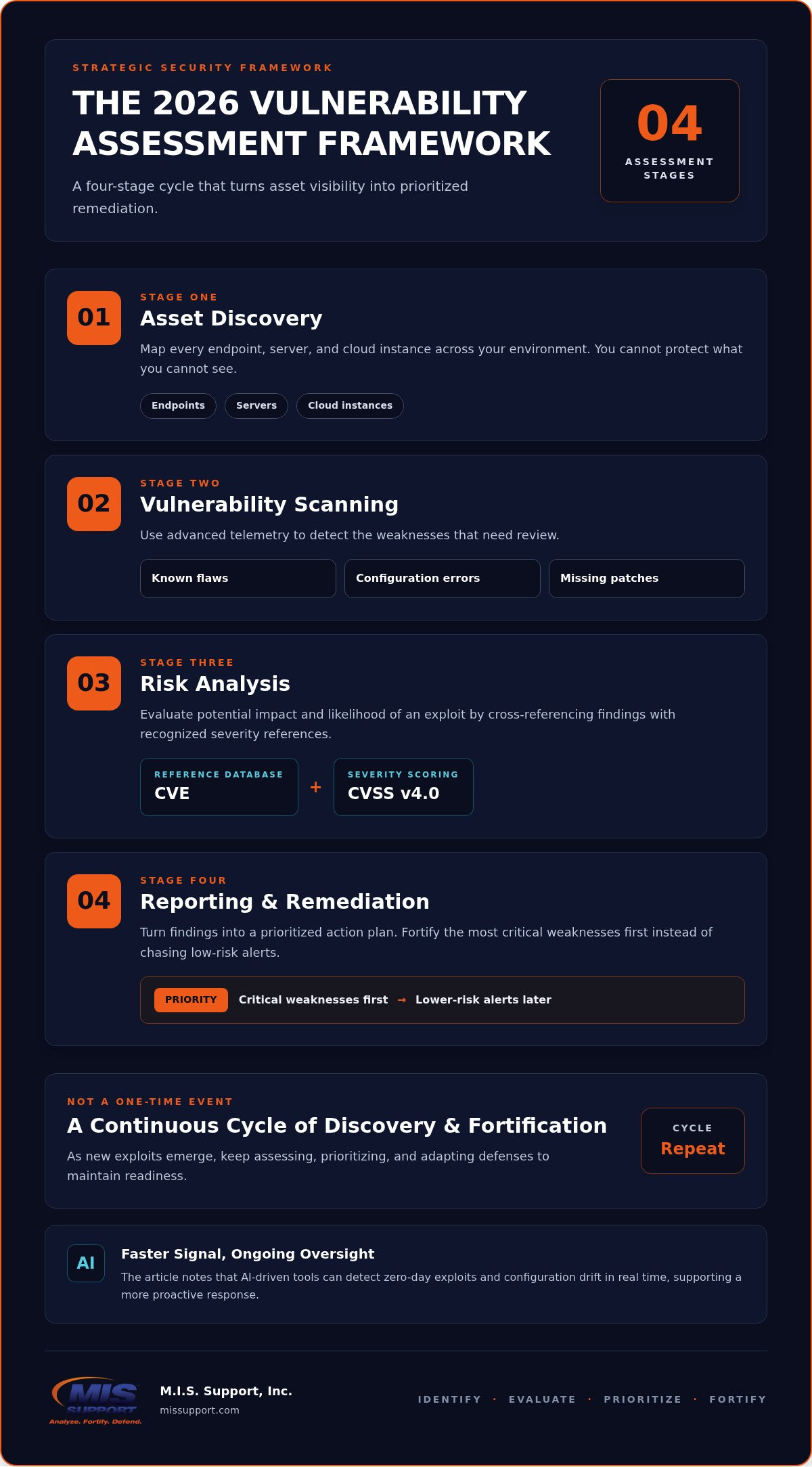
To fully grasp what is a vulnerability assessment, you must see it as a four-stage operation. It is not a one-time event; it is a continuous cycle of discovery and fortification. This framework transforms raw telemetry into strategic intelligence, allowing you to stay ahead of adversaries who are constantly probing for a way in. A disciplined approach ensures that no asset is left unmonitored and no flaw remains unaddressed. The process follows a logical, methodical path:
- Step 1: Asset Discovery. We map every endpoint, server, and cloud instance across the national network. You cannot protect what you cannot see.
- Step 2: Vulnerability Scanning. We utilize advanced telemetry to detect known flaws, configuration errors, and missing patches.
- Step 3: Risk Analysis. We determine the potential impact and likelihood of an exploit by cross-referencing findings with the CVE database and CVSS v4.0 scores.
- Step 4: Reporting and Remediation. We deliver a prioritized action plan. This ensures your team fortifies the most critical weaknesses first, rather than chasing low-risk alerts.
Types of Assessments for Modern Enterprises
The Role of CVSS in Prioritizing Your Defense
The Common Vulnerability Scoring System (CVSS) provides a standardized language for threat severity. In 2026, the integration of AI in cybersecurity is accelerating this process. AI-driven tools now detect zero-day exploits and configuration drifts in real-time, allowing for faster response than ever before. This intelligence ensures your defense is proactive, not reactive. If you’re ready to secure your perimeter, a professional vulnerability assessment is the first step toward total strategic oversight.
Beyond the Report: Transforming Findings into Operational Resilience
A stack of technical reports often leads to administrative paralysis. The most frequent objection we encounter is that there are too many findings and not enough time to fix them. Strategic prioritization solves this. By focusing on the vulnerabilities that actually threaten your critical operations, you reduce your attack surface without exhausting your IT staff. Professional oversight transforms a technical document into a business-wide security strategy. Understanding what is a vulnerability assessment is the first step, but executing the remediation is where resilience is born. For development teams tackling application-level flaws, specialized engineering partners like The Code Factory provide production readiness reviews and code remediation to turn assessment findings into secure, resilient systems.
Static reports are snapshots of a single moment in time. However, the threat landscape is fluid, evolving, and relentless. A continuous assessment cycle ensures that as new exploits emerge, your defenses adapt accordingly. This methodical approach moves your organization away from “check-the-box” security and toward a state of constant readiness. It allows your leadership to make informed decisions based on real-world risk rather than technical guesswork. Identify. Prioritize. Fortify. This is the path to stability. To help maintain this level of readiness, you can learn more about Proactive Networking Ltd and their tailored IT support for small and medium-sized businesses.
Managed Detection and Response: The Vigilant Guardian
A one-time assessment is only the beginning of a secure posture. To maintain a battle-hardened defense, you need a partner that remains observant and decisive. Our managed detection and response services provide the 24/7 oversight required to catch anomalies that automated scans might miss. We act as a protective force that is always on, ensuring your business remains unphased by digital threats. We don’t just identify the gaps; we stand guard over them.
Compliance and Business Stability
Regular assessments are a mandatory pillar for meeting strict compliance standards. Whether you’re navigating the requirements for SOC2, HIPAA, or PCI-DSS, knowing what is a vulnerability assessment in the context of your specific industry is vital. These audits prove to stakeholders that you are a reliable shield for their data. As a necessary companion to this proactive risk management, we recommend integrating cybersecurity incident response services. This ensures that if a breach is attempted, your team is disciplined, knowledgeable, and ready to act. Safety is not an accident; it is the result of strategic oversight.
Fortify Your Digital Perimeter for the Future
Security is a discipline of constant evolution. You now understand that what is a vulnerability assessment goes beyond a simple scan; it’s the active intelligence that fuels your entire defense strategy. By implementing a framework of asset discovery and risk analysis, you transform hidden weaknesses into a prioritized roadmap for remediation. This transition from reactive anxiety to strategic oversight is what separates stable enterprises from vulnerable targets. You don’t have to manage this burden alone.
Since 1998, M.I.S. Support, Inc. has acted as a vigilant guardian for businesses navigating the complex landscape of digital risk. We provide the expert Virtual CISO leadership and 24/7 Threat Monitoring & Response needed to keep your operations resilient. It’s time to turn your technical findings into a battle-hardened posture that protects your reputation and your bottom line. Secure Your Infrastructure with M.I.S. Support, Inc.’s Strategic Assessments. Build your defense on a foundation of experience and precision. You are ready to lead with confidence.
Frequently Asked Questions
How is a vulnerability assessment different from a penetration test?
A vulnerability assessment is a broad, diagnostic scan designed to identify and prioritize security gaps across your entire network. It provides a comprehensive inventory of “what” and “where” your weaknesses are. In contrast, a penetration testing strategy is a targeted, simulated attack that tests “how far” an adversary can go by exploiting those gaps. Think of the assessment as a thorough home security audit, while the pen test is a hired professional testing the strength of your locks. Both are necessary to build a battle-hardened defense.
How often should my organization conduct a vulnerability assessment in 2026?
You should conduct these assessments at least quarterly to maintain a resilient and observant security posture. In 2026, the speed of AI-driven exploits makes annual scanning a dangerous relic of the past. You must also trigger a new assessment after any significant network change, cloud migration, or software update. Continuous monitoring is the gold standard for organizations that require tireless protection against evolving threats. Stability depends on your ability to stay ahead of the landscape of risk.
What is the difference between an internal and external vulnerability assessment?
An external assessment scans your internet-facing perimeter to find flaws that remote attackers could exploit to gain entry. Internal assessments focus on the environment inside your firewall, identifying risks related to lateral movement and insider threats. A complete strategy requires both to ensure the total structural integrity of your digital assets. One guards the gates, while the other monitors the halls. Together, they provide a holistic shield for your sensitive data and critical operations.
Does a vulnerability assessment fulfill regulatory compliance requirements?
Yes, regular assessments are a mandatory requirement for maintaining compliance with standards like SOC2, HIPAA, and PCI-DSS. These frameworks demand that you proactively identify, evaluate, and remediate risks to prove you are a reliable guardian of data. Understanding what is a vulnerability assessment within your specific industry allows you to transform a legal obligation into a strategic business advantage. It provides the documented proof of due diligence that auditors and stakeholders require for trust.
What are the most common vulnerabilities found during an assessment?
The most frequent findings include unpatched software, misconfigured cloud settings, and weak authentication protocols. Outdated applications often harbor known flaws that adversaries exploit using automated tools. Misconfigurations in hybrid environments can create accidental backdoors that bypass your primary defenses. Identifying these cracks early allows you to fortify your perimeter, update your systems, and neutralize threats before they result in a breach. Vigilance is the only cure for invisibility.
What happens after a vulnerability assessment is completed?
After the assessment, you must prioritize the findings based on their severity and the potential impact on your business. You then follow a methodical roadmap to patch software, harden configurations, and fortify your defenses. Finally, you should conduct a follow-up scan to verify that the remediation was successful and that no new gaps were created. This disciplined cycle of action ensures your security posture remains proactive, decisive, and ready for any challenge. It turns a technical report into operational resilience.