
If you’re weighing huntress alternatives for complete managed cybersecurity, start by looking beyond endpoint features. A compromised account, an exposed cloud environment, or an untested recovery plan can create risks that device protection alone may not address. The right fit depends on which systems and risks need coverage, who monitors them, and who takes responsibility when an alert requires action.
The key difference is what each option delivers: a product, a managed service, or both. This comparison looks at coverage, response ownership, and strategic support so you can match protection to your risks without adding tools your team must manage alone. You’ll see where endpoint-focused platforms fit, where broader services address connected gaps, and how M.I.S. Support, Inc.’s managed cybersecurity approach brings monitoring and response together with assessments, Microsoft 365 security, recovery planning, and virtual CISO support.
Key Takeaways
- Compare alternatives by who monitors threats, owns response, and supports recovery, not just by endpoint features.
- Use huntress alternatives for complete managed cybersecurity to distinguish endpoint products from managed detection services and broader security partnerships.
- Map your exposures across identity, cloud, compliance, and recovery before deciding what coverage to add.
- See how monitoring, assessments, Microsoft 365 security, and virtual CISO support can help close connected security gaps.
Huntress alternatives: when endpoint protection is not the whole answer
A Huntress alternative might be another endpoint product, a managed detection service, or a broader security operating model that combines technology with ongoing oversight. The distinction matters. Endpoint detection can help identify suspicious activity on devices, but it doesn’t automatically cover every business risk or assign someone to coordinate what happens next.
Endpoint protection defends devices; MDR adds active monitoring and response; managed cybersecurity connects those defenses to risk management, recovery, and business priorities. That’s the lens to use when comparing huntress alternatives for complete managed cybersecurity. A feature checklist alone won’t show who reviews alerts, what actions they can take, or how identified gaps are addressed.
What does complete managed cybersecurity cover?
A complete approach links capabilities that are often treated separately: threat monitoring, endpoint defense, incident response, risk assessment, and recovery planning. Managed detection and response (MDR) describes a service model centered on monitoring and responding to threats; broader managed cybersecurity can also connect that response to assessments, compliance and risk management, and business continuity.
Tools provide visibility and controls. Human oversight turns signals into decisions, while clear service ownership helps ensure incidents are handled and lessons inform future defenses. For example, a dashboard may flag suspicious activity, but your response plan should also specify who investigates it, who can isolate an affected device, and who communicates with the people responsible for business operations.
For a fuller overview of how these capabilities work together, explore managed cybersecurity services. M.I.S. Support, Inc. brings monitoring and response together with endpoint protection, cybersecurity assessments, Microsoft 365 security, compliance and risk management, and disaster recovery planning. Virtual CISO support can also connect security activity with business priorities. The goal is coordinated coverage with clear accountability, not simply more tools.
Compare Huntress alternatives by coverage, response, and accountability
Compare the operating model, not just the feature list. Compare who acts on alerts, not only which tool generates them. Use the table to identify the typical differences, then confirm that the defined service scope matches the systems and responsibilities your organization needs covered.
| Model | Scope | Monitoring and response | Assessment, compliance, and recovery |
|---|---|---|---|
| Endpoint platform | Device-focused protection and detection | Your team or IT partner operates alerts unless managed response is included | Usually separate capabilities |
| MDR service | Managed detection across a defined set of systems and signals | Provider monitors and responds within the agreed scope | May be separate or limited |
| Broader managed cybersecurity partner | Connected security and resilience needs | Provider-led monitoring and response, with responsibilities defined | Can include assessments, compliance support, and recovery planning |
| M.I.S. Support, Inc. | Managed cybersecurity spanning endpoint defense and related business risks | 24/7 threat monitoring and response | Assessments, compliance and risk management, and disaster recovery planning |
Gartner defines managed detection and response as a service category centered on monitoring and response. Use that distinction to assess whether an option handles detection only, managed response within a set scope, or wider security and resilience responsibilities. For huntress alternatives for complete managed cybersecurity, the difference between those models can matter more than the number of features.
Which alternative model fits your organization?
An endpoint platform fits teams with the capacity to configure it, review alerts, and coordinate action. MDR fits organizations seeking provider-led detection and response for defined systems. A broader managed cybersecurity partner suits businesses that also need oversight across assessments, compliance, identity, and recovery. When comparing options, list the systems in scope, the actions the provider takes, and the responsibilities that remain with your team. M.I.S. Support, Inc. connects these needs through managed cybersecurity and strategic support. Explore managed cybersecurity support as you map coverage to your risks.
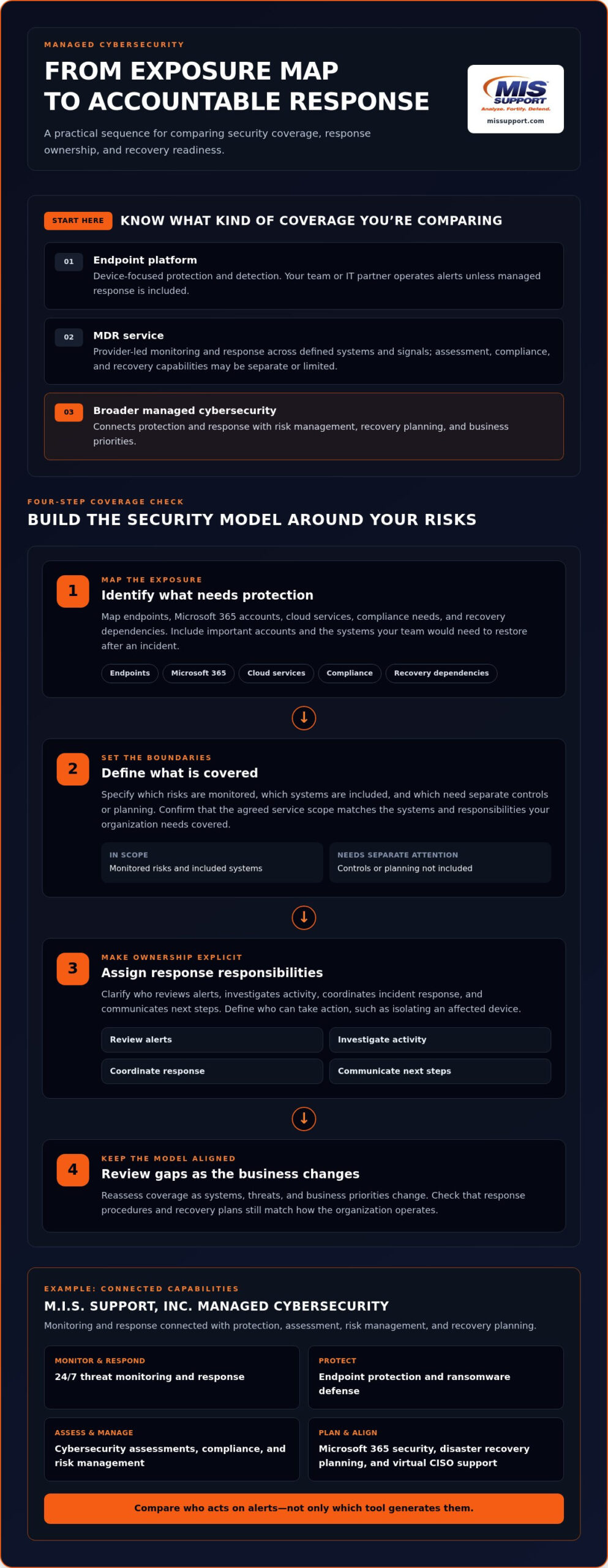
Choose a complete managed cybersecurity partner that closes the gaps
A stronger security model starts with ownership, not another layer of software. Use this sequence to test whether a Huntress alternative fits your business:
- Identify exposures: Map endpoints, Microsoft 365 accounts, cloud services, compliance needs, and recovery dependencies. Include important accounts and the systems your team would need to restore after an incident.
- Define coverage: Specify which risks are monitored, which systems are included, and which require separate controls or planning.
- Assign response ownership: Clarify who reviews alerts, investigates activity, coordinates incident response, and communicates next steps.
- Review gaps: Reassess coverage as systems, threats, and business priorities change. Check whether response procedures and recovery plans still match how the organization operates.
This makes it easier to evaluate huntress alternatives for complete managed cybersecurity based on the risks your organization needs to manage, rather than a feature checklist alone.
How M.I.S. Support connects protection with resilience
M.I.S. Support, Inc. brings 24/7 threat monitoring and response together with endpoint protection and ransomware defense. Cybersecurity gap assessments and vulnerability assessments help identify weaknesses, while internal and external penetration testing can examine defenses from different angles. Compliance and risk management, Microsoft 365 security, and disaster recovery planning connect technical controls to operational resilience.
Strategic oversight matters, too. Virtual CISO services help align security priorities with business needs. For a deeper look at that role, explore guidance on virtual CISO services and vulnerability assessments as part of your evaluation.
Use your exposure map and response-ownership plan to identify where monitoring, assessment, or recovery planning can strengthen your defenses.
Choose coverage that holds up beyond the endpoint
The right security approach depends on more than endpoint features. Compare who monitors alerts, owns response, assesses risk, and supports recovery. A tool may strengthen device defenses, while a broader managed service can connect protection with oversight across business risks.
Use that distinction to assess huntress alternatives for complete managed cybersecurity. Look for coverage that matches your exposure and gives your team clear response ownership, rather than adding tools no one has capacity to manage.
Founded in 1998, M.I.S. Support combines 24/7 threat monitoring and response with assessments, compliance and risk management, Microsoft 365 security, and recovery planning. These services connect day-to-day defense with preparedness and resilience.
Ready to identify your coverage gaps? Discuss complete managed cybersecurity coverage with M.I.S. Support. A clearer view of risk is a practical first step toward stronger, more coordinated protection.
Frequently Asked Questions
Is Huntress enough for complete managed cybersecurity?
Whether Huntress is enough depends on your organization’s required scope and how security responsibilities are assigned. Endpoint-focused protection addresses device-related risks, while broader needs may include risk assessments, compliance support, Microsoft 365 security, and recovery planning. Compare the services included and who investigates alerts, coordinates response, and manages each responsibility before deciding whether coverage fits.
What should I compare when evaluating Huntress alternatives?
Compare the environments covered, monitoring hours, and who investigates and responds to alerts. Then review assessment capabilities, compliance support, recovery planning, and strategic oversight. For huntress alternatives for complete managed cybersecurity, documented scope and clear responsibility matter more than a long feature list. Check how the service connects its tools and people to your business risks and response needs.
Can a managed cybersecurity service replace endpoint protection software?
Not necessarily, because managed services and endpoint tools serve related but different roles. Endpoint protection is a technical control on devices; a managed provider may oversee security technologies, monitor alerts, and coordinate response within its defined service scope. Some managed arrangements include endpoint protection, while others work with existing tools. Compare the stated coverage and operating model to understand how the parts fit together.
How do I know whether my business needs MDR or broader managed cybersecurity?
Assess your internal security capacity, monitoring and response needs, cloud and identity exposure, compliance requirements, and recovery readiness. MDR centers on detecting and responding to threats within a defined scope. Broader managed cybersecurity can also connect that work with assessments, risk management, Microsoft 365 security, and recovery planning. Choose the model that closes your priority gaps and gives each response responsibility a clear owner.