
What if your security program meets a framework on paper but still leaves critical business risks exposed? A cybersecurity gap analysis compares documented requirements with the protections your organization can demonstrate in practice. The challenge is real: frameworks, business risks, and technical controls don’t always line up neatly. And a list of findings won’t strengthen defenses unless someone owns the next steps.
You need a clear way to define what to review, identify evidence for each control, and decide which gaps need attention first. This guide explains how to scope an assessment, compare current safeguards with relevant requirements, and prioritize findings by risk. You’ll also learn how to assign owners and track improvements so the analysis becomes an accountable protection plan, not just another report.
Key Takeaways
- Use a cybersecurity gap analysis to compare current policies, controls, and evidence with requirements relevant to your business risks and obligations.
- Set a clear scope, then review records and safeguards to validate where protection falls short.
- Rank confirmed gaps by business risk and assign owners so findings become trackable corrective actions.
- Make improvements with support that complements your existing IT team, including Hackify’s automated, continuous monitoring and compliance-ready reporting.
What a cybersecurity gap analysis reveals about your current defenses
A cybersecurity gap analysis compares your organization’s policies, controls, and evidence with selected security requirements. It shows where protections align, where they fall short, and what needs attention to reduce business risk. It’s a structured review, not a verdict on the people managing your systems. The broader discipline of Information security provides context for protecting information and the systems that handle it.
Set the boundaries around your actual environment: business-critical operations, devices and cloud services, sensitive information, third-party connections, and applicable obligations. Then match the review to your starting point. If you have established policies, test whether controls work in practice. If you’re building a security program, document essential safeguards first and identify where evidence is missing.
Which security requirements should shape the analysis?
A cybersecurity gap analysis compares documented and operating safeguards with relevant security requirements so you can identify and prioritize the differences that matter to your organization. Choose a reference based on your obligations and objectives, rather than trying to assess every available framework. CIS or NIST can help structure security practices. HIPAA, CMMC, FedRAMP, DFARS, or SOC 2 may apply to particular organizations, contracts, or customer expectations.
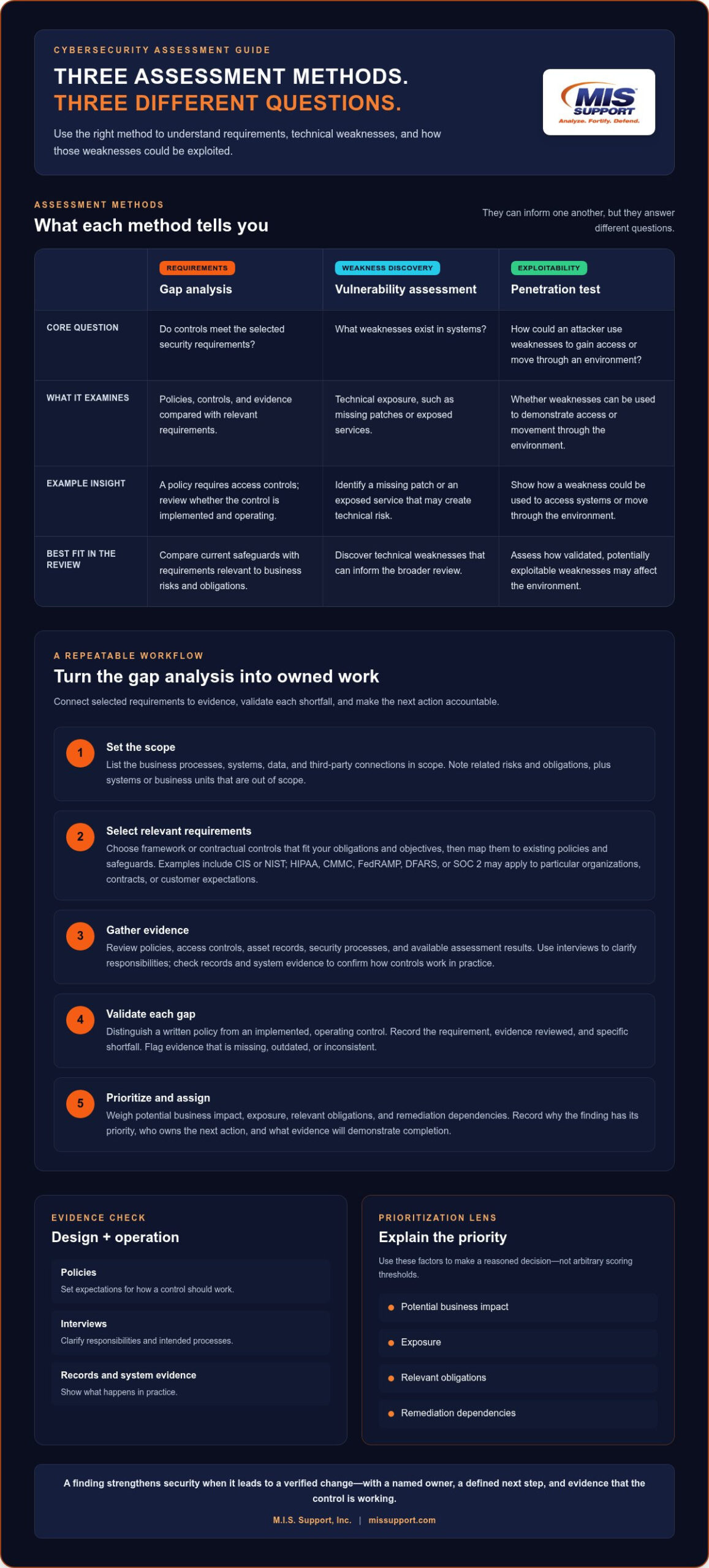
Keep the assessment methods distinct. A gap analysis asks whether controls meet selected requirements. A vulnerability assessment looks for weaknesses in systems, such as missing patches or exposed services. A penetration test attempts to use weaknesses to show how an attacker could gain access or move through an environment. These methods can inform one another, but they answer different questions. For example, a policy review may show that access controls are required, while technical testing checks for weaknesses in their implementation.
How to conduct a cybersecurity gap analysis and prioritize findings
Use a repeatable workflow so each finding is supported by evidence and can move toward resolution. A cybersecurity gap analysis is most useful when it connects requirements to actual safeguards, then turns confirmed weaknesses into owned work.
- Set the scope. List the business processes, systems, data, and third-party connections in the assessment. Include the risks and obligations tied to those operations, and note any systems or business units that are out of scope.
- Select requirements. Choose relevant framework or contractual controls, then map them to existing policies and safeguards. The U.S. Department of Energy’s Cybersecurity Standards Gap Analysis offers an example of applying standards to a defined domain.
- Gather evidence. Review policies, access controls, asset records, security processes, and available assessment results. Interviews can explain who is responsible and how a control should work. Check records and system evidence to confirm whether it does.
- Validate each gap. Distinguish a written policy from a control that is implemented and operating. An access policy alone, for instance, doesn’t prove permissions are reviewed or removed when they’re no longer needed. Record the requirement, the evidence reviewed, and the specific shortfall.
- Prioritize and assign. Weigh potential business impact, exposure, relevant obligations, and remediation dependencies. Don’t rely on arbitrary scoring thresholds. Record why each finding has its priority, who owns the next action, and what evidence will demonstrate completion.
What evidence makes a gap assessment actionable?
Evidence should show both how a control is designed and whether it operates. Interviews clarify responsibilities; policies set expectations; system records and other control evidence show what happens in practice. Compare the evidence with the exact requirement, and note when records are missing, outdated, or inconsistent. A vulnerability assessment guide can help clarify how technical exposure discovery contributes to the review.
For specialized support that works alongside your existing IT team, Cybersecurity Gap Assessments can help identify and prioritize security gaps.
Turn cybersecurity gap analysis findings into lasting protection
A finding strengthens security only when it leads to a verified change. Convert each validated gap into a corrective action tied to a business risk or relevant obligation. Name an owner, define the next step, and specify what evidence will show the control is working. Address urgent exposure and high-impact weaknesses before lower-priority improvements, while accounting for dependencies such as approvals, configuration changes, or staff training.
Keep the process constructive. Hackify partners with existing IT teams, adding specialized cybersecurity support rather than replacing the people who manage daily operations. Its reporting is available at three levels: Technical, Executive, and Attestation Letter. These formats help communicate findings to the people responsible for remediation, leaders overseeing risk, and audiences that need compliance-related documentation.
How does continuous defense support a gap-remediation plan?
Remediation needs follow-through as systems and threats change. Hackify provides automated, continuous threat detection, vulnerability identification, and ransomware monitoring to help surface security issues beyond a point-in-time assessment. Its human-factor training supports safer decisions, and cybersecurity awareness training is required for all users. Set strict policies that block unknown or insecure devices from corporate networks. This aligns with zero-trust, meaning “never trust, always verify.”
Connect each capability to the gap it addresses, then track whether the improvement is implemented and remains effective. For ongoing protection, managed cybersecurity services can complement your team’s work. Where validated findings point to exploitable weaknesses, penetration testing can help assess how those weaknesses may affect the environment. Together, these steps turn cybersecurity gap analysis findings into sustained, accountable improvements. Cybersecurity Gap Assessments support this work alongside your IT team.
Make the next security improvement count
Security requirements and business systems change. Treat your cybersecurity gap analysis as the start of ongoing improvement, not a report to file away. Revisit priorities as your environment evolves, confirm corrective actions remain effective, and keep security decisions connected to the risks your organization needs to manage.
That work doesn’t have to fall on your IT team alone. Hackify partners with existing teams to fill specialized cybersecurity gaps, using automated, continuous monitoring and compliance-ready reporting to support sustained oversight. A breach can be far costlier than investing in robust protection, so make the next step deliberate and accountable.
Strengthen your cybersecurity defenses with M.I.S. Support, Inc. through a partnership that supports your team and turns findings into action.
Frequently Asked Questions
How often should an organization conduct a cybersecurity gap analysis?
Set a review cadence that reflects your risk, obligations, and pace of change. Reassess sooner after a major cloud migration, acquisition, new contract requirement, or significant security incident. These changes can alter which systems are in scope and whether existing safeguards still address the organization’s exposure.
Does a cybersecurity gap analysis guarantee compliance?
No. A cybersecurity gap analysis can identify misalignment with selected requirements and organize supporting evidence, but it can’t guarantee a compliance outcome. Results depend on the applicable obligations, the assessment’s scope, and how requirements are interpreted by the relevant authority. Use the findings to guide readiness work, then verify that corrective actions and records remain current.
Can a cybersecurity gap analysis identify vulnerabilities?
It can surface vulnerability-related gaps, especially when the review examines security evidence or existing assessment results. But it isn’t a substitute for technical testing designed to discover weaknesses in systems. If the analysis raises concerns about exposed services, outdated software, or configuration issues, use a vulnerability assessment or penetration test to investigate those technical risks.
What should an organization do first after receiving gap analysis findings?
First, validate the findings and determine whether any require immediate containment. Then assign an owner to each action and document the intended fix, target date, and proof of completion. For example, if a departed worker’s account remains active, prioritize disabling it and retain evidence that access was removed.