
The best Expel MDR alternative may not be another MDR provider. For corporate network protection, the key difference is who investigates and acts when an alert signals a real threat, not whether a service is labeled MDR, EDR, XDR, or MSSP. Comparing expel mdr alternatives for corporate network protection starts with response ownership, coverage, and fit with your existing tools and team.
A security tool can detect suspicious activity without ensuring it is investigated or contained. This comparison explains how common service models differ in coverage and response responsibilities, and how to assess them against your organization’s needs. Managed cybersecurity can bring monitoring, endpoint defense, assessments, and strategic oversight together, helping you choose an approach that fits your risks and staffing capacity.
Key Takeaways
- Use expel mdr alternatives for corporate network protection to compare service models, not just security product labels.
- Separate the roles of MDR, EDR, XDR, and SIEM to see where detection ends and investigation or response begins.
- Build a scorecard around the systems you need covered, including endpoints, network, cloud, and Microsoft 365.
- Map risks, coverage, response ownership, and staffing needs to find an approach that strengthens security operations.
Expel MDR alternatives: what corporate network protection needs to cover
An MDR alternative is a different service or operating model for detecting, investigating, and responding to threats. Some alternatives provide a managed team that works with your security environment; others provide software your staff operates. The Managed Detection and Response (MDR) model combines security technology with human investigation and response, but the exact scope varies by service.
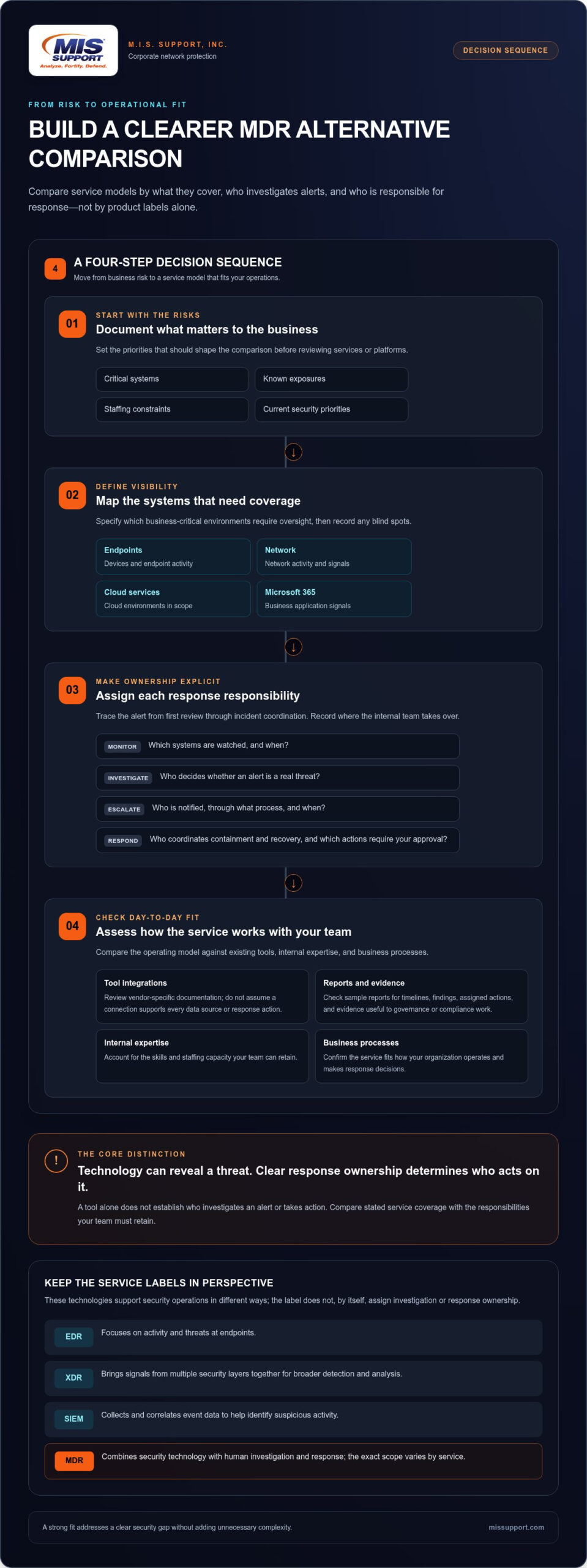
Keep the categories clear. EDR tools focus on activity and threats at endpoints. XDR platforms bring signals from multiple security layers together for broader detection and analysis. SIEM tools collect and correlate event data to help identify suspicious activity. These technologies can support security operations, but a tool alone does not establish who investigates an alert or takes action. Technology can reveal a threat, but clear response ownership determines who acts on it.
Which security gaps should an MDR comparison reveal?
Start with business-critical assets, then trace how an alert moves from detection to action. This turns expel mdr alternatives for corporate network protection into an operational comparison, not just a feature checklist. A broader managed cybersecurity services approach can bring monitoring, endpoint defense, assessments, and strategic oversight into one security plan.
- Map endpoints, network activity, cloud services, and Microsoft 365 to the systems and information your business relies on.
- Assign responsibility for alert monitoring, investigation, escalation, and incident coordination. Record where your internal team takes over.
Compare Expel MDR alternatives using a corporate security scorecard
Evaluate each option against the same business requirements, not a vendor’s feature list. For expel mdr alternatives for corporate network protection, compare what gets monitored, how alerts are investigated, and what happens when an incident requires action. Separate the service’s stated coverage from responsibilities your team must retain.
A security tool can detect suspicious activity; a managed service must make clear who investigates it, escalates it, and coordinates the response. Record whether endpoint, network, cloud, and Microsoft 365 signals are in scope, then note any blind spots. For example, a service that sees endpoint alerts but lacks visibility into a critical cloud environment may leave an important part of the risk picture uncovered.
- Monitoring: Which systems are watched, and when?
- Investigation: Who determines whether an alert is a real threat?
- Escalation: Who is notified, through what process, and when?
- Response: Who coordinates containment and recovery, and which actions require your approval?
How should buyers weigh integrations, reporting, and risk coverage?
Check how the service connects with your current security tools and workflows. Review vendor-specific integration documentation rather than assuming a connection supports every data source or response action. Examine sample reports for clear timelines, findings, assigned actions, and evidence useful to internal governance or compliance work. The NIST Cybersecurity and Privacy Program offers a reference point for structuring cybersecurity priorities, while vulnerability assessment guidance can help teams identify and prioritize exposure.
Use the scorecard to expose gaps before comparing costs or platforms. Managed cybersecurity support can align monitoring, endpoint defense, and risk oversight. Learn more about managed cybersecurity support.
Choose an Expel MDR alternative that strengthens response and resilience
Turn the comparison into a decision sequence. For expel mdr alternatives for corporate network protection, start with the risks that matter to your business, then define the visibility and response your team needs. A strong fit should align with your actual operations and address a clear gap without adding unnecessary complexity.
- Document risks. Identify critical systems, known exposures, staffing constraints, and current security priorities.
- Map coverage. Specify which endpoints, network activity, cloud services, and business applications require oversight.
- Assign response ownership. Set out who reviews alerts, coordinates investigation, escalates incidents, and makes response decisions.
- Assess operational fit. Consider how the service works with existing tools, internal expertise, and business processes.
Each security layer serves a distinct purpose. Managed monitoring provides ongoing oversight; endpoint protection and ransomware defense focus on devices; vulnerability assessments and penetration testing help identify weaknesses; and virtual CISO services support strategic security planning. Together, these capabilities can address operational and planning needs without treating a single tool as a complete security program.
When does a managed cybersecurity partner make sense?
A managed partner can be a practical option for teams that need continuous monitoring, response support, or additional security expertise. M.I.S. Support, Inc. provides 24/7 threat monitoring and response, endpoint protection, ransomware defense, vulnerability assessments, penetration testing, and virtual CISO services. These services can help organizations connect ongoing monitoring with assessment and security planning.
Use your coverage map and response assignments to define the right operating model. Explore M.I.S. Support, Inc.’s managed cybersecurity services to see how managed oversight can support ongoing security operations.
Turn your security comparison into a clear next step
Choosing among expel mdr alternatives for corporate network protection is an opportunity to shape how security fits your organization’s priorities, people, and day-to-day operations. Use your evaluation to identify the capability gaps that matter most, clarify where your team needs support, and set a practical direction for building resilience over time.
M.I.S. Support, Inc. provides managed cybersecurity services that bring together 24/7 threat monitoring and response, endpoint protection, ransomware defense, assessments, and virtual CISO services. These capabilities support ongoing oversight and security planning, helping your organization build an approach around its needs rather than relying on a tool alone. Talk with M.I.S. Support, Inc. about managed cybersecurity services and take the next step toward a more prepared, resilient operation.
Frequently Asked Questions
Does MDR replace a corporate firewall?
No. A firewall controls network traffic according to configured rules, while MDR focuses on monitoring and investigating security signals. For example, a firewall may block a connection, while an MDR analyst investigates whether related activity suggests a wider incident. Organizations may use both as layers of defense, with the right configuration shaped by their network design and risk requirements.
Do companies still need EDR if they use MDR?
Often, yes. EDR is technology that detects and helps respond to suspicious activity on endpoints; MDR is a managed service model that may use endpoint telemetry as part of its work. For example, a company might already have EDR while outsourcing alert investigation. Compare which systems are covered and where the service’s responsibilities end and your team’s begin.
Can MDR protect cloud services as well as endpoints?
It can, depending on the service’s scope, integrations, and configuration. For expel mdr alternatives for corporate network protection, list the cloud platforms, identity systems, endpoints, and Microsoft 365 environments your business relies on. Then compare documented visibility and escalation responsibilities for each. A coverage gap in a key cloud account, for example, may require a different service scope or additional internal controls.
What is the difference between MDR and a 24/7 security operations center?
MDR describes a managed detection-and-response service; a security operations center, or SOC, is the function responsible for security monitoring and related operations. A provider may deliver SOC capabilities within an MDR service, but the labels do not define the work by themselves. Compare who reviews alerts, investigates incidents, communicates findings, and coordinates response, including how information reaches your internal team.