
What if passing an audit still leaves your most important systems exposed? Compliance and risk management can feel like a maze of overlapping requirements, policies, and evidence requests. Meeting a standard matters, but it does not automatically show whether your organization’s real-world cybersecurity risks are under control.
Audit preparation is not the same as managing operational risk. This guide explains how compliance and cybersecurity risk management differ, and how to connect them so requirements inform stronger defenses. You’ll learn how to identify which obligations may apply, rank gaps by business impact and available evidence, and build defensible oversight. It also covers practical assessment options and how leadership support, including virtual CISO guidance, can help turn findings into focused action.
Key Takeaways
- Separate compliance obligations from cybersecurity risk decisions, then connect them so meeting controls supports stronger defenses.
- Build a repeatable compliance and risk management process that defines scope, identifies obligations, assesses risk, assigns treatment, records evidence, and reviews changes.
- Prioritize security gaps by business impact, likelihood, exposure, and existing safeguards. Document the assumptions behind each decision.
- Keep oversight current with recurring reviews and monitoring. Use assessments, penetration testing, or virtual CISO guidance to inform next steps.
Compliance and Risk Management: How They Work Together in Cybersecurity
Compliance and risk management work together, but they answer different questions. Compliance asks whether an organization meets the obligations that apply to it. Risk management asks what could harm the business, how likely or damaging that harm may be, and what action is appropriate.
Compliance demonstrates alignment; risk management guides decisions about exposure. An audit or control assessment can show that requirements are being met, but it cannot eliminate every cyber threat. A documented access policy, for example, is useful evidence. The organization must also consider whether access is configured and monitored effectively, and whether a compromised account could disrupt critical operations. Review the actual access settings and monitoring process, not just the policy document.
This distinction sits within the broader Governance, risk, and compliance (GRC) approach. Obligations, business priorities, and oversight should inform one another rather than operate as separate checklists.
What does cybersecurity compliance and risk management mean for a business?
Requirements depend on an organization’s activities, data, contracts, and operating context. Laws, customer or supplier agreements, and industry frameworks may set different expectations, so don’t assume one checklist applies to every business. For example, HIPAA may be relevant to organizations covered by its requirements, while PCI DSS may apply to organizations that handle payment card data. Similarly, in sector-specific settings such as UK healthcare, providers often consult specialists like CQC Consultancy to navigate rigorous regulatory standards and registration requirements. Applicability is fact-specific; this overview isn’t legal advice.
The NIST Cybersecurity Framework (CSF) 2.0 offers a voluntary way to organize cybersecurity outcomes. Published in February 2024, it includes a Govern function alongside Identify, Protect, Detect, Respond, and Recover. Organizations can use it to structure discussions and map security work, but using the framework alone doesn’t establish compliance with every law or contract.
In practice, connect each applicable obligation to the safeguard, owner, and evidence that address it. This helps leaders see what is required, where controls may be weak, and which actions can reduce exposure or improve resilience.
How to Build a Cybersecurity Compliance and Risk Management Process
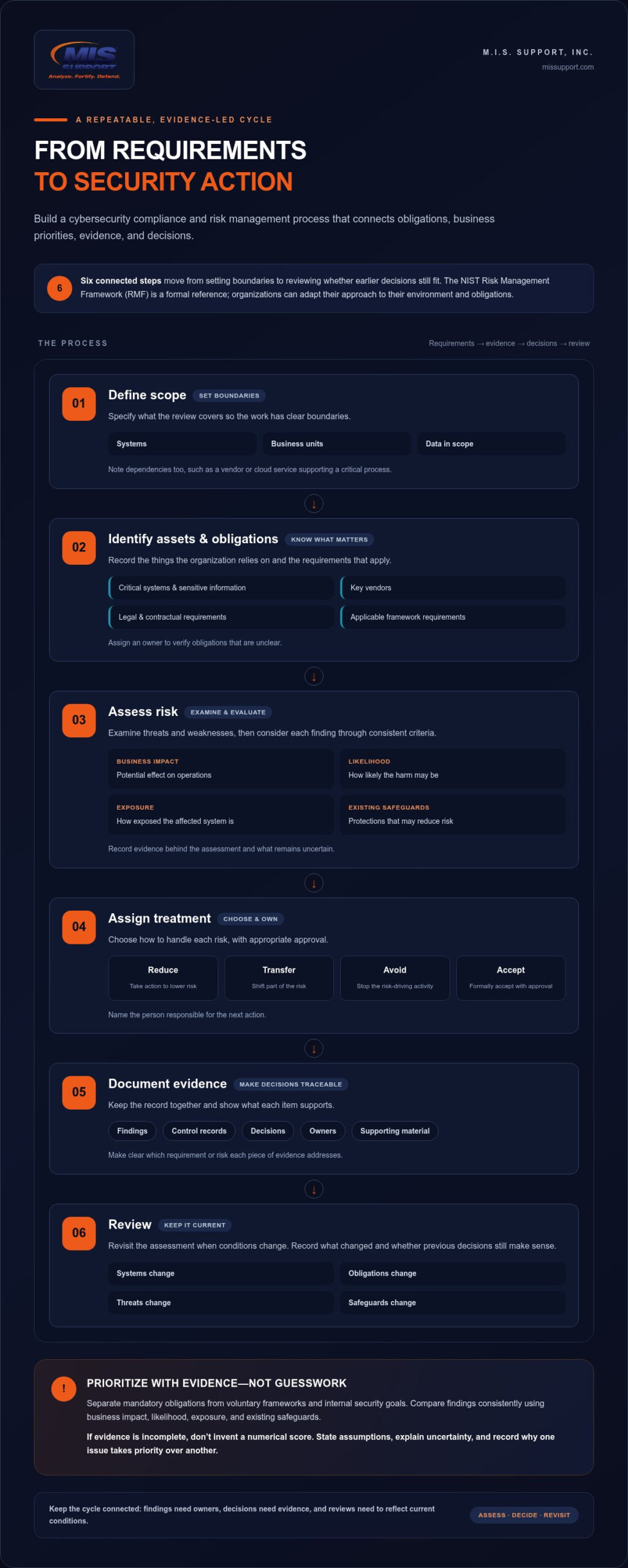
Make the process repeatable, evidence-led, and tied to business priorities. This six-step cycle helps teams move from requirements to action. The NIST Risk Management Framework (RMF) offers a formal reference for managing security risk. Organizations can adapt their approach to their own environment and obligations.
- Define scope. Set boundaries for the review, such as systems, business units, and data in scope. Note important dependencies, such as a vendor or cloud service that supports a critical process—for example, cloud-based clinical platforms like mayamd.ai.
- Identify assets and obligations. Record critical systems, sensitive information, key vendors, and applicable legal, contractual, and framework requirements. Assign an owner to verify obligations that are unclear.
- Assess risk. Examine threats and weaknesses, then consider business impact, likelihood, exposure, and existing safeguards. For each finding, note what evidence supports the assessment and what remains uncertain.
- Assign treatment. Decide whether to reduce, transfer, avoid, or formally accept each risk, with appropriate approval. Name the person responsible for the next action.
- Document evidence. Keep findings, control records, decisions, owners, and supporting material together. Make it clear which requirement or risk each item of evidence addresses.
- Review. Revisit the assessment when systems, obligations, threats, or safeguards change. Record what changed and whether earlier decisions still make sense.
How should organizations prioritize compliance gaps and cyber risks?
Separate mandatory obligations from voluntary frameworks and internal security goals. Then compare findings using consistent criteria: the potential effect on business operations, the likelihood of exploitation, how exposed the affected system is, and whether existing safeguards reduce the risk. Don’t invent a numerical score when evidence is incomplete. State assumptions, explain uncertainty, and record why one issue takes priority over another.
Vulnerability assessments help identify known weaknesses across systems. Penetration testing examines how weaknesses might be exploited within a defined test. These methods provide different kinds of evidence, and neither automatically proves compliance. Assessment findings need owners, deadlines, and documented follow-up. Record remediation decisions, accepted risks, and reassessment plans, adapting the method to your organization’s circumstances.
If you need help establishing a baseline, consider cybersecurity gap assessments as one way to gather evidence and guide next steps.
Turn Compliance Findings into Ongoing Security Oversight
A risk register is a starting point, not a finish line. Systems change, new weaknesses emerge, and safeguards can drift. Schedule recurring reviews, monitor relevant security alerts, maintain incident response and continuity plans, and update evidence when controls or business processes change. The GAO report on cybersecurity risk management underscores the need for a structured approach to managing cybersecurity risk. Ongoing oversight keeps decisions connected to current conditions rather than relying on a snapshot from the last assessment.
Use assessments to identify gaps and track whether corrective actions work. Penetration testing can help examine how weaknesses may be exploited, while managed security services can support monitoring and response. Neither assessment results nor testing automatically establishes certification or guarantees compliance. Keep evidence, response plans, and ownership records aligned with the obligations and risks they’re meant to address.
When should a business seek outside compliance and risk management support?
Consider additional support if control ownership is unclear, assessment gaps keep recurring, or internal security leadership is stretched. A cybersecurity gap assessment can help establish where controls need attention. Vulnerability assessments and penetration testing provide technical evidence. Virtual CISO services can support strategic oversight, while managed cybersecurity and business continuity planning can help connect security operations with response and recovery readiness.
M.I.S. Support, Inc. offers cybersecurity assessments, penetration testing, virtual CISO services, and managed cybersecurity. Explore managed cybersecurity services or virtual CISO services to consider how they may fit your oversight needs. The right support depends on your environment, obligations, and internal capacity.
Build Security Oversight That Holds
Strong compliance and risk management connects requirements to threats that could disrupt your business. Keep obligations distinct from risk decisions, prioritize findings by business impact, and give every important action an owner and a review point. Evidence should reflect how safeguards work in practice, not just what a policy says.
Make oversight continuous. Revisit assessments as systems and risks change, use penetration testing to examine potential weaknesses, and keep response and continuity planning current. When internal leadership is limited, virtual CISO guidance can help bring strategy and accountability into focus.
M.I.S. Support, Inc. provides cybersecurity assessments, penetration testing, virtual CISO services, managed cybersecurity, and business continuity planning. Discuss your cybersecurity compliance and risk priorities with M.I.S. Support, Inc. to identify practical next steps for your organization. With clear ownership and steady review, you can build stronger, more defensible oversight.
Frequently Asked Questions
What is the difference between compliance and risk management?
Compliance means meeting applicable obligations and keeping evidence that requirements are addressed. Risk management means identifying, evaluating, and treating potential harm to business operations. They overlap, but they aren’t interchangeable: meeting a requirement doesn’t remove every cybersecurity risk. Which obligations apply depends on the organization’s activities, data, contracts, and other circumstances.
How do businesses start a cybersecurity compliance and risk management program?
Start by identifying critical systems, important data, applicable obligations, and accountable owners. Then assess safeguards and exposure, prioritize gaps by potential business impact, assign treatment actions, and retain evidence of decisions and follow-up. Because legal and contractual obligations vary by organization, seek qualified advice when interpreting specific requirements rather than assuming a general checklist applies.
Can a business be compliant and still face cybersecurity risks?
Yes. Compliance addresses defined requirements, while attackers, systems, and business operations can change. A control may meet an obligation without addressing every threat or weakness. Ongoing assessments, security monitoring, incident readiness, and periodic reviews help organizations respond to changing conditions and keep decisions current. These practices can strengthen resilience, but no program can eliminate all risk.
What happens if an organization finds a compliance or security gap?
Record the finding, assess its business impact and any relevant obligation, assign an owner, and set a reasonable remediation or risk-treatment plan. Preserve evidence of decisions and follow-up, including reassessment where appropriate. If the gap may involve a specific law, contract, or security incident, consult qualified legal or compliance professionals before deciding what action is required.