
94% of leaders surveyed by the World Economic Forum identify AI as the most significant driver of cybersecurity change this year. It’s a staggering figure that marks a new era of risk. You’re likely facing an overwhelming volume of security alerts and the relentless speed of AI-powered phishing. The shortage of skilled talent to manage complex stacks only adds to the burden. It’s a high-stakes environment. Traditional defenses are failing. The landscape demands a more vigilant approach.
We recognize the urgency of this shift. Strategically implementing ai in cybersecurity is the force multiplier your team needs to neutralize modern threats at machine speed. This guide explores how AI-native defense is redefining digital resilience. You’ll discover a clear roadmap for integration that reduces your mean time to detect and respond. We’ll show you how to transform your security posture, reduce operational friction, and build a foundation of lasting stability. Secure your data. Protect your assets. Fortify your future.
Key Takeaways
- Move beyond reactive signatures. Learn why predictive defense is the only way to stop automated vulnerability exploitation before it breaches your perimeter.
- Prioritize your implementation. Focus your AI resources on high-impact areas like endpoint protection and network traffic analysis to maximize defensive ROI.
- Master the data foundation. Understand why the success of ai in cybersecurity depends entirely on the integrity and depth of your telemetry data.
- Bridge the expertise gap. Discover how harmonizing autonomous agents with Virtual CISO oversight ensures your technology remains aligned with business goals and regulatory mandates.
- Fortify your resilience. Establish a battle-hardened strategy that combines machine speed with human intuition to maintain a proactive security posture.
The Paradigm Shift: Why AI-Native Defense is Essential in 2026
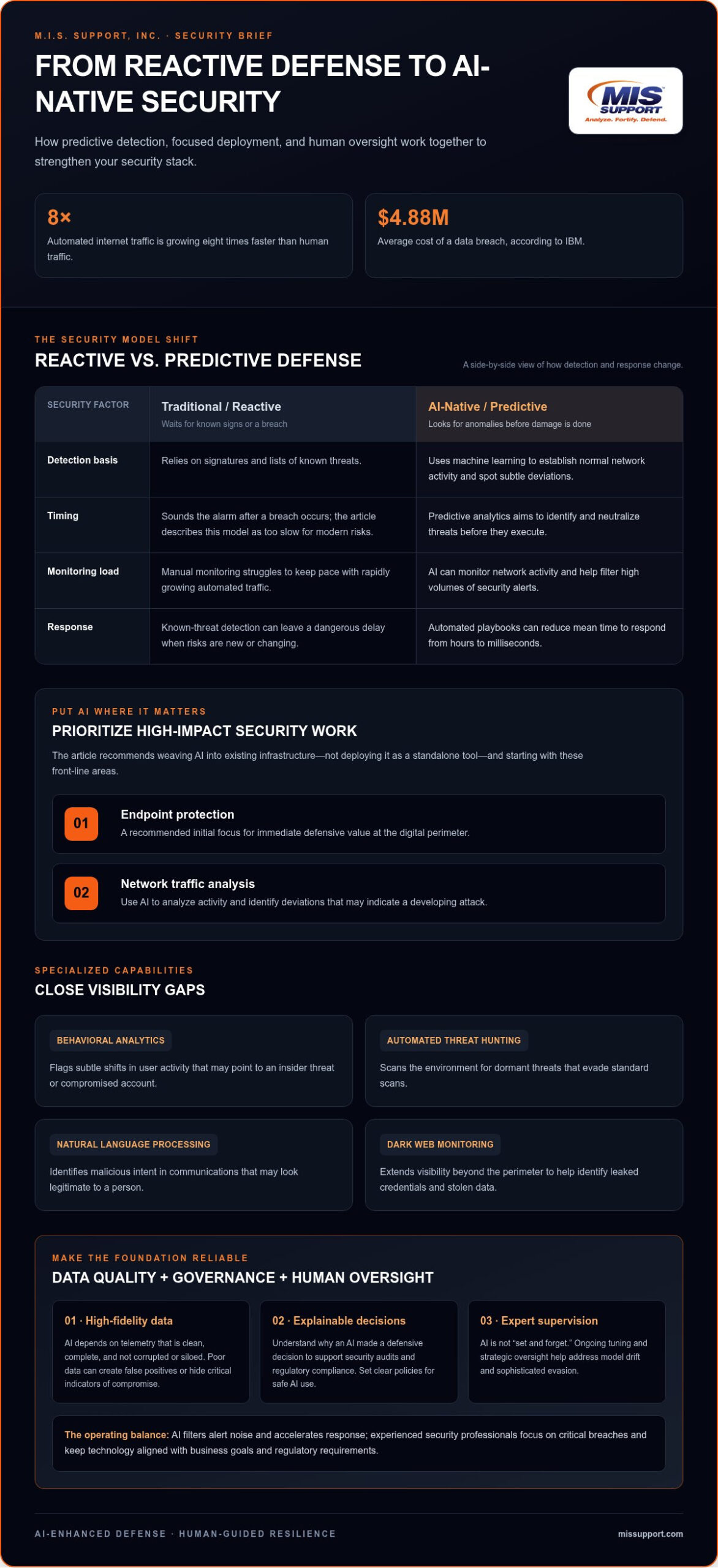
The digital battlefield has fundamentally changed. In 2026, automated internet traffic is growing eight times faster than human traffic. This surge renders manual monitoring obsolete. We’ve moved beyond the era of signature-based detection. Relying on a list of known threats is no longer a viable strategy. It’s a dangerous delay. A robust posture now requires ai in cybersecurity to act as a dynamic, self-learning shield. This technology doesn’t just watch; it anticipates. It fortifies the perimeter, monitors internal traffic, and secures cloud assets in a single, cohesive motion.
From Reactive to Predictive: The New Security Standard
Traditional security waits for a breach to occur before sounding the alarm. This reactive model is too slow for modern risks where the average cost of a data breach has reached $4.88 million according to IBM. Predictive defense shifts the focus toward identifying anomalous behavior before damage is done. By using machine learning, systems establish a baseline of normal network activity. They recognize the subtle deviations that signal a burgeoning attack. Predictive analytics is the ability to neutralize threats before they execute. This proactive stance ensures your infrastructure remains resilient, stable, and secure.
The Rise of Adversarial AI
The threat is evolving. Attackers now leverage generative AI to craft hyper-personalized phishing campaigns and automate vulnerability exploitation. They use these applications of artificial intelligence to bypass traditional firewalls and multi-factor authentication with surgical precision. It’s an AI arms race. To survive, your organization needs a cyber security service that evolves at the same pace as these sophisticated adversaries. Passive defense is an invitation to disaster. You must deploy intelligent systems that can outthink, outpace, and outmaneuver the opposition. Vigilance is the only path to protection.
Strategic Implementation: Orchestrating AI Within Your Security Stack
Strategic deployment is the difference between a fragmented defense and a unified shield. You don’t want to implement ai in cybersecurity as a standalone tool. It must be woven into your existing infrastructure. Prioritize high-impact areas first. Focus your initial efforts on endpoint protection and network traffic analysis. These sectors provide the most immediate return on investment. They are the front lines of your digital perimeter. Observe, orient, and act at machine speed.
Data integrity is the bedrock of this transition. AI is only as effective as the telemetry data it consumes. If your data is siloed, incomplete, or corrupted, your AI will produce false positives. Worse, it will miss critical indicators of compromise. Success requires a clean, high-fidelity stream of information. This ensures your managed cybersecurity services framework remains accurate. Integration over isolation is the mandatory standard for 2026.
Core Applications of AI Security
Effective defense utilizes specialized AI capabilities to close visibility gaps. The role of ai in cybersecurity extends to behavioral analytics, identifying the insider threat or compromised account through subtle shifts in user activity. Automated threat hunting scans your environment for dormant threats that evade standard scans. Meanwhile, Natural Language Processing (NLP) revolutionizes phishing defense. It identifies malicious intent in communication that looks perfectly legitimate to the human eye. These tools reduce your mean time to respond (MTTR) from hours to milliseconds through automated playbooks. Extending this visibility beyond your perimeter with dark web monitoring services ensures that leaked credentials and stolen data are identified before attackers can weaponize them against your organization.
Risk Management and AI Governance
To ensure your organization maintains control during this transition, check out Centrum voor IT for expert guidance on establishing robust AI policies and specialized training.
Governance is the critical anchor for technical innovation. Security leaders must address the “Black Box” problem. Explainable AI is essential for security audits and regulatory compliance. You must understand why an AI made a specific defensive decision. Establishing clear policies for safe AI usage prevents accidental data leakage and maintains structural integrity. As discussed in AI and the Future of Cybersecurity, the evolution of these tools requires a balance of innovation and strict oversight. If you are unsure where to start, aligning your AI tools with your broader managed cybersecurity services strategy can identify where automation will provide the most immediate fortification for your specific risk profile. A critical first step in this process is understanding what is a vulnerability assessment and how it reveals the hidden weaknesses your AI systems need to prioritize and remediate. Complementing this with structured penetration testing simulates real adversary tactics to uncover the hidden entry points that automated tools alone will miss.
The Vigilant Guardian: Harmonizing AI with Managed Expertise
Technology alone cannot secure an organization. The belief that ai in cybersecurity is a “set and forget” solution is a dangerous fallacy that leaves businesses vulnerable to model drift and sophisticated evasion. Machine learning requires constant tuning and oversight by seasoned strategists to remain effective. It needs a pilot. We act as that pilot. Our Managed Detection and Response (MDR) centers leverage AI to filter out the relentless noise of thousands of daily alerts. This allows our battle-hardened experts to focus exclusively on the critical breaches that threaten your stability. It’s about precision, not just automation.
Strategic resilience is the ultimate goal. In a landscape where cybercrime losses exceeded $16.6 billion in recent years according to the FBI IC3, survival isn’t enough. Your organization must remain operational through an attack. By positioning AI as a component of a broader managed framework, you build a structure that absorbs shocks. You don’t just react to threats. You endure them. This proactive approach ensures that your digital assets remain protected while your business continues to function without interruption. For organizations that also require physical operational support, Alliance Fleet Solutions provides the B2B fleet management and leasing services necessary to maintain full-scale business continuity.
The Role of the Virtual CISO in an AI World
Strategic adoption requires a clear roadmap. Our virtual ciso services provide this direction by bridging the gap between technical AI output and executive-level risk decisions. We ensure your technology aligns with business goals and the latest regulatory mandates, such as the 2026 National Cybersecurity Strategy. This high-level oversight is essential for transforming cybersecurity from a technical challenge into a pillar of organizational strength.
Maximizing ROI on AI Security Investments
Fortification is an investment in long-term stability. By reducing breach-related costs and minimizing downtime, AI-integrated systems provide a measurable return. Our secure managed it services incorporate these intelligent tools to ensure business continuity. We don’t just help you survive an attack. We position your organization to remain unphased throughout the event. This is the hallmark of a truly resilient enterprise in 2026. Protect your revenue. Secure your reputation. Fortify your future.
Secure Your Strategic Edge
The transition to a predictive defense model is no longer optional. It’s a requirement for survival in a landscape where automated threats move at machine speed. You’ve seen how the strategic integration of ai in cybersecurity provides a self-learning shield that anticipates attacks before they execute. Success depends on high-fidelity telemetry data and the constant tuning of these intelligent systems by seasoned professionals. Passive tools won’t protect your assets. True resilience requires the harmony of autonomous technology and battle-hardened human intelligence.
Don’t leave your infrastructure to chance. We provide the expertise needed to navigate this high-stakes environment with confidence. Our approach combines 24/7 proactive threat monitoring, expert virtual CISO strategic guidance, and battle-hardened ransomware defense to keep your operations stable. Secure Your Future with AI-Driven Managed Cybersecurity and transform your vulnerability into a position of strength. The threats are evolving. Your defense should be faster. Step forward into a more secure, resilient future today.
Frequently Asked Questions
Is AI in cybersecurity safe for small to mid-sized businesses?
Yes, implementing ai in cybersecurity is safe and increasingly mandatory for small to mid-sized businesses. These organizations are often targeted because they lack the resources to maintain massive in-house security operations. AI acts as a tireless guardian, automating routine monitoring and providing high-level protection without a large headcount. It levels the playing field against sophisticated attackers. It provides a reliable, disciplined, and observant shield for those who are overextended.
Can AI-powered security tools prevent 100% of cyberattacks?
No security tool can guarantee 100% prevention. Relying on a single solution for absolute safety is a strategic error. It’s about resilience. AI significantly reduces the window of opportunity for attackers by identifying anomalies at machine speed. It hardens your perimeter and accelerates response. The goal is to detect, contain, and recover from an incident with minimal operational friction. A battle-hardened defense assumes a breach is always possible.
How does AI improve Managed Detection and Response (MDR)?
AI transforms MDR by drastically reducing the noise of false positives. Traditional systems often overwhelm analysts with thousands of low-priority alerts. AI filters this data, identifies high-risk patterns, and prioritizes critical threats for human intervention. This synergy allows 24/7 monitoring teams to act with surgical precision. It ensures that every second of human expertise is spent identifying, analyzing, and neutralizing real dangers rather than chasing ghosts.
What is the difference between machine learning and AI in a security context?
Artificial intelligence is the broad discipline of creating systems that can perform complex tasks. Machine learning is a specific subset of that field. In security, ML uses historical telemetry to recognize patterns and establish a baseline of normal activity. While AI encompasses the entire strategic framework of intelligent defense, machine learning is the engine that allows ai in cybersecurity to observe, learn, and adapt to new threats over time. Pairing these intelligent systems with a structured vulnerability assessment process ensures that the patterns your AI learns from are grounded in a comprehensive, prioritized map of your actual risk exposure. When you’re ready to act on those insights, selecting the right cybersecurity services company ensures you have a battle-hardened partner to translate AI-driven intelligence into a resilient, audit-ready defense strategy.