
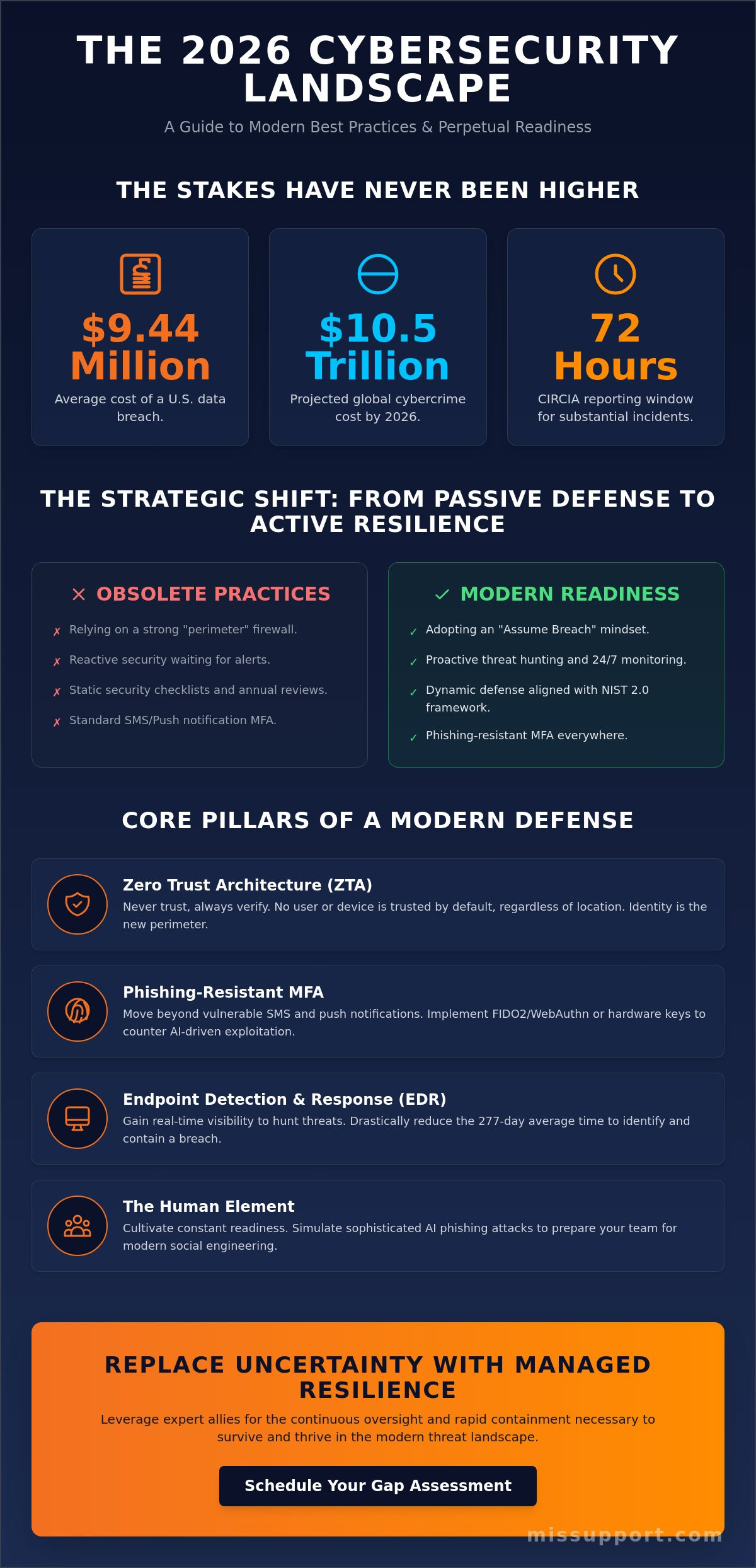
The average U.S. data breach now costs $9.44 million, a figure that demands your absolute attention. You’re likely overwhelmed by the complexity of agentic AI threats and the strict 72 hour reporting windows mandated by CIRCIA. It’s exhausting to maintain a defense when the landscape shifts every hour. Implementing modern cybersecurity best practices often feels like trying to build a fortress while the ground is shaking beneath you. You need a strategy that’s tireless, disciplined, and decisive.
A Security Operations Center (SOC) acts as your digital watchtower. Leveraging SOC-as-a-Service provides the constant oversight needed to stop midnight attacks before they can move laterally through your network. The primary objective is to slash your Mean Time to Detect (MTTD) and Mean Time to Respond (MTTR). Every second of delay increases the potential for catastrophic data loss and operational downtime. Managed Detection and Response (MDR) functions as a proactive, seamless extension of your internal IT team. It provides the specialized expertise required to contain sophisticated ransomware and AI-driven exploits in real-time, ensuring that a single breach doesn’t become a total system failure.
This guide provides the essential roadmap to stabilize your operations and meet every regulatory demand. We’ll explore the NIST 2.0 framework, the move to zero-trust architecture, and the strategic governance required for enterprise resilience. You’ll learn how to harden your perimeter, automate your response, and cultivate a culture of vigilance. It’s time to replace uncertainty with a state of perpetual, managed readiness.
Key Takeaways
- Implement phishing-resistant MFA and Zero Trust Architecture to fortify your perimeter against automated, AI-driven exploitation.
- Align your defense strategy with the NIST Cybersecurity Framework 2.0 and commit to quarterly penetration testing to identify critical gaps.
- Cultivate a culture of constant readiness by simulating sophisticated AI phishing attacks to prepare your team for modern social engineering.
- Discover why modern cybersecurity best practices require a transition from static checklists to active, 24/7 threat monitoring and response.
- Scale your resilience by leveraging expert allies who provide the continuous oversight and rapid containment necessary to survive the 2026 landscape.
Table of Contents
-
The 2026 Threat Landscape: Why Passive Cybersecurity Best Practices Fail
-
Hardening the Technical Perimeter: Core Infrastructure Best Practices
-
Strategic Governance: Implementing Risk Management Frameworks
-
The Human Element: Cultivating Vigilance and Managing Supply Chain Risk
-
Managed Resilience: Scaling Your Security with an Expert Ally
The 2026 Threat Landscape: Why Passive Cybersecurity Best Practices Fail
The digital battlefield has shifted. In 2026, the era of the casual hacker is over. It’s been replaced by a landscape where global cybercrime costs are projected to reach $10.5 trillion. Attackers no longer knock on your door; they use automated, AI-driven systems to dismantle your infrastructure before you even detect a tremor. Passive cybersecurity best practices that once relied on a strong perimeter are now fundamentally obsolete. Your organization lives in the cloud, and your employees work from everywhere. There is no perimeter left to defend.
Adopting an "Assume Breach" mindset is the only path to resilience. This strategic pillar recognizes that a compromise is not a possibility, but an inevitability. The goal isn’t just to keep them out. You must find them fast, limit their movement, and neutralize the threat. Reactive security is a financial black hole. With the average cost of a U.S. data breach hitting $9.44 million, waiting for an alert is a high-stakes gamble. Proactive defense offers more than safety. It provides the operational stability required to survive in a volatile market.
AI-Driven Threats and Sophisticated Ransomware
Generative AI has weaponized social engineering. Attackers now craft hyper-personalized, flawless phishing attempts that bypass traditional email filters with ease. They don’t just steal data. They use AI to map your network architecture in minutes, identifying the path of least resistance. Ransomware-as-a-Service (RaaS) has democratized high-level exploitation, allowing low-skill actors to target mid-market enterprises with devastating precision. In this environment, the speed of detection is the only metric that matters. If you can’t contain a threat in hours, you’ve already lost. Understanding core computer security principles is no longer a task for the IT basement; it is a survival requirement for the boardroom.
The Regulatory Reality of 2026
The regulatory net is tightening. Under the 2026 CIRCIA final rule, covered entities must report substantial incidents within 72 hours and ransomware payments within 24 hours. Compliance is no longer a suggestion. It’s a mandate with teeth. Cyber insurance providers have also raised the bar. You should expect premium hikes of 15% to 20% if your security checklist doesn’t meet the latest maturity standards. Fiduciary responsibility now rests squarely on executive shoulders. Leaders are being held personally accountable for digital resilience, making cybersecurity best practices a central component of corporate governance. You must document your defense, prove your readiness, and act with decisive speed.
Hardening the Technical Perimeter: Core Infrastructure Best Practices
Fortify your foundation. In a cloud-first world, your old firewall is a relic. Modern cybersecurity best practices demand a shift from hardware boundaries to identity-centric defense. You must implement phishing-resistant Multi-Factor Authentication (MFA) across every system. Standard SMS or push notifications are no longer sufficient. They’re vulnerable to interception and fatigue attacks. Transitioning to a Zero Trust Architecture (ZTA) ensures that no user or device is trusted by default. Trust must be earned, verified, and continuously monitored, regardless of whether a user is in the office or remote.
Continuous vulnerability scanning and automated patch management are non-negotiable. Attackers exploit known flaws within hours of disclosure. You can’t afford to wait for a manual cycle. Endpoint Detection and Response (EDR) is now the baseline for enterprise stability. It provides the visibility needed to hunt threats in real-time, reducing the average 277 days it takes to identify and contain an incident. Secure configuration of Microsoft 365 and your cloud environment is equally vital. Misconfigurations account for a massive percentage of cloud breaches. If you’re unsure where your vulnerabilities lie, a comprehensive cybersecurity gap assessment can illuminate the hidden risks in your infrastructure.
Identity as the New Perimeter
Passwords are a liability. They’re easily stolen, sold, and recycled. In 2026, identity is the only true perimeter. Enforce "Least Privilege" access controls for every user. This ensures staff only have the permissions necessary for their specific role. It limits the blast radius of a compromised account. Vigilance requires constant monitoring for credential stuffing and unauthorized login attempts. By aligning your strategy with CISA’s Cyber Essentials framework, you build a program rooted in proven defense principles. Secure the identity, and you secure the organization.
Data Integrity and Resilient Backups
Defense isn’t just about blocking access; it’s about ensuring survival. The 3-2-1-1 backup rule is the modern gold standard. Maintain three copies of your data. Use two different media types. Keep one copy offsite. Most importantly, keep one copy air-gapped or in immutable storage. This prevents ransomware from encrypting your last line of defense. Regularly test your restoration procedures. A backup you haven’t tested is a backup you don’t have. Encrypt your data at rest, in transit, and in use. This holistic approach to cybersecurity best practices ensures that even if a breach occurs, your core assets remain shielded, private, and recoverable.
Strategic Governance: Implementing Risk Management Frameworks
Strategy must dictate technology. Without a rigorous governance framework, even the most advanced tools fail to provide a cohesive defense. Adopting the NIST Cybersecurity Framework (CSF) 2.0 provides the structure required for modern resilience. It expands the scope to all organizations and introduces the "Govern" function. This ensures security is a boardroom priority rather than an isolated IT burden. Aligning with CISA cybersecurity best practices allows you to standardize your defense across the entire enterprise. It’s about building a repeatable, scalable process that evolves with the threat.
Testing your defenses must be relentless. Annual audits are a relic of a slower era. They offer a snapshot of a past that no longer exists. Implementing quarterly internal and external penetration testing sessions exposes vulnerabilities before attackers find them. This proactive validation ensures your cybersecurity best practices are actually working in the real world. Resilience also requires a formal Incident Response Plan (IRP). Every stakeholder must know their role when a crisis hits. You need clear communication channels, defined escalation paths, and pre-authorized containment protocols. Security shouldn’t be a roadblock to growth. It should be the engine that makes growth sustainable.
The Role of Continuous Risk Assessment
Point-in-time audits offer a false sense of security. They capture a single moment in a rapidly changing environment. You must move toward continuous security monitoring to maintain true visibility. This approach identifies, prioritizes, and closes gaps in your security posture as they emerge. It transforms security from a cost center into a strategic asset. Use these assessments to justify security ROI to stakeholders. When you can demonstrate a reduction in organizational risk with hard data, security becomes a powerful tool for business stability.
Virtual CISO: Strategic Leadership Without the Overhead
Most mid-market organizations lack the budget for a full-time executive security leader. Yet, they face the same sophisticated threats as the Fortune 500. A Virtual CISO (vCISO) provides that vigilant guardian perspective without the massive overhead of a full-time hire. They align technical security with your specific business goals and compliance needs. Managing the complexity of modern risk doesn’t require hiring an internal army. It requires decisive leadership. A vCISO acts as your battle-hardened strategist. They ensure your roadmap remains clear, compliant, and ready for whatever 2026 brings.
The Human Element: Cultivating Vigilance and Managing Supply Chain Risk
Technology is only half the battle. Your staff forms the final line of defense, yet they remain the primary target for sophisticated social engineering. Annual training is dead. It creates a false sense of security that 2026 threats easily bypass. Modern cybersecurity best practices require a transition to a culture of perpetual awareness. You must move beyond static slides and implement continuous, adaptive learning modules that evolve alongside the threat landscape. A resilient organization is observant, decisive, and unified.
Simulate AI-driven phishing attacks to test your readiness. These aren’t the obvious, poorly written emails of the past. They are hyper-personalized, context-aware, and incredibly convincing. In May 2026, the "Five Eyes" alliance published joint guidance on Agentic AI, warning of the risks posed by autonomous software agents. Testing employee readiness against these realistic scenarios is the only way to build muscle memory. Pair this with formal offboarding procedures. When an employee leaves, their access must vanish instantly. Leaving dormant accounts active is an open invitation for insider threats or credential exploitation.
Building a Culture of Defensive Vigilance
Empower your team. They should feel like active participants in your defense, not potential liabilities. Encourage them to report suspicious activity immediately. There should be no fear of retribution for a false alarm; a reported mistake is a lesson learned for the whole firm. Tailor your training to specific roles. Your finance team faces different risks than your engineering department. Executive-level participation is also mandatory. If leadership doesn’t take security drills seriously, the rest of the organization won’t either. Fortify your human firewall by investing in specialized security awareness training that prepares your team for the realities of 2026.
Third-Party and Supply Chain Security
Your security is only as strong as your weakest vendor. You must vet the security posture of every third-party provider and cloud partner before granting access. Assess their digital risk with the same intensity you apply to your own infrastructure. This includes reviewing their incident response history and compliance certifications. Implement contractual requirements for security standards in every vendor agreement. Once they’re onboarded, monitor their access to your internal network continuously. Supply chain attacks are rising in frequency and impact. Don’t let a partner’s negligence become your catastrophe. Strategic oversight of your entire ecosystem is the only way to ensure true enterprise resilience.
Managed Resilience: Scaling Your Security with an Expert Ally
Internal IT teams are often overextended. They manage help desk tickets, maintain infrastructure, and deploy software. They rarely have the capacity for 24/7 threat hunting. In 2026, attackers don’t keep business hours. They wait for the weekend. They strike at 2:00 AM when your defenses are most likely to be unattended. Scaling your resilience requires an ally that never sleeps. Consolidating your security tools into a unified, managed ecosystem eliminates the noise of disconnected alerts. It allows for a cohesive, decisive response. This is the ultimate evolution of cybersecurity best practices. It’s about moving from passive defense to perpetual, managed resilience.
Partnering with a provider that offers both technical depth and strategic vision is a necessity. You need more than a service provider; you need a battle-hardened strategist. A true ally identifies vulnerabilities, implements fortifications, and monitors for movement. Before selecting a partner, it’s worth understanding how different managed security services defense models compare so you can make an informed decision that aligns with your specific risk profile. This partnership allows your internal team to focus on core business growth while the experts handle the high-stakes world of risk management. It transforms your security posture from a source of constant anxiety into a reliable shield for your organization’s future.
24/7 Threat Monitoring: The ‘Always On’ Advantage
A Security Operations Center (SOC) acts as your digital watchtower. It provides the constant oversight needed to stop midnight attacks before they can move laterally through your network. The primary objective is to slash your Mean Time to Detect (MTTD) and Mean Time to Respond (MTTR). Every second of delay increases the potential for catastrophic data loss and operational downtime. Managed Detection and Response (MDR) functions as a proactive, seamless extension of your internal IT team. It provides the specialized expertise required to contain sophisticated ransomware and AI-driven exploits in real-time, ensuring that a single breach doesn’t become a total system failure. Understanding how managed IT security services have evolved into AI-driven, proactive defense platforms is essential for organizations looking to close the gap between tool adoption and actual threat containment.
Choosing the Right Cybersecurity Services Company
Not all partners are created equal. You need a vigilant guardian who understands the gravity of modern threats. Evaluate a partner’s experience in conducting rigorous internal and external penetration testing. They must be capable of performing deep cybersecurity gap assessments to find the cracks in your armor. The value of a partner who understands managed cybersecurity services lies in their ability to integrate technology with business logic. They should offer a comprehensive roadmap for long-term stability and regulatory compliance. This ensures your organization remains disciplined, ready, and resilient against whatever the 2026 landscape delivers. Cybersecurity best practices are no longer a static checklist; they are a state of constant, expert-led readiness.
Fortify Your Foundation for Perpetual Resilience
Operational stability in 2026 demands more than just software. It requires a relentless commitment to active defense. You’ve seen why passive measures fail and how identity has become the new perimeter. True resilience is built on three unwavering pillars: rigorous governance, continuous validation, and an "always on" defensive posture. Adopting modern cybersecurity best practices isn’t just a compliance requirement. It is a strategic mandate to protect your organization’s integrity, assets, and future growth.
Don’t face these sophisticated threats alone. You need a battle-hardened ally to monitor your environment and sharpen your strategy. Our team provides the 24/7 Threat Monitoring & Response, internal and external penetration testing, and certified vCISO strategic consulting required to keep you ahead of the risk landscape. Take the first step toward total digital readiness today. Secure Your Enterprise with a Professional Cybersecurity Assessment. It’s time to transform your security from a source of anxiety into a powerful shield of confidence. You’ve built your business to last; let’s ensure it stays protected.
Frequently Asked Questions
What are the most important cybersecurity best practices for businesses in 2026?
Leading cybersecurity best practices for 2026 center on Zero Trust Architecture, phishing-resistant MFA, and 24/7 threat monitoring. These protocols move beyond simple prevention. They focus on rapid detection and containment. You must also prioritize supply chain security and executive-level governance to meet new regulatory standards. A multi-layered approach ensures that even if one barrier fails, your core assets remain shielded. Fortification requires a proactive, disciplined mindset from the boardroom to the front line.
How often should an organization conduct a cybersecurity risk assessment?
You should move toward a model of continuous security monitoring rather than relying on annual checks. Formal cybersecurity gap assessments are essential at least quarterly or whenever you implement significant infrastructure changes. This frequency ensures you identify vulnerabilities before attackers can exploit them. Regular reviews allow you to adjust your roadmap in real-time. It transforms security from a static event into a dynamic, defensive strategy that evolves with the threat landscape.
Is multi-factor authentication (MFA) still effective against modern threats?
Phishing-resistant multi-factor authentication remains one of the most effective defenses in your arsenal. Traditional SMS or push-based MFA can be bypassed through fatigue attacks or interception. You must upgrade to FIDO2 or hardware-based tokens to ensure absolute identity integrity. Modern cybersecurity best practices dictate that identity is the new perimeter. Securing it with robust, unphishable credentials is the first step in any resilient architecture. It’s a non-negotiable standard for enterprise protection.
What is the difference between basic IT support and managed cybersecurity services?
Basic IT support focuses on operational uptime and user productivity, while managed security services prioritize threat hunting and risk mitigation. IT support fixes a broken printer or resets a password. Managed security provides 24/7 monitoring, rapid incident response, and continuous vulnerability management. It’s the difference between maintaining a tool and defending a fortress. One keeps the lights on; the other ensures the building doesn’t burn down during a midnight attack.
How can we protect our business from AI-driven phishing attacks?
Defeating AI-driven phishing requires a combination of advanced endpoint protection and continuous security awareness training. Attackers use generative AI to create hyper-personalized messages that bypass older filters. You must train your team to identify subtle psychological triggers rather than just looking for typos. Implementing AI-powered email security tools helps detect anomalies in communication patterns. Vigilance must be a shared responsibility across every level of your organization to prevent a single click from becoming a breach.
Why is penetration testing considered a best practice for enterprise security?
Penetration testing is the only way to validate that your security controls actually work under pressure. It provides a real-world simulation of an attack, exposing hidden pathways that automated scanners often miss. By conducting both internal and external tests, you gain an objective view of your risk profile. This proactive validation allows you to fortify your defenses before a malicious actor finds the same cracks. It’s a critical component of strategic resilience and informed decision-making.
What should be included in a modern incident response plan?
A modern incident response plan must include clear escalation paths, defined stakeholder roles, and pre-authorized containment protocols. It shouldn’t just be a technical document. It needs to cover legal obligations, public relations, and business continuity steps. Under 2026 CIRCIA regulations, you must be prepared to report substantial incidents within 72 hours. Your plan serves as the decisive playbook that prevents a security event from becoming a total operational collapse. Preparation is the bridge between crisis and recovery.
How does a virtual CISO help with regulatory compliance?
A virtual CISO (vCISO) provides the executive leadership needed to align your technical security with complex regulatory requirements like CMMC or GDPR. They translate high-level compliance mandates into actionable security roadmaps. By providing a vigilant guardian perspective, a vCISO ensures your organization is prepared for audits and regulatory scrutiny. They bridge the gap between technical teams and the boardroom. This strategic oversight reduces organizational risk without the overhead of a full-time executive hire.