
In 2026, a network that isn’t inherently secure isn’t just a bottleneck; it’s a liability that invites disaster. You’ve likely felt the sting of unpredictable downtime. You’ve watched your internal team drown in reactive troubleshooting. You’ve seen the gap between network speed and cybersecurity safety widen. Modern managed network services bridge this divide. Discover how a security-first approach transforms vulnerable infrastructure into a resilient, high-performance asset that guards your bottom line. We’ll show you how to move beyond basic connectivity to build a system that is resilient, proactive, and fortified.
You don’t lose control; you gain superior oversight. While the provider handles the manual configuration and routine patching, you retain authority through centralized dashboards. These tools offer deeper visibility into traffic patterns and security events than legacy systems can provide. You spend less time troubleshooting hardware and more time making strategic decisions for your business. This level of oversight is vital in any complex environment; for instance, educators can find out more about RISE CCI (California College & Career Indicator) to see how a unified platform provides real-time tracking of student activity and performance analytics.
With the FCC’s May 20, 2026, rule accelerating the shift to IP-based infrastructure and CMMC requirements raising the stakes for contract eligibility, your connectivity must be active, observant, and disciplined. This article examines the critical move toward security-first management. You’ll learn how to unify your defense, stabilize your performance, and reclaim your team’s strategic focus. We’ll explore the convergence of SD-WAN, zero-trust protocols, and automated oversight to ensure your operations remain unshakable. It’s time to stop reacting to threats and start outmaneuvering them.
Key Takeaways
- Fortify your perimeter. Transition from reactive “break-fix” models to a proactive framework that prioritizes defense over recovery.
- Calculate the true cost of DIY networking. Account for recruitment, constant staffing burdens, and the hidden expense of tool sprawl.
- Leverage security-first managed network services to transform vulnerable infrastructure into a resilient, high-performance asset.
- Audit for foundational security. Ensure your provider treats protection as a core requirement rather than a secondary feature.
- Verify compliance readiness. Guarantee your network meets the strict requirements of HIPAA, PCI-DSS, and SOC2 standards without friction.
Defining Modern Managed Network Services: Beyond Basic Connectivity
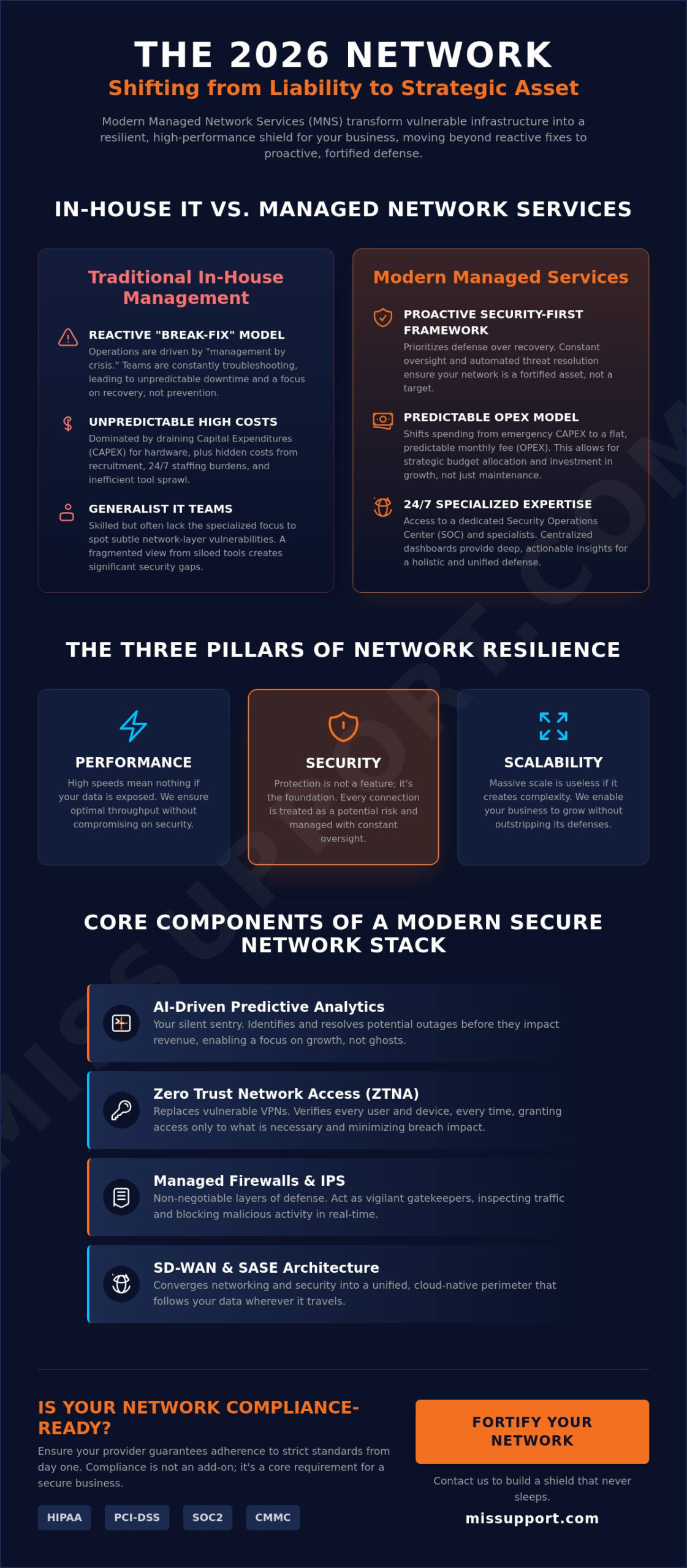
Connectivity is the lifeblood of your operation. In 2026, simply staying “online” is no longer the standard for success. Modern managed network services represent a total shift from the outdated “break-fix” model toward a proactive, security-integrated management of your entire digital infrastructure. Unlike traditional managed services that focus solely on maintenance, this “Vigilant Guardian” approach treats every connection as a potential entry point for risk. It demands constant oversight. It requires immediate action. It ensures your network remains a strategic asset rather than a growing liability.
Core Components of a Secure Network Stack
Modern architecture replaces aging infrastructure with agile, cloud-native solutions. SD-WAN and SASE converge wide-area networking with advanced security protocols to create a unified perimeter. This perimeter follows your data wherever it travels. Managed firewalls and Intrusion Prevention Systems (IPS) serve as standard, non-negotiable layers of defense. For remote access, Zero Trust Network Access (ZTNA) has effectively replaced vulnerable VPNs. It verifies every user and every device, every time. It grants access only to what is necessary, minimizing the blast radius of any potential breach.
The 2026 Shift: AI and Automation in MNS
Automation is your silent sentry. AI-driven predictive analytics now identify and resolve potential outages before they impact your revenue. Automated patch management and firmware updates provide a relentless defense against zero-day exploits. This ensures your systems are fortified without the delays of manual intervention. Your internal team can stop chasing ghosts and start focusing on growth. Network Resilience is the ability to maintain operations during an active threat.
Evaluating Managed Network Services vs. In-House Management
Control is not the same as visibility. Legacy tools often provide a fragmented, siloed view of your infrastructure. In contrast, modern managed network services offer centralized dashboards that deliver deep, actionable insights in real time. M.I.S. Support, Inc. positions its secure managed IT services as the essential bridge between your internal goals and our external expertise. This transparency ensures you see threats before they materialize.
Cost-Benefit Analysis: CAPEX to OPEX
Capital expenditures for hardware refreshes are unpredictable and draining. Moving to an OPEX model through managed lifecycle services eliminates these spikes. You trade sudden, high-cost emergency response invoices for predictable, flat monthly billing. This shift allows you to redirect your internal IT talent. They can stop patching servers and start driving high-value business growth initiatives. It’s about investing in outcomes rather than just buying boxes.
The ‘Security Gap’ in Traditional IT Departments
Generalist IT teams are skilled, but they often lack the specialized focus required to spot subtle network-layer vulnerabilities. A single misconfigured port can bypass years of perimeter defense. Effective protection requires 24/7 SOC integration that monitors your traffic at all times. By linking your network performance directly to managed cybersecurity services, you create a holistic defense system. You aren’t just connecting devices. You’re building a shield that never sleeps. Strengthening your human layer is equally critical; implementing robust security awareness training for employees ensures your staff becomes an active line of defense rather than an exploitable vulnerability.
Choosing Your Managed Network Services Provider: Critical Selection Criteria
Selecting a partner to oversee your infrastructure is a high-stakes decision. It requires more than just a basic definition of managed network services; it requires a deep audit of operational philosophy. You must determine if a provider treats security as a fundamental foundation or a secondary feature. In 2026, a “bolt-on” security model is an invitation to failure. Your provider must demonstrate rigorous compliance expertise, ensuring your network architecture adheres to HIPAA, PCI-DSS, or SOC2 standards from day one. Compliance is not a static checkbox. It’s a continuous state of readiness.
Demand total transparency in Service Level Agreements (SLAs). While “five nines” of uptime is a common industry baseline, it’s no longer the only metric that matters. You must hold providers accountable for their Mean Time to Detect (MTTD). If an anomaly enters your environment, speed of detection determines the severity of the impact. To bridge the gap between technical connectivity and business risk, look for providers offering virtual CISO services. This strategic depth ensures your network evolves alongside your broader corporate objectives.
SLA Essentials for the Modern Enterprise
Uptime guarantees are hollow if your applications suffer from crippling latency or jitter. Your SLA should include specific performance benchmarks for these metrics to ensure a seamless user experience. Beyond the data, evaluate the human element. Ensure you have clear escalation paths and direct access to dedicated account engineers who understand your specific environment. An SLA is a promise of performance, but a partnership is a commitment to your business continuity.
Scalability and Future-Proofing
Your network must be as agile as your business strategy. A superior managed network services provider supports hybrid cloud and multi-cloud environments without introducing friction. Whether you are navigating rapid M&A activity or managing massive seasonal spikes, your infrastructure must scale instantly. Don’t let legacy limitations dictate your growth. Secure your perimeter and your performance with M.I.S. Support, Inc. Fortify your network today.
Secure Your Digital Perimeter for 2026
The transition from legacy infrastructure to modern connectivity requires a disciplined, security-first mindset. You’ve seen how the shift from reactive troubleshooting to proactive oversight prevents downtime and secures your revenue. By prioritizing Mean Time to Detect (MTTD) and strategic alignment, managed network services move beyond basic maintenance to become a vital force for operational resilience. This evolution ensures your technology serves your business goals without introducing unmanaged risk.
M.I.S. Support, Inc. brings over 25 years of battle-hardened IT expertise to act as your vigilant guardian. We deliver 24/7 Threat Monitoring & Response and comprehensive Compliance & Risk Management to fortify every layer of your stack. Don’t leave your perimeter to chance. Stop managing crises and start commanding your digital environment with a partner that understands the high stakes of the 2026 landscape.
Fortify your infrastructure with a Security-First Network Audit.
Take the decisive step toward total stability today. Your organization’s future resilience depends on the strategic choices you make right now. We’re ready to stand as your shield.
Frequently Asked Questions
What is the difference between Managed IT Services and Managed Network Services?
Managed IT services cover your entire technology stack, including end-user helpdesk support, mobile device management, and software updates. In contrast, managed network services focus specifically on the infrastructure that facilitates connectivity. This includes the disciplined management of routers, switches, and firewalls to ensure your data pathways remain open, fast, and fortified against intrusion.
How do managed network services improve cybersecurity?
These services integrate security into the network fabric rather than treating it as a secondary layer. By implementing Zero Trust Network Access and managed firewalls, providers block threats at the very edge of your perimeter. 24/7 threat monitoring identifies anomalies in real time. This proactive stance stops lateral movement within your infrastructure before a breach can escalate into a catastrophe.
Can managed network services help with regulatory compliance?
Yes, specialized providers design your infrastructure to meet the rigorous standards of HIPAA, PCI-DSS, and the latest CMMC requirements. They maintain the detailed logs and encryption protocols required for successful audits. This systematic approach reduces the risk of non-compliance penalties. It provides a documented trail of your commitment to data integrity and risk management.
What should be included in a Managed Network Services SLA?
A modern SLA must go beyond simple uptime percentages. It should define clear benchmarks for latency, packet loss, and Mean Time to Detect (MTTD) security incidents. Demand transparency regarding escalation paths and access to senior engineers. An effective agreement holds the provider accountable for both the speed of your connection and the safety of your data.
How does SD-WAN fit into a managed network service?
SD-WAN is the backbone of modern, agile connectivity. It allows for the intelligent routing of traffic across hybrid cloud and multi-cloud environments. When integrated into managed network services, it provides the foundation for SASE (Secure Access Service Edge). This ensures that your security policies follow your data regardless of where your employees or servers are located.
Will I lose control over my network if I use a managed provider?
You don’t lose control; you gain superior oversight. While the provider handles the manual configuration and routine patching, you retain authority through centralized dashboards. These tools offer deeper visibility into traffic patterns and security events than legacy systems can provide. You spend less time troubleshooting hardware and more time making strategic decisions for your business. For a deeper understanding of how proactive defense strategies protect your enterprise, explore our guide to information security services and the frameworks that keep your data safe in 2026.