
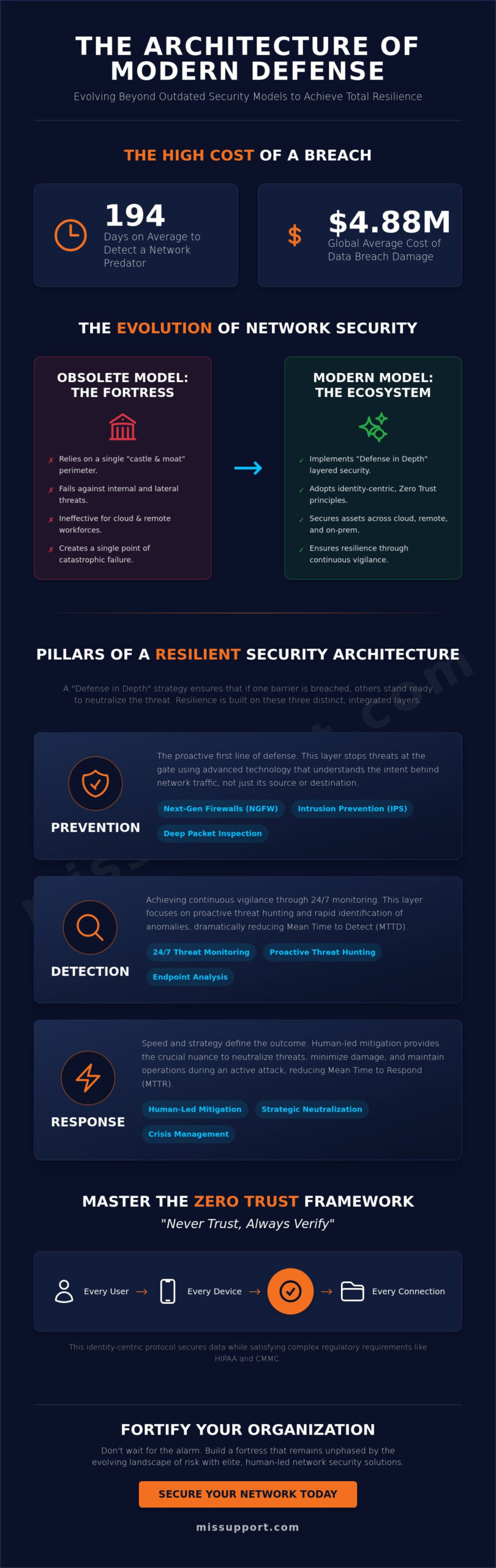
It takes the average business 194 days to realize a predator is already inside their network. By the time the alarm sounds, the global average cost of the damage has reached $4.88 million. You likely feel the weight of this reality every time a new, urgent alert pings your dashboard. The volume of threats is overwhelming. Finding skilled talent to manage them is nearly impossible. You need more than just software; you need elite network security solutions that act as a tireless, disciplined shield for your operations.
You understand that a single ransomware attack could mean total business extinction. It’s a high-stakes environment where new compliance deadlines, such as the CIRCIA 72-hour reporting rule, leave no room for error. We promise to provide the strategic roadmap you need to master the architecture of modern defense. This guide evaluates the current landscape, implements resilient frameworks, and manages the systems that ensure zero breach-induced downtime. We will explore how to bridge the gap between technical data and strategic oversight. You’re about to build a fortress that remains unphased by the evolving landscape of risk.
Key Takeaways
- Evolve beyond the firewall. Transition from outdated perimeter models to identity-centric defense to secure your digital assets in a perimeter-less environment.
- Construct a “Defense in Depth” architecture. This strategy layers elite network security solutions across prevention, detection, and response to ensure no single point of failure.
- Master the Zero Trust framework. Discover how the “Never Trust, Always Verify” protocol secures your data while satisfying complex regulatory requirements like HIPAA and CMMC.
- Validate your readiness with an audit-first roadmap. Use internal and external penetration testing to expose vulnerabilities before adversaries can exploit them.
- Achieve continuous vigilance. Understand how 24/7 threat monitoring and response provide the strategic oversight necessary for total business resilience.
Table of Contents
Beyond the Firewall: The Evolution of Network Security Solutions in 2026
Defense isn’t a product. It’s a posture. Modern network security solutions have evolved from simple barriers into an integrated ecosystem of tools, protocols, and human intelligence. In an era where threats are constant, relying on a single piece of software is a strategic failure. True security requires a holistic approach that combines advanced technology with the seasoned judgment of a vigilant guardian. You need a system that doesn’t just block; it understands.
This philosophy of proactive, multi-layered protection extends beyond digital networks. For example, those interested in how advanced laser sensors provide precision defense and parking assistance for physical assets can learn more about AL Priority USA.
The foundational principles of network security involve protecting the usability and integrity of your data. However, the methods used to achieve this have shifted fundamentally. We’ve moved away from the traditional perimeter-based model. We now focus on identity-centric defense. This means verifying every user, every device, and every connection, regardless of where they sit on the globe. We don’t just wait for an alert to sound; we engage in proactive threat hunting to find and neutralize risks before they manifest into a crisis. It’s about staying one step ahead of the adversary at all times.
The Death of the Traditional Perimeter
The "castle and moat" strategy is obsolete. In a cloud-first, distributed world, your data no longer lives behind a single stone wall. It’s scattered across SaaS platforms, remote endpoints, and hybrid infrastructures. When the perimeter is fluid, attackers prioritize lateral movement. They gain a foothold through a single vulnerable device and then crawl through the internal network to find high-value targets. This reality makes internal network security solutions just as vital as external defenses. Organizations must prioritize internal penetration testing and gap assessments to identify these hidden paths. You must secure the interior as aggressively as the border. The enemy is often already inside the gates.
Vigilance as a Service: Why Real-Time Response Matters
Speed defines the outcome of a cyberattack. We measure success through Mean Time to Detect (MTTD) and Mean Time to Respond (MTTR). Automated blocking tools are helpful, but they aren’t enough. They can be bypassed, or worse, they can trigger false positives that paralyze your operations. Human-led threat mitigation provides the nuance needed to distinguish between a legitimate spike in traffic and a sophisticated data exfiltration attempt. Our approach focuses on three core actions: observe, analyze, and neutralize. 24/7 monitoring ensures that when an adversary strikes at 3:00 AM, a strategist is already there to meet them. Network resilience is the ability to maintain operations during an active attack.
The Essential Pillars of a Resilient Security Architecture
Resilience is built on layers. A single point of failure is a strategic liability. To achieve total operational resilience, your network security solutions must be categorized into three distinct layers: prevention, detection, and response. This "Defense in Depth" philosophy ensures that if one barrier is breached, others remain to neutralize the threat. It combines the brute force of perimeter hardware with the surgical precision of endpoint analysis and the strategic oversight of human led monitoring. You can’t rely on a single wall when the adversary is capable of digging tunnels.
Data security isn’t just about keeping people out. It’s about protecting what is already inside. Encryption and Data Loss Prevention (DLP) serve as the final safeguards for your sensitive assets. These tools ensure that even if data is intercepted, it remains unreadable and cannot be exfiltrated without authorization. The synergy between endpoint protection and network level traffic analysis creates a comprehensive view of your environment. It allows you to see the full story of an attack, from the initial entry to the attempted data theft.
Next-Generation Firewalls (NGFW) and Intrusion Prevention
Legacy firewalls only look at ports and addresses. Modern NGFWs perform deep packet inspection to understand the intent behind the traffic. They identify malicious applications hidden within legitimate streams. Intrusion Prevention Systems (IPS) take this further by neutralizing known exploit patterns in real time. By integrating global threat intelligence feeds, these systems stay updated on emerging risks before they reach your network. It’s a proactive stance that stops threats at the gate.
Endpoint Defense and Ransomware Prevention
The endpoint is the new front line. With remote work and distributed teams, every laptop and mobile device is a potential entry point. Traditional antivirus signatures are no longer enough to stop modern threats. You need behavioral based detection that identifies suspicious activity, such as unauthorized file encryption. Strong ransomware defense mechanisms, including file integrity monitoring and automated isolation, can stop an infection in its tracks. Validating these defenses through comprehensive network security audits ensures your front line remains unyielding.
Cloud Security and Microsoft 365 Hardening
Cloud environments present unique vulnerabilities. Misconfigurations are a primary cause of breaches. Hardening Microsoft 365 is critical because approximately 90% of cyberattacks are caused by human error. This involves implementing multi factor authentication, restrictive access policies, and continuous monitoring to prevent account takeovers. Aligning your cloud strategy with established Compliance Frameworks provides a clear path to regulatory stability. Secure cloud migration services ensure that your transition to the cloud doesn’t leave gaps for adversaries to exploit. Your digital transformation must be as secure as it is efficient.
Strategic Integration: Zero Trust and Compliance Frameworks
Security is no longer a technical silo. It is a fundamental pillar of business strategy. In the modern landscape, implementing network security solutions that satisfy specific regulatory requirements is a mandatory requirement for survival. Whether you are navigating the complexities of HIPAA in healthcare, PCI-DSS in retail, or the rigorous CMMC standards for defense contracting, your defense must be audit-ready. Compliance isn’t a checkbox. It’s a continuous state of readiness that proves your organization can protect the sensitive data entrusted to it.
To achieve this, we adopt the Zero Trust model. This strategic philosophy operates on a simple, uncompromising principle: "Never Trust, Always Verify." We assume the network is already compromised. By integrating these network security solutions into a cohesive business strategy, we move away from broad access and toward granular, risk-based control. We prioritize the "Crown Jewels" of your organization. We identify your most critical assets, protect them with the highest level of scrutiny, and sustain that defense through constant validation. This approach ensures that even if a perimeter is breached, your most vital data remains isolated and secure.
Implementing Zero Trust Network Access (ZTNA)
The era of the traditional VPN is ending. While VPNs provide a tunnel into the network, they often grant too much trust once a user is inside. ZTNA replaces this "connect-then-authenticate" model with "authenticate-then-connect." It uses Identity Access Management (IAM) as its foundation to ensure that only authorized users on healthy devices can reach specific applications. We utilize micro-segmentation to divide the network into small, isolated zones. This prevents an attacker from moving laterally between systems. If one segment is compromised, the rest of the network remains dark to the intruder. You don’t just secure the entrance; you secure every room in the building.
The vCISO: Strategic Oversight for Mid-Market Resilience
Enterprise-grade security requires executive-level leadership. However, many mid-market organizations don’t need a full-time, seven-figure security executive. This is where Virtual CISO (vCISO) services bridge the gap. A vCISO acts as your battle-hardened strategist. They translate technical risks into business impact, ensuring your security spend aligns with your growth goals. They lead the charge in conducting cybersecurity gap assessments to identify where your defenses are thin. This strategic consulting provides the oversight necessary to manage complex risk management programs. You gain the wisdom of a seasoned professional who understands the gravity of the 2026 threat landscape without the overhead of a permanent hire. It’s about having a guardian who is always "on," guiding your path toward total operational stability.
Evaluating and Implementing Your Defense Roadmap
Implementation is not a single event. It is a disciplined progression. Deploying elite network security solutions without a strategic roadmap often leads to fragmented defenses and wasted capital. To build true resilience, you must follow an "Audit-First" methodology. This ensures that every tool you deploy addresses a verified weakness rather than a theoretical risk. You don’t build a fortress by guessing where the ground is soft; you survey the land first. A structured approach transforms your security from a reactive expense into a proactive business advantage.
A phased rollout is the only way to maintain operational stability while fortifying your environment. Modern businesses cannot afford downtime caused by over-aggressive configuration changes. We prioritize high-risk segments first, ensuring that your most critical data is shielded immediately. This methodical pace allows for continuous testing and refinement. It ensures your team adapts to new protocols without being overwhelmed by a sudden shift in workflow. Stability and security must move in lockstep.
The Audit: Identifying Vulnerabilities and Gaps
A vulnerability scan is merely a "check engine" light. A comprehensive security audit is a full mechanical inspection. While scans identify known software bugs, an audit examines your entire posture, including configurations, user permissions, and policy enforcement. Internal and external penetration testing serves as the ultimate stress test. It reveals the hidden entry points that automated tools miss by simulating the creative tactics of a human adversary. In 2026, these audits are no longer optional for those seeking cyber insurance. Underwriters now demand proof of regular testing and gap remediation to maintain eligibility and manage premiums. You must prove your resilience before you can insure it. Engaging professional cybersecurity risk assessment services transforms this process from a static report into a blueprint for active, strategic resilience. Organizations looking for real-world evidence of this approach can explore how cyber security assessment services drive strategic resilience and risk mitigation through a documented case study.
Managed IT vs. In-House Security: The ROI Analysis
Building an in-house Security Operations Center (SOC) is a massive undertaking. The total cost of ownership includes not just the technology, but the continuous recruitment and retention of specialized talent. The industry currently faces a severe talent gap; finding and keeping analysts who can manage a 24/7 threat landscape is both difficult and expensive. Managed providers solve this by offering a battle-hardened team that is always "on." This proactive management reduces the long-term costs associated with disaster recovery and business continuity. You gain enterprise-level defense without the executive overhead of a full-time internal department. To begin your journey toward a more secure future, schedule a cybersecurity gap assessment to see where your current defenses stand.
Fortifying Your Organization with MIS Support.
MIS Support acts as the battle-hardened strategist for national organizations that demand uncompromising stability. We understand that the margin for error has vanished. While many providers focus solely on selling software licenses, we deliver a comprehensive protective force. Our network security solutions integrate managed IT services with advanced cloud security and strategic compliance consulting. This holistic approach ensures that your defense isn’t a collection of siloed tools, but a unified ecosystem designed to withstand the most sophisticated adversaries. We provide the strategic oversight required to keep your business moving forward, no matter the threat environment.
True resilience requires a proactive stance. We don’t wait for a breach to occur before we act. Our ransomware defense and disaster recovery planning are baked into the core of our service model. We focus on business continuity, ensuring that your operations can survive even the most aggressive digital assaults. By combining internal and external penetration testing with regular vulnerability assessments, we eliminate the gaps that attackers exploit. You gain a partner that is as invested in your survival as you are. We provide elite network security solutions that act as a reliable shield for organizations that are overextended.
24/7 Vigilance: Our Security Operations Center (SOC)
Continuous oversight is the only way to achieve total peace of mind. Our SOC provides 24/7 threat monitoring and response, led by experts who understand the gravity of every alert. When a threat is detected, our rapid response protocols trigger immediate action to isolate the danger and neutralize the risk. This speed is critical for minimizing the impact of a digital incident and preventing lateral movement within your network. MIS Support’s national reach ensures that your infrastructure remains stable across all locations. We maintain a tireless, disciplined watch so you don’t have to.
Compliance and Resilience: A Partnership for Growth
A secure organization is a scalable organization. Our Virtual CISO services bridge the gap between technical defense and executive strategy, driving operational resilience across your entire enterprise. We help you navigate the complexities of modern regulations, ensuring your path to compliance is clear and documented. This partnership allows you to transform your security posture from a potential liability into a competitive advantage. Clients and partners trust businesses that can prove their structural integrity. It’s time to replace anxiety with strategic preparedness. Fortify your network today with a comprehensive security assessment and secure your organization’s future.
Secure Your Operational Future
The landscape of 2026 demands more than just passive defense. You’ve seen how the shift toward Zero Trust and identity centric models has redefined the perimeter. Resilience is no longer about building higher walls; it’s about deep visibility and rapid response. By adopting an audit first roadmap and integrating expert oversight, you transform security from a source of anxiety into a foundation for growth. You move from being a target to being a fortress.
MIS Support has served as a vigilant guardian since 1998. We bring decades of battle hardened experience to every partnership. Our approach combines 24/7 proactive threat monitoring with expert vCISO and compliance consulting to ensure your organization remains unphased by evolving risks. You don’t have to manage the overwhelming volume of alerts alone. We provide the elite network security solutions necessary to maintain total operational stability and protect your critical infrastructure.
Take the decisive step toward a fortified future. Secure Your National Infrastructure with a Professional Risk Assessment. Your path to total resilience starts with a single, strategic choice. You’re ready to lead your organization with confidence and certainty.
Common Questions Regarding Network Security Solutions
What is the difference between network security and cybersecurity?
Cybersecurity is the broad discipline of protecting all digital assets and systems; network security is the specialized practice of fortifying the infrastructure that connects them. It targets the integrity of data in transit and the usability of the internal network. While cybersecurity covers everything from software development to physical data centers, network security focuses on firewalls, encryption, and access control to maintain structural integrity.
How do managed network security solutions reduce business risk?
Managed network security solutions reduce risk by providing continuous, expert led oversight that automated tools lack. They bridge the gap between detection and neutralization. By utilizing 24/7 monitoring and response, these services identify anomalies in real time before they manifest into a crisis. This proactive stance prevents minor vulnerabilities from escalating into the type of catastrophic breaches that lead to business extinction.
Why is penetration testing necessary if I already have a firewall?
A firewall is a locked door, but penetration testing is a professional locksmith checking for hidden keys and open windows. Even the most advanced hardware can be bypassed through misconfigurations or lateral movement. Regular internal and external penetration testing validates that your defenses actually work under the pressure of a simulated attack. It exposes the creative entry points that automated scans often miss.
Can a virtual CISO (vCISO) help my business meet compliance requirements?
A vCISO provides the strategic leadership necessary to navigate complex regulations like HIPAA, PCI-DSS, or CMMC. They lead cybersecurity gap assessments to identify where your current controls fail to meet legal standards. This oversight ensures your security spend is focused on both protection and audit readiness. They act as your primary strategist for risk management and regulatory stability.
What are the most common network security threats for businesses in 2026?
Ransomware, credential theft, and supply chain vulnerabilities are the primary threats in the 2026 landscape. Attackers now use advanced techniques to exploit the 90% of breaches caused by human error. You must also account for shorter regulatory reporting windows, such as the 72 hour CIRCIA requirement for critical infrastructure. Defending against these requires a multi-layered, identity centric approach that assumes the network is always under observation.
How does Zero Trust Network Access (ZTNA) improve remote work security?
ZTNA replaces the outdated "connect then authenticate" model of traditional VPNs with a stricter "authenticate then connect" protocol. It ensures that remote workers only access the specific applications they need to perform their duties. By verifying identity, device health, and location for every request, ZTNA prevents compromised devices from infecting the broader network. It treats every connection as a potential risk until proven otherwise.
What should be included in a disaster recovery and business continuity plan?
Your plan must include clear communication hierarchies, redundant data backup protocols, and defined restoration timelines. It identifies critical business functions and the steps required to keep them operational during an active crisis. A robust plan also incorporates disaster recovery testing to ensure your team can execute the strategy under high stakes pressure. It serves as your blueprint for maintaining resilience during an attack.
How much do managed cybersecurity services typically cost for a mid-sized firm?
Costs for managed services vary based on the scale of your infrastructure and the depth of required monitoring. Factors such as the number of protected endpoints, the complexity of your compliance needs, and the frequency of penetration testing influence the final investment. Some industry professionals report that pricing is typically structured per user or per device. You should consult with a provider to receive a tailored quote for your specific operational requirements.