
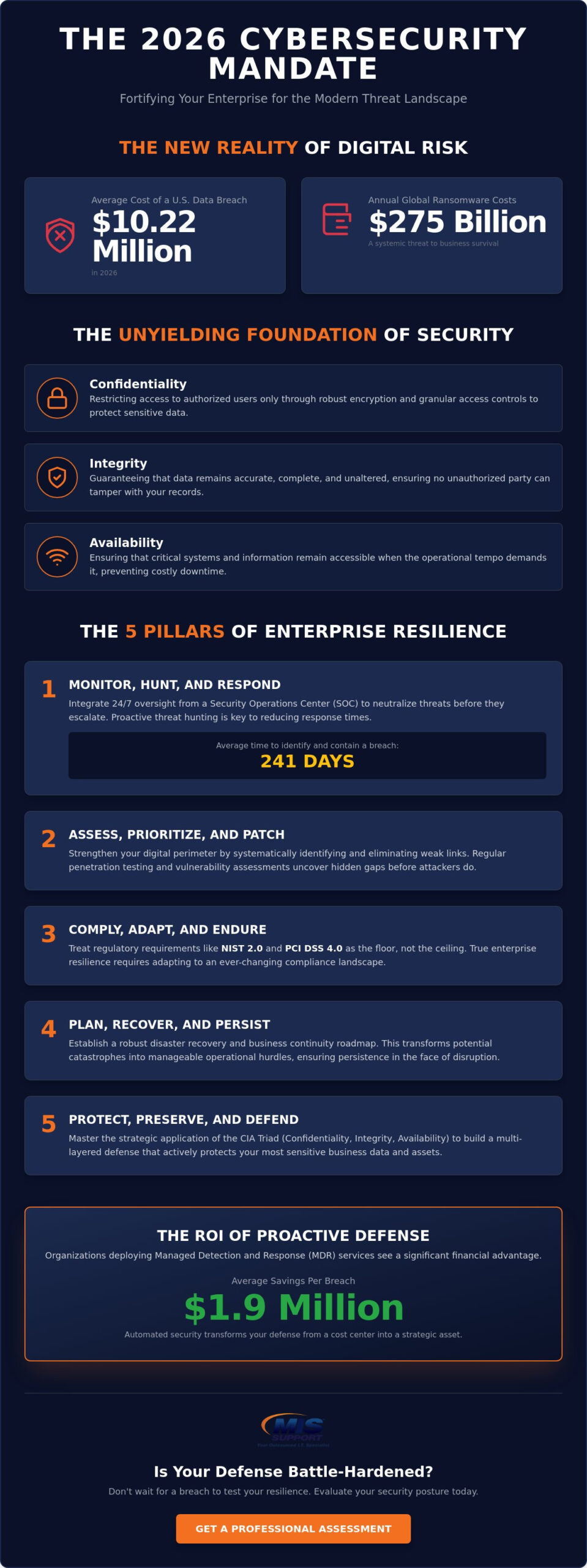
In 2026, the average cost of a data breach in the United States has climbed to an all-time high of $10.22 million. This figure represents more than a financial loss; it reflects a systemic threat to your enterprise’s survival. You’re likely facing the relentless pressure of an environment where global ransomware costs are hitting $275 billion annually. Implementing robust information security services is no longer a back-office task. It’s a strategic mandate. It’s understandable to feel anxious about the complexity of NIST 2.0 or the strict requirements of PCI DSS 4.0. You need a defense that’s tireless, observant, and decisive.
You recognize that checkbox compliance isn’t enough to stop a sophisticated adversary. We’re here to help you master the core components of modern information security to protect your assets and ensure operational stability. This guide provides a clear roadmap for reducing digital risk through managed oversight and proactive defense. We’ll explore the essential pillars of resilience, from 24/7 monitoring to endpoint protection. By the end, you’ll have the strategic confidence to fortify your perimeter, secure your data, and lead your organization with a battle-hardened posture.
Key Takeaways
- Protect, preserve, and defend. Master the strategic application of confidentiality, integrity, and availability to secure your most sensitive business data.
- Monitor, hunt, and respond. Integrate 24/7 oversight into your information security services to neutralize threats before they escalate into breaches.
- Assess, prioritize, and patch. Strengthen your digital perimeter by identifying and eliminating the weak links within your technical infrastructure.
- Comply, adapt, and endure. Learn why treating regulatory requirements as the floor rather than the ceiling is essential for true enterprise resilience.
- Plan, recover, and persist. Establish a robust disaster recovery roadmap that transforms potential catastrophes into manageable operational hurdles.
Defining Information Security Services in a High-Stakes Digital Era
Modern information security isn’t just about locking doors. It’s about building a digital fortress that breathes and adapts. In 2026, the stakes are absolute. A single breach now costs U.S. enterprises an average of $10.22 million. Information security services provide the strategic framework, specialized technologies, and expert oversight required to shield your digital assets from this volatility. We’ve moved past the era of reactive “break-fix” IT. Today, enterprise resilience demands a proactive, vigilant defense that anticipates threats before they manifest. This is the shift from basic maintenance to battle-hardened strategic oversight.
The CIA Triad: The Foundation of Digital Fortification
The core mission of any resilient enterprise rests on three unyielding pillars. These concepts form the structural integrity of your defense posture. Without one, the entire system collapses under pressure. A comprehensive strategy addresses each with equal intensity.
- Confidentiality: Restricting access to authorized users only. We employ robust encryption and granular access controls to keep proprietary data in the right hands.
- Integrity: Guaranteeing that data remains accurate, complete, and unaltered. We ensure that no unauthorized party can tamper with your records or corrupt your files.
- Availability: Ensuring critical systems remain accessible. Your business cannot afford downtime. Your information must be available whenever the operational tempo demands it.
The Evolution of Managed Cybersecurity Services
Perimeter defense is no longer sufficient. The “castle and moat” strategy fails when threats originate from within or through compromised supply chains. Modern organizations are transitioning to managed cybersecurity services that prioritize “Zero Trust” architectures. This model assumes no user or device is inherently safe. You must verify every request, secure every endpoint, and hunt every anomaly. In 2026, a defense-in-depth approach is the only way to counter the $275 billion annual cost of global ransomware. Implementing comprehensive information security services ensures your organization remains unphased by the complexity of the modern threat landscape. It’s a relentless, 24/7 commitment to operational stability.
Core Pillars of a Comprehensive Security Framework
Resilience isn’t a static state. It’s a continuous cycle of detection, containment, and neutralization. To survive the current threat landscape, your organization needs more than a firewall; it needs a living defense system. This system is built upon several critical pillars that work in unison to protect your assets. High-tier information security services provide the architecture for this defense, ensuring that no single point of failure can bring down your operations. We focus on identifying anomalies, patching vulnerabilities, and securing every endpoint.
Continuous Monitoring and Threat Detection
A Security Operations Center (SOC) acts as your digital sentry, providing 24/7 vigilant oversight. Real-time threat intelligence is the key to reducing your Mean Time to Respond (MTTR), which is vital since the average breach takes 241 days to identify and contain. By integrating managed network services, you gain holistic visibility across your entire infrastructure. This allows for proactive threat hunting rather than reactive firefighting. Adopting essential cybersecurity measures ensures your team isn’t just watching the gates but actively searching for intruders who have already slipped through.
Testing the Shield: Penetration Testing and Audits
You don’t trust a shield that hasn’t been tested. Regular vulnerability assessments identify the “weak links” in your digital chain, but penetration testing goes further. Penetration testing is a proactive stress test for digital defenses. While a surface-level scan might find a missing patch, a deep-dive security audit uncovers the complex logic flaws that attackers exploit. We simulate real-world attacks through internal and external testing to find exploitable gaps before a malicious actor does. If you aren’t sure where your vulnerabilities lie, it’s time to evaluate your current defense posture with a professional assessment.
Managed detection and response (MDR) adds the final layer of rapid incident containment. It ensures that when a threat is detected, it’s neutralized within minutes, not months. Organizations that deploy these automated information security services save an average of $1.9 million per breach according to recent industry data. This level of fortification transforms your security from a cost center into a strategic asset.
Strategic Implementation: Aligning Security with Business Goals
Compliance is the floor, not the ceiling. In 2026, meeting regulatory standards like NIST 2.0 or PCI DSS 4.0 is merely a starting point, not a final destination. True resilience requires moving beyond checkboxes toward an integrated model of enterprise governance of I&T. When you align information security services with your core business objectives, you transform a defensive necessity into a competitive advantage. This alignment protects your brand reputation and builds deep trust with your clients. They need to know their data is handled with a battle-hardened sense of duty.
Prepare for the “when,” not the “if.” Disaster recovery and business continuity planning are the bedrock of operational stability. A catastrophic breach or system failure doesn’t have to be terminal. By establishing clear recovery protocols, you ensure your organization can absorb a blow and continue to function. This proactive movement is supported by robust security awareness training for employees. Your employees are your first line of defense; fortifying this “human firewall” is essential to stop social engineering before it breaches your perimeter.
Virtual CISO (vCISO): Executive Leadership on Demand
Growing organizations often face a leadership gap. They need strategic oversight but may not require a full-time executive. Our virtual ciso services bridge this gap by providing enterprise-grade leadership on demand. A vCISO translates technical risks into business impact. They focus on policy development, strategic risk management, and long-term stability. This ensures your security posture evolves alongside your business goals, keeping you observant and decisive in a volatile market.
Selecting the Right Security Partner
Choosing a partner is a high-stakes decision. You need a cybersecurity services company that offers more than just software. Evaluate potential partners based on their experience, response times, and technological stack. It’s critical to select an ally that understands the broader secure managed IT services landscape. Your next step should be a comprehensive cybersecurity gap assessment. This process identifies your current posture and provides a roadmap for fortification. Don’t wait for a crisis to test your resolve. Implement professional information security services today to secure your enterprise’s future.
Fortify Your Future: The Path to Enterprise Resilience
The threat landscape in 2026 demands more than passive defense. It requires a battle-hardened strategy that integrates technical vigilance, executive oversight, and proactive testing. You’ve seen that modern information security services are the backbone of this resilience. They transform your security posture from a potential vulnerability into a reliable shield. By aligning your defense with your business goals, you don’t just survive; you thrive in a volatile digital economy.
M.I.S. Support, Inc. brings nearly 30 years of defensive expertise to your perimeter. Founded in 1998, we’ve spent decades mastering 24/7 threat monitoring and response. We specialize in internal and external penetration testing to ensure your digital fortress remains impenetrable under pressure. It’s time to move from anxiety to action. Secure your organization with a comprehensive Cybersecurity Gap Assessment from M.I.S. Support, Inc. You don’t have to face these high-stakes challenges alone. With a vigilant ally by your side, you can lead your enterprise with confidence and strength.
Frequently Asked Questions
What is the difference between cybersecurity and information security services?
Information security is the broad umbrella protecting all data forms, while cybersecurity is the specific defense of digital networks. While cybersecurity focuses on shielding your perimeter from digital intruders, information security services cover the entire lifecycle of data protection. This includes physical safeguards, policy development, and the strategic alignment of confidentiality, integrity, and availability across every business asset, whether digital or physical.
How do information security services help with regulatory compliance like HIPAA or SOC2?
These services provide the technical controls and administrative frameworks required to meet rigorous audit standards like HIPAA or SOC2. We implement 24/7 monitoring, granular access logs, and encryption protocols that serve as documented proof of compliance. Instead of struggling with complex regulatory language, you gain a battle-hardened roadmap. This ensures your organization meets specific mandates for data privacy while maintaining operational integrity under scrutiny.
Why should a business choose managed security services over an in-house IT team?
Managed services provide specialized expertise and 24/7 vigilant oversight that most in-house teams cannot sustain alone. Internal IT often focuses on operational uptime and user support; they’re frequently overextended. A dedicated provider acts as a tireless guardian, offering advanced threat intelligence and rapid incident response. This fortifies your perimeter without the overhead of building a full-scale Security Operations Center from the ground up.
What are the most critical information security services for a mid-market enterprise?
Mid-market enterprises must prioritize 24/7 threat monitoring, endpoint protection, and regular vulnerability assessments. These information security services form a resilient foundation by identifying “weak links” before they’re exploited. Adding a Virtual CISO (vCISO) provides the necessary strategic leadership to align these technical defenses with your long-term business goals. This ensures you remain unphased by the evolving threat landscape and maintain a decisive defense posture.