
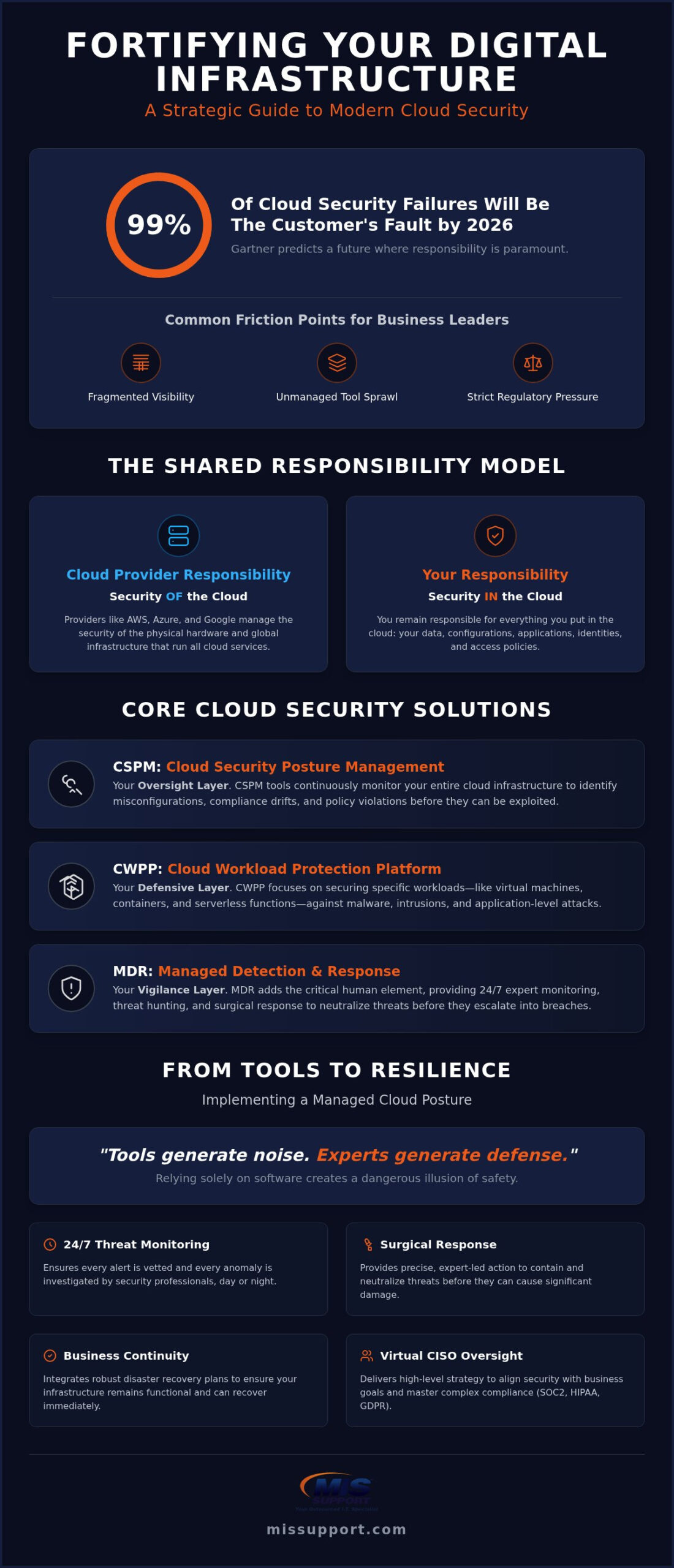
By the close of 2026, Gartner predicts that a staggering 99% of cloud security failures will be the customer’s fault. It’s a sobering reality for any leader deploying complex cloud security solutions across a multi-cloud environment. You likely face the daily friction of fragmented visibility, unmanaged tool sprawl, and the constant pressure of meeting strict regulatory requirements. It’s a high-stakes environment where one misconfiguration can invite catastrophe. The weight of this responsibility can feel overwhelming, but it doesn’t have to be a solo burden.
This guide empowers you to fortify your digital infrastructure with a comprehensive strategy for selecting and managing modern defenses. You’ll discover how to move beyond reactive patching to a state of strategic preparedness. We will detail the path toward a unified security posture, 24/7 vigilant threat monitoring, and the strategic oversight required to ensure your next audit is a non-event.
Key Takeaways
- Master the modern threat landscape. Transition from rigid, on-premises perimeters to the fluid, borderless infrastructure required for 2026 resilience.
- Evaluate essential tools for fortification. Understand the tactical differences between CSPM and CWPP to select the most effective cloud security solutions for your enterprise.
- Neutralize threats with surgical precision. Learn how Managed Detection and Response (MDR) provides the proactive defense needed to stop attacks before they cause damage.
- Build a resilient shield for your data. Implement a managed posture that integrates 24/7 monitoring, expert response, and strategic virtual CISO oversight.
Navigating the Cloud Threat Landscape: Why Basic Security Isn’t Enough
Cloud security solutions represent the integrated suite of technologies and processes engineered to shield your data, applications, and infrastructure from exploitation. Traditional on-premises security relied on physical walls and static perimeters. In 2026, the environment is fluid and borderless. You can’t rely on old maps for new territory. SentinelOne reports that 80% of organizations will face cloud data breaches this year due to identity drifts. Vigilance is your only constant. Defense must be total. It must be immediate. It must be precise.
Modern vulnerabilities aren’t just external. They’re structural. Primary risks stem from misconfigurations, insecure APIs, and credential theft. These cloud computing security issues require a “Vigilant Guardian” mindset. Deploying effective cloud security solutions means adopting a posture that is proactive, constant, and decisive. You aren’t just buying tools. You’re building a defense that never sleeps. It’s about strategic oversight and a deep understanding of the landscape of risk.
The Shared Responsibility Model: Knowing Your Defensive Borders
Providers like AWS, Azure, and Google manage the security of the cloud. They secure the physical hardware and global infrastructure. However, you remain responsible for everything in the cloud. This includes your data, your configurations, and your access policies. Assuming your provider handles every threat is a critical vulnerability that leaves your business exposed. Gartner predicts that 99% of cloud security failures through 2026 will be the customer’s fault. You must own your configuration. You must own your identities. You must own your response. The Shared Responsibility Model is the foundational contract of cloud defense.
Evaluating Core Cloud Security Solutions for Enterprise Fortification
Enterprise fortification requires a multi-layered arsenal. Cloud Security Posture Management (CSPM) serves as your oversight layer, identifying misconfigurations and compliance drifts across your entire infrastructure. Contrast this with Cloud Workload Protection Platforms (CWPP), which defend the specific applications, containers, and processes running within those environments. These cloud security solutions work in tandem to create a comprehensive shield. Managed Detection and Response (MDR) adds the human element, providing 24/7 vigilance to neutralize threats before they escalate into full-scale breaches.
Resilience is built on data, not assumptions. Use vulnerability assessments as a diagnostic tool to map your cloud health and prioritize patching. To validate your defenses, utilize penetration testing to simulate real-world attacks. This identifies the hidden gaps in configurations that automated tools might miss. This proactive approach ensures your security posture is battle-tested and ready for the 2026 threat landscape.
Fortifying the Microsoft 365 Environment
Microsoft 365 remains the primary entry point for business email compromise (BEC). It’s a high-value target that requires specialized defense. You must deploy advanced endpoint protection and ransomware defense to secure this critical ecosystem. Implement Zero Trust principles: verify every access request explicitly, grant only the least privilege required, and always assume a breach has occurred. If your internal team is overextended, partnering with an expert for managed IT services can provide the strategic oversight needed to harden these portals against sophisticated adversaries.
From Tools to Resilience: Implementing a Managed Cloud Posture
The most sophisticated cloud security solutions are effectively silent if no one is listening to their alerts. Tools generate noise. Experts generate defense. Relying solely on software creates a dangerous illusion of safety that crumbles during a real-time exploit. Transition from fragmented, reactive IT support to comprehensive managed cybersecurity services that provide 24/7 threat monitoring and surgical response. This shift ensures every alert is vetted, every anomaly is investigated, and every threat is neutralized.
Resilience requires more than stopping attacks. It demands operational stability. Your infrastructure must remain functional even when under fire. Integrating secure managed IT services provides the engine for this stability. It pairs proactive defense with robust disaster recovery and business continuity planning. If a cloud incident occurs, your recovery must be immediate, scripted, and total. You don’t just need a provider. You need a shield that is always on.
Virtual CISO Oversight and Strategic Compliance
Navigating the complex requirements of SOC2, HIPAA, or GDPR in the cloud isn’t a task for software alone. Specialized virtual CISO services provide the high-level strategy needed to master these standards. A vCISO acts as your strategic brain. They align your cloud security solutions with long-term business growth and risk appetite. They transform compliance from a burden into a demonstrable competitive advantage.
When choosing a managed security partner, prioritize these criteria:
- Demonstrated 24/7 monitoring and rapid response capabilities.
- Deep expertise in industry-specific compliance frameworks and audits.
- A proactive culture that values prevention, fortification, and strategic readiness.
Securing Your Digital Future: The Path to Total Resilience
The 2026 threat landscape demands a departure from reactive IT. You’ve seen that effective cloud security solutions require more than just software; they necessitate a managed posture built on 24/7 vigilance and strategic oversight. By embracing the shared responsibility model and hardening critical entry points like Microsoft 365, you transform your infrastructure from a vulnerability into a fortress. True resilience is a continuous process of assessment, monitoring, and expert response. Don’t leave your enterprise’s safety to chance or unmanaged toolsets. It’s time to move from uncertainty to strategic preparedness.
Fortify your cloud infrastructure with an expert Cybersecurity Gap Assessment from M.I.S. Support. Our team provides 24/7 Threat Monitoring & Response, proactive ransomware defense, and strategic vCISO guidance to ensure your operations remain stable. Your resilience starts now.
Frequently Asked Questions
What are cloud security solutions and why does my business need them?
Cloud security solutions are an integrated suite of technologies and processes designed to protect data, applications, and infrastructure from unauthorized access or exploitation. Your business needs them because traditional perimeter defenses are obsolete in a borderless digital environment. These tools provide the visibility and control necessary to prevent data breaches, ensure operational continuity, and maintain customer trust across diverse cloud platforms.
How do managed cloud security services differ from standard IT support?
Standard IT support focuses on operational uptime and general troubleshooting. In contrast, managed security services provide a specialized, defensive layer focused on risk mitigation. This includes 24/7 threat monitoring, proactive ransomware defense, and real-time incident response. While IT support keeps your systems running, managed security ensures they aren’t compromised by sophisticated adversaries seeking to exploit your cloud infrastructure.
Can cloud security solutions help my business meet regulatory compliance?
Yes. Modern cloud security solutions automate the monitoring and reporting required for frameworks like SOC2, HIPAA, and GDPR. By embedding compliance-as-code into your infrastructure, these tools ensure continuous adherence to strict regulatory standards. This proactive approach allows you to provide demonstrable proof of security during audits, reducing the risk of heavy fines and legal complications for your enterprise.
What is the most common security risk in cloud computing today?
Human error remains the most significant threat to cloud environments. This often manifests as misconfigured storage buckets, insecure APIs, or compromised credentials. Research indicates that the vast majority of cloud failures are the customer’s fault rather than the provider’s. Implementing strong identity management and regular vulnerability assessments is critical to closing these gaps before attackers can find them.
How does a Virtual CISO improve my cloud security strategy?
A Virtual CISO acts as your strategic brain, providing high-level leadership without the cost of a full-time executive. They align your security posture with your specific business goals and risk appetite. By coordinating gap assessments and penetration testing, a vCISO ensures your defenses are both comprehensive and efficient. They transform security from a technical hurdle into a strategic business advantage.
Is Microsoft 365 security included in my standard subscription?
Microsoft provides security of the underlying cloud infrastructure, but you’re responsible for the security in your specific environment. Standard subscriptions offer basic protections, but they often lack the advanced endpoint defense and 24/7 monitoring required to stop business email compromise. You must implement additional layers, such as managed Microsoft 365 security, to fully protect your data from modern ransomware threats.