
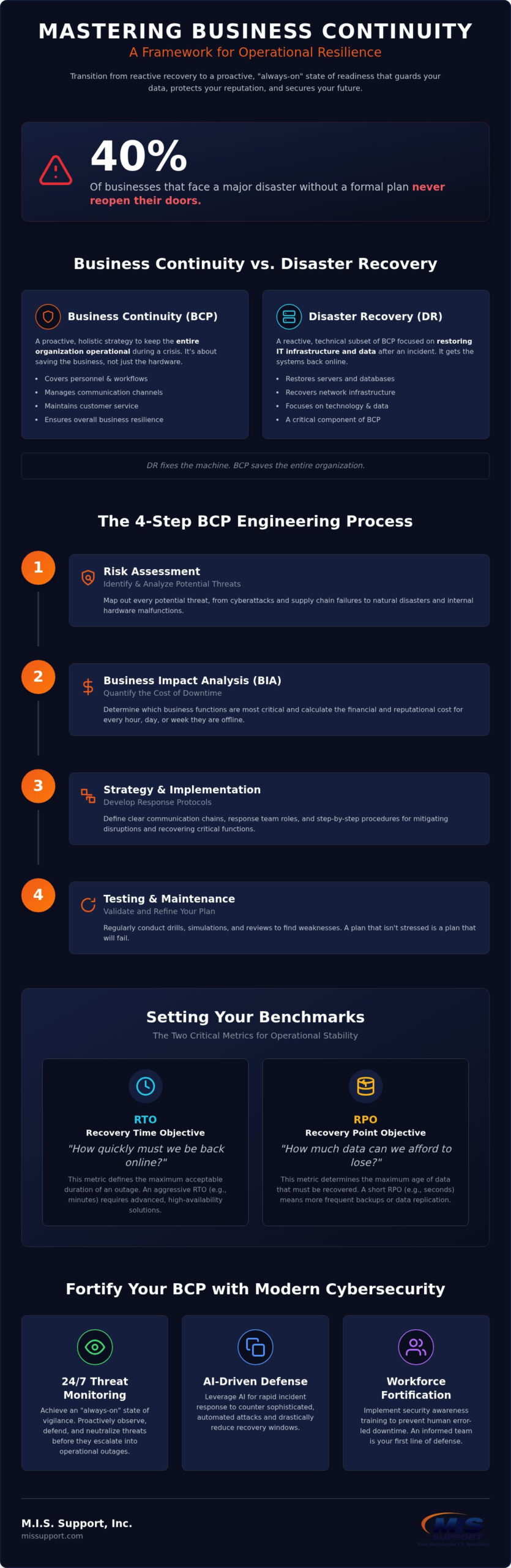
Forty percent of businesses that face a major disaster without a formal plan never reopen their doors. It’s a sobering reality for any leader who views downtime as a mere inconvenience rather than a terminal threat. Effective business continuity planning is no longer a static checklist stored in a drawer. It’s a proactive state of operational readiness that guards your data, protects your reputation, and secures your future. You likely already feel the pressure of rising cyber threats and the staggering cost of unplanned downtime, which can reach hundreds of thousands of dollars per hour. This article promises to help you master the essentials of resilience to shield your operations from any disruption. We’ll provide a clear roadmap to minimize recovery time and ensure your organization remains always-on, regardless of the crisis. It’s time to replace confusion with a battle-hardened strategy for stability.
Key Takeaways
- Transition from reactive recovery to a proactive, “always-on” state by mastering the core pillars of business continuity planning.
- Quantify the true cost of downtime and identify hidden vulnerabilities through structured risk assessments and Business Impact Analysis.
- Fortify your operations with 24/7 threat monitoring and AI-driven defense to stop disruptions before they impact your bottom line.
- Establish a clear roadmap for operational resilience that builds stakeholder confidence and ensures long-term organizational stability.
What is Business Continuity Planning? Defining the Resilience Framework
Survival demands more than a backup drive. Business continuity planning (BCP) is the proactive strategy that ensures your critical functions remain operational during a crisis. It’s the difference between a temporary pause and a permanent collapse. We’ve moved beyond the days of reactive recovery. The modern “Vigilant Guardian” approach focuses on operational resilience. It’s about being observant, decisive, and prepared before the first alert sounds. This mindset transforms potential anxiety into strategic readiness.
In 2026, the threat landscape is unforgiving. Sophisticated ransomware, fragile global supply chains, and climate-driven outages create a trifecta of risk. A robust BCP isn’t just a safety net; it’s a regulatory mandate for long-term growth. Adhering to standards like ISO 22301 or NIST CSF 2.0 provides a sharp competitive edge. It builds stakeholder trust, ensures stability, and facilitates rapid recovery. Without it, you aren’t just vulnerable to hackers. You’re vulnerable to total operational failure.
Business Continuity vs. Disaster Recovery: Understanding the Critical Difference
Many leaders confuse these terms, but the distinction is vital. Disaster Recovery (DR) is a technical subset of BCP. It focuses on restoring servers, databases, and network infrastructure. DR gets the hardware back online. BCP ensures the business keeps serving customers while that restoration happens. It covers personnel, workflows, and communication channels. To find the gaps in this framework, organizations utilize penetration testing to simulate failures. This identifies where your continuity might snap under real-world pressure. DR fixes the machine. BCP saves the entire organization.
The 4-Step Process for Effective Business Continuity Planning
Resilience isn’t accidental; it’s engineered. To move from vulnerability to fortification, follow a disciplined four-step process for business continuity planning. This cycle ensures your organization remains observant and decisive during chaos. Effective business continuity planning transforms a reactive response into a proactive shield that protects your operations from the unknown.
First, conduct a comprehensive Risk Assessment. Identify every threat. Map out cyberattacks, natural disasters, and internal hardware failures. Second, execute a Business Impact Analysis (BIA). This phase quantifies the cost of silence. It identifies which departments are critical and how much revenue vanishes every hour you’re offline. Third, develop strategy and implementation protocols. Define your communication chains. Who leads, who acts, and who communicates? Fourth, prioritize testing and maintenance. A plan that isn’t regularly stressed is a “paper tiger” that will fail when reality strikes. Consult authoritative guidance on BCP to ensure your drills align with national standards and best practices.
Setting Your Benchmarks: Understanding RTO and RPO
Operational stability relies on two technical metrics. Recovery Time Objective (RTO) measures the duration of the outage. It’s the answer to how quickly you must resume operations. Recovery Point Objective (RPO) measures data loss. It determines the maximum age of files that must be recovered for normal operations to resume. Achieving aggressive targets requires more than basic backups. High-availability managed cybersecurity services provide the infrastructure needed to shield your data and minimize recovery windows. If you’re unsure where your current gaps lie, consider a professional network security audit to verify your readiness and strengthen your defense.
Strengthening Your BCP with Managed Security and Strategic Oversight
Modern continuity is a digital battlefield. While physical disasters still pose risks, effective business continuity planning in 2026 is fundamentally a cybersecurity challenge. You must neutralize threats before they escalate into operational outages. Integrating 24/7 Threat Monitoring provides the vigilant oversight needed to keep your systems in an “always-on” state. It allows you to observe, defend, and recover without missing a beat. This proactive stance transforms your security posture from a cost center into a resilient shield.
Speed defines survival. Leveraging AI in cybersecurity enables the rapid incident response required to counter automated attacks. However, technology alone isn’t enough. You must also fortify your workforce through security awareness training to prevent human-error-led downtime. An informed team is a critical component of your defense. Beyond mere survival, a sophisticated approach to business continuity planning acts as a powerful competitive advantage. It demonstrates to clients that your organization is stable, reliable, and deeply committed to integrity. Foundational resources like Ready.gov Business Continuity Planning offer a starting point, but true resilience requires a specialized, tech-forward strategy.
The Role of Virtual CISO and Strategic Risk Management
Executive-level oversight is non-negotiable for long-term stability. Dedicated virtual CISO services provide the strategic leadership required to maintain, evolve, and validate your BCP. A battle-hardened strategist ensures your protocols aren’t just compliant but effective against evolving risks. They lead the annual audits and stress tests that keep your organization battle-ready. Don’t leave your resilience to chance. Secure your operational future with M.I.S. Support, Inc.’s expert continuity planning.
Secure Your Operational Integrity
Operational resilience is not a destination; it’s a constant state of readiness. Modern business continuity planning requires a shift from reactive recovery to a vigilant, “always-on” defense. By integrating 24/7 threat monitoring, conducting comprehensive risk assessments, and leveraging strategic vCISO oversight, you transform your organization into a fortified entity. These pillars ensure your data remains protected, your recovery times stay minimal, and your stakeholders maintain absolute confidence in your stability. Don’t wait for a crisis to expose your vulnerabilities. It’s time to build a battle-hardened strategy that survives any disruption. Fortify your business with expert Continuity and Disaster Recovery Planning and ensure your operations never stop. With the right alliance, you can face the digital landscape with unwavering confidence and strength.
Frequently Asked Questions
What is the primary goal of business continuity planning?
The primary goal of business continuity planning is to ensure that critical organizational functions remain operational during and after a significant disruption. It goes beyond simple data recovery by focusing on personnel, communication, and workflows. This proactive strategy aims to minimize downtime and protect your brand’s reputation. By establishing a resilient framework, you guarantee that your business remains always-on, regardless of the crisis encountered.
How often should a business continuity plan be updated and tested?
You should update and test your business continuity plan at least once a year or whenever significant changes occur in your infrastructure. A plan that isn’t tested is a “paper tiger” that may fail during a real emergency. Regular tabletop exercises and full-scale simulations identify gaps in your defense. This cadence ensures your protocols stay aligned with current threats and organizational growth.
What are the four stages of business continuity planning?
Effective business continuity planning follows a disciplined four-stage cycle. First, you conduct a Risk Assessment to identify internal and external threats. Second, you execute a Business Impact Analysis (BIA) to quantify the cost of downtime. Third, you develop Strategy and Implementation protocols for response. Finally, you perform Testing and Maintenance to validate your readiness. This structured approach ensures a comprehensive and holistic defense.
Does my business need a BCP if all our data is in the cloud?
Yes, cloud-native businesses still require a robust BCP. While cloud providers offer infrastructure redundancy, they don’t manage your internal workflows, employee communication, or human error risks. Service outages at major providers can still paralyze your operations. A comprehensive plan addresses how your team functions when the primary cloud tools are unavailable. It ensures that your specific business logic and critical dependencies remain resilient.