
A full-time Chief Information Security Officer in 2026 can command a total compensation package exceeding $565,000. It is a staggering barrier to essential defense. You likely feel the mounting pressure of new CPPA regulations and the updated NIST CSF 2.0 framework. It is difficult to distinguish where technology strategy ends and security governance begins when weighing vcio vs vciso options. Overlapping responsibilities create gaps in your shield. These gaps invite risk.
We understand the need for clarity in a high-stakes landscape. This analysis settles the role confusion so you can deploy the right leadership at the right time. You will learn the distinct functions of each role and how they work in tandem to secure your operations. We provide a clear framework for choosing the strategic partner your business requires. Discover how to achieve executive-level oversight, reduce operational risk, and align your technology with your long-term goals without the burden of a full-time salary.
Key Takeaways
- Distinguish between the vCIO as your technology architect and the vCISO as your security guardian to eliminate leadership overlap.
- Navigate the vcio vs vciso decision by identifying whether your primary risk lies in outdated infrastructure or evolving digital threats.
- Implement a “Security by Design” culture that integrates technology roadmaps and defensive posture into a single, unified mission.
- Secure high-level strategic oversight and regulatory compliance expertise without the prohibitive cost of a full-time C-suite executive.
Defining the Virtual Executive: Infrastructure vs. Integrity
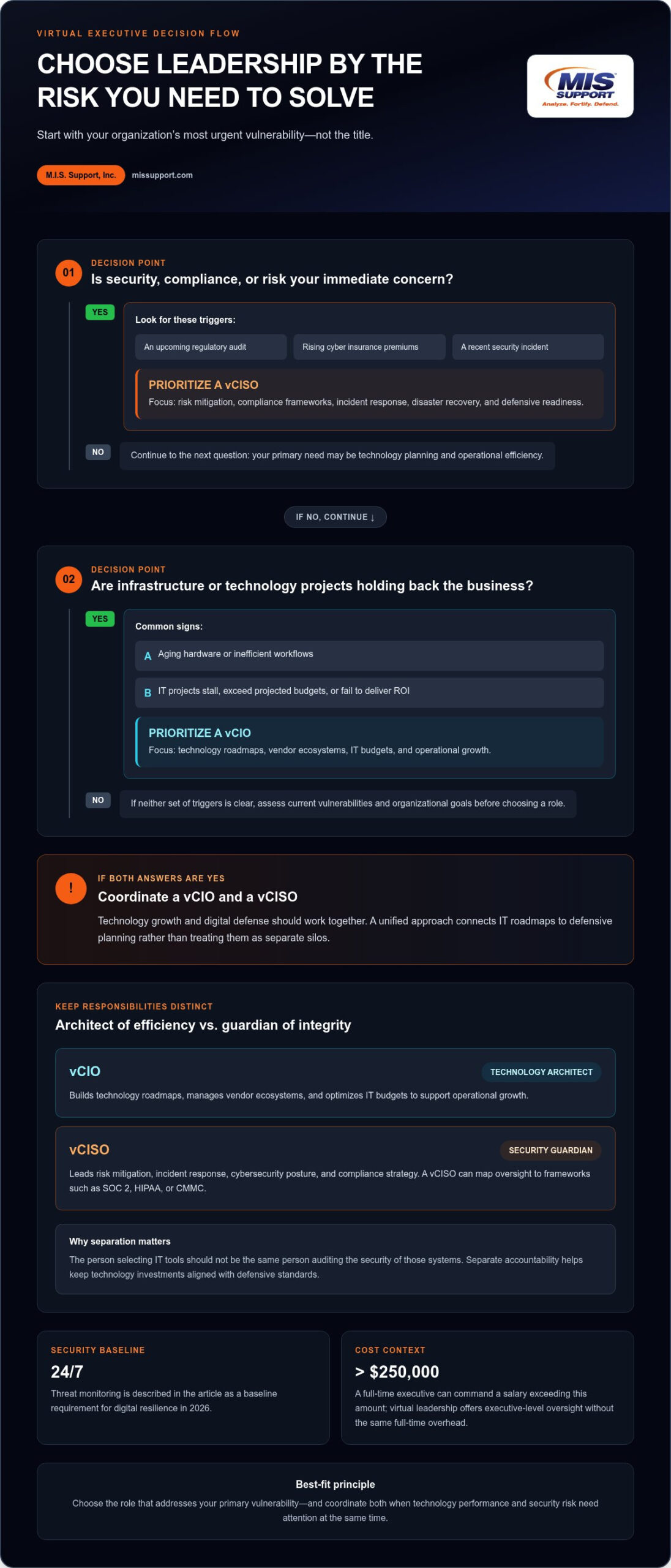
Strategic leadership is not a monolith. When evaluating vcio vs vciso, you must distinguish between the architect and the guardian. The vCIO functions as an architect of efficiency. They design technology roadmaps, manage complex vendor ecosystems, and optimize IT budgets to drive operational growth. Conversely, the Chief Information Security Officer (CISO), delivered virtually, acts as the guardian of integrity. They prioritize risk mitigation, lead rapid incident response, and harden your entire cybersecurity posture.
The distinction is critical for structural balance. You cannot allow the person buying the IT tools to be the same person auditing the security of those systems. A vCISO is a strategic partner responsible for an organization’s digital defense and compliance framework. This essential separation of duties ensures that technology investments never compromise defensive standards or create hidden vulnerabilities.
The vCISO Focus: Compliance and Proactive Defense
Regulatory pressure is intensifying. Modern leadership must map virtual oversight directly to frameworks like SOC2, HIPAA, or CMMC to avoid catastrophic penalties. A vCISO provides the strategic layer above tactical execution. They oversee critical tasks like penetration testing and vulnerability assessments to identify weaknesses before attackers do. For organizations managing mobile ecosystems, this involves utilizing a Mobile Application Security Testing (MAST) Platform and Services to validate the security of their applications.
In 2026, 24/7 threat monitoring is no longer an optional luxury. It’s a baseline requirement for digital resilience. Understanding the nuances of vcio vs vciso allows you to assign these critical tasks to the correct expert. Your vCISO ensures these defenses remain active, vigilant, and ready to repel sophisticated incursions at any hour. They transform compliance from a static checklist into a proactive shield that protects your reputation and your bottom line.
Strategic Selection: Which Role Does Your Organization Need Now?
Deciding between vcio vs vciso requires a cold assessment of your current vulnerabilities. Are you struggling with aging hardware, inefficient workflows, and a hostile threat landscape? Your primary objective dictates the hire. While both roles provide executive-level oversight, they solve different fundamental problems. Understanding the key differences between CIO and CISO prevents strategic misalignment. A full-time executive often commands a salary exceeding $250,000; virtual leadership delivers that same caliber of expertise without the massive overhead.
You’ve likely outgrown your current IT structure if you recognize these three indicators:
- IT projects consistently stall, exceed their projected budgets, or fail to deliver ROI.
- Compliance audits trigger internal panic rather than routine, disciplined execution.
- Cybersecurity is treated as a reactive task instead of a proactive, board-level strategy.
When to Prioritize a Virtual CISO
Prioritize a vCISO when risk reduction is your non-negotiable mission. Specific triggers include upcoming regulatory audits, rising cyber insurance premiums, or the aftermath of a security incident. Specialized virtual CISO services bridge the critical gap between daily IT operations and executive risk management. These strategists develop disaster recovery plans, lead business continuity efforts, and harden your defensive perimeter. They function as a tireless shield for your digital assets. If your immediate goal is securing your foundation, consulting with a battle-hardened strategist ensures your organization remains resilient against evolving threats.
Beyond the Title: Implementing a Unified Resilience Framework
The rapid evolution of AI in cybersecurity has fundamentally altered the vcio vs vciso dynamic. In 2026, automated threats execute at machine speed. You can’t afford to treat infrastructure and integrity as separate silos. A “Security by Design” culture mandates that every IT roadmap begins with a defensive audit. When you integrate security into the initial blueprint, you eliminate the traditional friction between operational speed and digital safety. This proactive movement ensures your organization remains agile without exposing critical vulnerabilities.
M.I.S. Support, Inc. delivers a comprehensive approach by merging executive-level oversight with managed cybersecurity services. This synergy ensures that strategic goals translate into tactical strength. While the CIO vs. CISO distinction remains important for accountability, their daily operations must be interdependent. We act as your protective force, providing the tireless discipline needed to manage risk across your entire enterprise. A unified leadership model eliminates the “security vs. speed” barrier, allowing your business to grow with total confidence.
Strategic Oversight for Microsoft 365 and Cloud Environments
Modern organizations operate in high-stakes hybrid cloud environments. Virtual executives manage the resulting complexity of identity governance, endpoint protection, and data sovereignty. Your secure managed IT services must align with both long-term ROI and immediate threat defense. M.I.S. Support, Inc. provides the strategic blueprint and the 24/7 monitoring required to fortify your Microsoft 365 infrastructure against sophisticated incursions. This dual focus ensures your technology stack is not just a tool for productivity, but a resilient shield for your digital assets. Balancing vcio vs vciso priorities in the cloud creates a stable foundation for future innovation.
Secure Your Strategic Advantage
Choosing between vcio vs vciso isn’t just about filling a seat; it’s about fortifying your future. You’ve seen how these roles balance operational growth with essential governance. M.I.S. Support, Inc. has been a battle-hardened ally for organizations since 1998. We provide comprehensive compliance and risk management. This expertise is backed by our tireless 24/7 threat monitoring and response teams. Our experts transform your digital strategy into a resilient shield that protects your bottom line. Don’t let executive gaps expose your sensitive data. Fortify your strategy with expert Virtual CISO and CIO services from M.I.S. Support, Inc. You’ll gain the discipline of a vigilant guardian that’s always on. Every step we take ensures your organization is ready for the high-stakes threats of 2026. Stand firm with a partner that never blinks.
Frequently Asked Questions
Can one person serve as both vCIO and vCISO for my company?
While technically possible, it’s not recommended for true resilience. These roles have inherent conflicts of interest that require a strict separation of duties. A CIO focuses on technology adoption and operational speed, while a CISO prioritizes risk mitigation and security integrity. Maintaining distinct leadership prevents a single individual from auditing their own infrastructure decisions and ensures objective oversight.
How many hours a month does a typical virtual CISO or CIO work?
Engagement levels vary based on your specific risk profile and organizational complexity. A typical virtual executive might dedicate anywhere from 10 to 40 hours per month to your strategy. This time is focused on high-impact tasks like compliance auditing, technology roadmapping, and vendor management. It ensures you receive elite strategic oversight without the continuous overhead of a full-time executive salary.
What is the average cost difference between a virtual executive and a full-time hire?
The financial gap is substantial. A full-time CISO in 2026 can command total compensation between $250,000 and $565,000 per year. Virtual leadership provides the same caliber of expertise at a fraction of that cost. When comparing vcio vs vciso models, the virtual approach allows you to reallocate hundreds of thousands of dollars toward tactical defense tools and infrastructure upgrades.
Do virtual CISO services include tactical work like penetration testing?
Virtual CISO services provide the strategic layer that governs tactical execution. While a vCISO manages the framework, they typically oversee specialized teams that perform penetration testing and vulnerability assessments. This ensures tactical results translate into board-level risk management strategies. It creates a comprehensive defense cycle that includes 24/7 threat monitoring, incident response planning, and proactive compliance auditing.