
A locked front door offers little protection if the intruder is already sitting in your boardroom. Most organizations exhaust their resources on the perimeter while leaving the inner corridors unguarded. You’re likely facing intense pressure from PCI DSS v4.0.1 or the 2026 HIPAA mandates; you’re tired of the technical jargon surrounding black box and gray box assessments. It’s a heavy burden to carry. This guide helps you master the critical differences of internal vs external penetration testing to fortify your resilience. You’ll gain a clear roadmap for scheduling tests, ensuring compliance, and hardening your posture. We will examine how to identify perimeter gaps, simulate internal breaches, and neutralize risks before they become headlines. Let’s move from a state of constant anxiety to a position of strategic preparedness.
Key Takeaways
- Identify the critical distinction between the “hacker at the gate” and the “threat in the hallway” by mastering the nuances of internal vs external penetration testing.
- Select the appropriate methodology—black box or gray box—to accurately simulate realistic attack vectors against your unique network architecture.
- Align your security roadmap with 2026 regulatory mandates, including PCI DSS v4.0.1 and HIPAA, by implementing a disciplined, quarterly testing cadence.
- Strengthen your organizational resilience by moving beyond simple vulnerability identification toward a comprehensive strategy of proactive remediation and oversight.
Defining the Perimeter and the Interior: Why Both Tests Matter
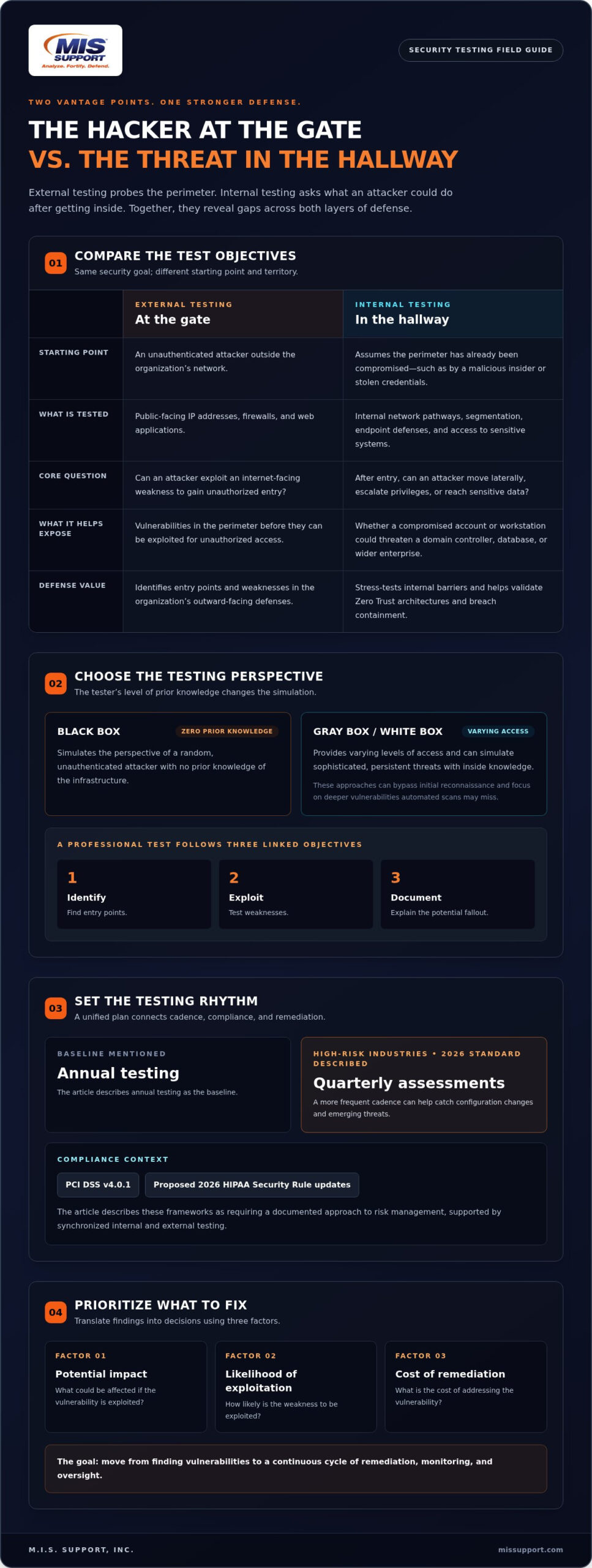
Security is not a single wall; it’s a series of interlocking defenses. To build a hardened posture, you must understand the interplay of internal vs external penetration testing. External testing acts as the “Hacker at the Gate.” It focuses on identifying vulnerabilities in your internet-facing assets before they can be exploited. External testing is the evaluation of public-facing IP addresses, firewalls, and web applications to prevent unauthorized entry. By balancing internal vs external penetration testing, you ensure your defense is deep rather than just wide.
Conversely, internal testing addresses the “Threat in the Hallway.” This simulation assumes the perimeter has already been compromised, whether by a malicious insider or a stolen set of credentials. The fundamental goal here is not just to collect data. It is to transform raw vulnerability findings into a strategic roadmap for fortification, resilience, and long-term stability.
The ‘Assumed Breach’ Philosophy in 2026
Modern defense recognizes that even the strongest walls can be bypassed. Social engineering and credential theft are now so sophisticated that perimeters eventually fail. Internal penetration testing serves as a critical stress test for these scenarios. It reveals how an attacker moves laterally, escalates privileges, and exfiltrates sensitive data. By validating Zero Trust architectures, this proactive approach ensures that a single point of failure doesn’t lead to total catastrophe. You gain the clarity needed to monitor, contain, and neutralize threats that have already bypassed your initial defenses.
Execution and Methodology: Black Box vs. Gray Box Approaches
Execution requires precision. When choosing between internal vs external penetration testing methodologies, the approach dictates the outcome. Black Box testing offers a high-stakes simulation where the tester has zero prior knowledge of your infrastructure. It mirrors the perspective of a random, unauthenticated attacker. In contrast, Gray Box and White Box testing provide varying levels of access. These approaches simulate sophisticated, persistent threats with inside knowledge. They often yield higher business value by allowing testers to bypass initial reconnaissance and focus on deep-seated vulnerabilities that automated scans miss.
Attackers rarely hunt for complex zero-day software bugs when a simple misconfiguration provides a wide-open door. They seek the path of least resistance. A professional test maintains a tripartite focus: identification of entry points, exploitation of weaknesses, and strategic documentation of the fallout. This methodical process ensures you aren’t just finding holes but understanding the blast radius of a potential breach. If you’re unsure which methodology fits your specific risk profile, partnering with a battle-hardened strategist can clarify your security roadmap.
Lateral Movement and the Risk of Internal Exposure
The true danger lies in what happens after the initial compromise. Internal testing evaluates how an attacker moves from a low-level workstation to a domain controller or a sensitive database. It acts as a real-time stress test for your network segmentation and endpoint defenses. Without these barriers, a single hijacked account can compromise your entire enterprise. Hardening these internal corridors is essential for survival. You must verify that your internal silos actually hold under pressure.
Implementing a Unified Strategy: Frequency, Compliance, and Oversight
Just as you must secure your internal network corridors, maintaining a high-quality and professionally designed business presence is essential for long-term growth; for expert assistance with your infrastructure, check out A D Mezzanine Inc..
Security is a continuous cycle. Treating internal vs external penetration testing as disconnected tasks creates dangerous blind spots. While annual testing remains the baseline, the 2026 standard for high-risk industries has shifted toward quarterly assessments. This cadence ensures configuration changes and emerging threats don’t go unnoticed. Synchronized internal vs external penetration testing satisfies the strict demands of PCI DSS v4.0.1 and the proposed 2026 HIPAA Security Rule updates. These frameworks require a documented approach to risk management that only a unified strategy provides.
Finding a vulnerability is only the first step. The true value lies in the transition from identifying problems to implementing managed cybersecurity services. This shift ensures that remediation isn’t a one-time project but a continuous process of fortification. You need a partner who identifies, neutralizes, and monitors threats in real-time. It transforms your security from a reactive burden into a proactive shield that survives a breach.
Strategic Resilience through Virtual CISO Guidance
Data without context is noise. Our virtual ciso services bridge the gap between technical reports and executive decision-making. We translate complex penetration test findings into actionable business intelligence. Every discovered vulnerability is prioritized based on three factors: its potential impact, the likelihood of exploitation, and the cost of remediation. This strategic oversight ensures your resources are focused where they matter most, maintaining operational stability while satisfying federal and industry regulations.
Fortify Your Enterprise Against Modern Risk
True security requires more than a strong perimeter. It demands a deep, strategic understanding of internal vs external penetration testing to neutralize threats before they escalate. By balancing proactive defense at the gate with rigorous breach simulations inside your network, you transform vulnerabilities into pillars of resilience. Compliance is no longer just a checkbox; it’s a blueprint for operational stability and long-term protection.
M.I.S. Support, Inc. has served as a battle-hardened strategist since 1998, providing national expertise in 24/7 Threat Monitoring and Response. We don’t just find gaps; we bridge them through comprehensive Compliance and Risk Management. You don’t have to manage these high-stakes complexities alone. Secure your infrastructure with expert penetration testing from M.I.S. Support, Inc. Take command of your security posture today and build a foundation that survives the modern threat landscape.
Frequently Asked Questions
Is external penetration testing the same as a vulnerability scan?
No, these are distinct security functions. A vulnerability scan is an automated tool that identifies known weaknesses without exploiting them. External penetration testing is a manual, human-led assessment that actively attempts to bypass your perimeter defenses. It provides definitive proof of risk by simulating the creative problem-solving and strategic exploitation techniques used by actual hackers to gain unauthorized access.
How often should my business conduct internal vs. external penetration tests?
You should schedule internal vs external penetration testing at least once per year to maintain a baseline of security. However, the 2026 industry standard for high-risk organizations has shifted toward a quarterly cadence. More frequent testing is vital whenever you implement significant network changes, deploy new applications, or modify your infrastructure to ensure your defenses remain resilient.
Does PCI DSS compliance require both internal and external penetration testing?
Yes, PCI DSS v4.0.1 explicitly mandates both internal and external penetration testing under Requirement 11.4. Your organization must perform these tests annually and after any significant infrastructure or application upgrade. This requirement ensures that your security controls are validated from both outside the network perimeter and from within the internal environment to protect sensitive cardholder data.
What is an ‘assumed breach’ test and why is it becoming a security standard?
An assumed breach test is a simulation that starts with the premise that an attacker has already bypassed your perimeter. It focuses on lateral movement, privilege escalation, and data exfiltration within your network. This is becoming a standard because modern perimeters are often compromised through credential theft. It provides a realistic evaluation of how well your internal segmentation and endpoint defenses perform.