
Threat monitoring is only as effective as the action taken after an alert. The Sophos MDR vs. dedicated MSSP threat-monitoring decision comes down to scope: MDR focuses on threat detection, hunting, and response, while an MSSP typically covers a broader range of security systems and operations. The services can also work together, as long as responsibilities for alerts and response are clearly defined.
Both options can strengthen security, but they do not necessarily do the same work. MDR is designed to identify and contain threats; an MSSP may manage a wider range of infrastructure and route alerts to your team.
This comparison explains what MDR does, how its monitoring differs from an MSSP’s, and when combining the services makes sense. Use the practical criteria to match an approach to your team’s response capacity and security needs.
Key Takeaways
- Understand how MDR combines continuous monitoring with expert investigation and response, and how that differs from security software alone.
- See how MDR and an MSSP can share coverage, and why clear escalation roles and service-level agreements matter.
- Compare the data sources and threat-monitoring focus each service can bring to your security operations.
- Learn when managed cybersecurity support, threat monitoring, penetration testing, or a gap assessment can help strengthen your defenses.
What Is MDR – Managed Detection and Response?
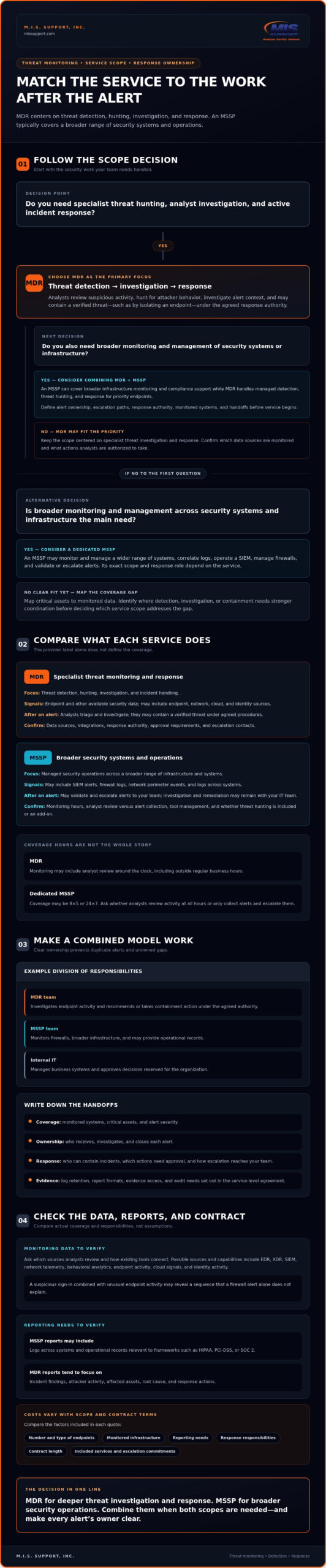
MDR combines automated detection with analysts who investigate suspicious activity and support active response around the clock. Compared with a dedicated MSSP, it usually centers on deeper threat hunting and incident handling, while an MSSP may monitor and manage a wider range of security systems.
Around-the-Clock Monitoring
MDR monitoring uses security tools to collect alerts, then analysts review activity continuously, including outside regular business hours. Dedicated MSSPs may provide monitoring on an 8×5 or 24×7 schedule, often across broader infrastructure. Ask whether coverage includes analyst review at all hours, or only alert collection and escalation. The answer clarifies who sees a threat first and who acts next.
Threat Detection and Hunting
MDR analysts investigate alerts and hunt for signs of attacker behavior, using endpoint and other available security data to spot activity automated rules may miss. A dedicated MSSP may operate a SIEM, correlate logs, validate alerts, and manage systems such as firewalls; threat hunting may be an add-on. Tooling and integrations vary by service. Clarify which data sources are monitored and how existing tools connect.
Investigation and Active Response
After detection, MDR analysts triage alerts, investigate context, and may contain a verified threat, for example by isolating an endpoint. An MSSP may instead pass a validated alert to your IT team, leaving investigation and remediation to you. Response authority depends on the service agreement. Clarify who can contain incidents, which actions need approval, and how escalations reach your team.
| Option | Monitoring focus | Typical response role | Control and customization |
|---|---|---|---|
| MDR | Threat detection and hunting | Analysts investigate and may contain threats | Depends on integrations and agreed response authority |
| Dedicated MSSP | Broader security systems and operations | May validate and escalate alerts | Can manage multiple tools and infrastructure |
Choose MDR when specialist threat investigation and active response are your priority. Choose an MSSP when you need broader monitoring and managed security operations.
Can MDR and MSSP services be combined?
Yes. An organization can use an MSSP for broad infrastructure monitoring and compliance support, while MDR handles managed detection, threat hunting, and incident response for priority endpoints. This approach works best when responsibilities, escalation paths, and ownership of every alert are clear.
For compliance reporting, an MSSP may collect logs across systems and provide operational records relevant to frameworks such as HIPAA, PCI-DSS, or SOC 2. MDR reports tend to focus on incident findings, attacker activity, affected assets, root cause, and response actions. Log retention, report formats, and evidence access should match the organization’s audit needs and be set out in the service-level agreement.
Define monitored systems, alert severity, escalation contacts, response authority, and coordination during an incident. For example, the MDR team might investigate endpoint activity and recommend or take containment action, while the MSSP monitors firewalls and provides infrastructure records. Internal IT can manage business systems and approve decisions reserved for the organization.
Costs vary with service scope and contract terms. Key factors include the number and type of endpoints, monitored infrastructure, reporting needs, and response responsibilities. When comparing quotes, review contract length, included services, and escalation commitments.
Combining providers can also create duplicated alerts or gaps if responsibilities don’t align. Map which team receives, investigates, and closes each alert, then document handoffs before service begins. Organizations coordinating broader security coverage planning can use that map to align monitoring, compliance records, and incident response.
MDR continuous threat monitoring
Continuous monitoring is a workflow, not just an alert feed. MDR services review security signals continuously, connect activity across endpoint, network, cloud, and identity sources, then investigate behavior that may indicate an intrusion. Suspicious sign-ins combined with unusual endpoint activity can reveal a sequence that a firewall alert alone may not explain.
MDR may use EDR, XDR, SIEM, network telemetry, and behavioral analytics across existing infrastructure. In the Sophos MDR vs. dedicated MSSP threat-monitoring comparison, examine the tools and data sources monitored rather than assuming a product name defines coverage. Analysts can correlate signals, hunt for attacker behavior, validate alerts, and contain a confirmed threat under agreed response procedures.
A dedicated MSSP often focuses on managed security operations, SIEM alerts, firewall logs, and network perimeter events, while also managing broader infrastructure. The National Institute of Standards and Technology (NIST) describes how an MSSP can provide an off-site SOC, where analysts monitor security-relevant data for multiple customers. This model supports broad operational oversight; threat hunting and active incident response depend on the service scope.
Compare the services by mapping critical assets to the data being monitored. If cloud identities and endpoint behavior matter, confirm that analysts review those signals, not just automated rules. When comparing Sophos MDR with a dedicated MSSP for threat monitoring, define who investigates alerts, who can isolate endpoints, and how internal teams retain control of infrastructure. These details show whether monitoring leads to action or only notification.
Use a coverage map to expose blind spots between MDR and firewall-focused monitoring. Review your threat-monitoring coverage and identify where detection, investigation, or containment needs stronger coordination.
M.I.S. Support: Managed Cybersecurity Services
M.I.S. Support, Inc. can help organizations strengthen monitoring and response through Managed Cybersecurity Services and 24/7 Threat Monitoring & Response. Turn to this support when internal teams need help identifying suspicious activity, coordinating response, or understanding gaps in their defenses.
Cybersecurity Gap Assessments can help identify weaknesses in security practices, while Internal & External Penetration Testing examines defenses from different access points. Each serves a different purpose: monitoring tracks threats, assessments reveal gaps, and testing probes how defenses withstand an attack.
Turn the MDR-versus-MSSP decision into a practical next step: identify which systems need coverage, who handles incident response, and where a stronger assessment could help. Contact M.I.S. Support, Inc. to discuss your organization’s security priorities.
Make Your Next Security Decision Deliberate
The Sophos MDR versus dedicated MSSP threat-monitoring decision should reflect how your organization expects to grow, not just the tools it uses today. As infrastructure changes, review who owns each security responsibility, how teams coordinate, and where independent testing could reveal overlooked weaknesses. That review turns a service comparison into a practical security plan.
M.I.S. Support offers Managed Cybersecurity Services, 24/7 Threat Monitoring & Response, and Internal & External Penetration Testing. These offerings can help organizations assess monitoring needs, strengthen operational defenses, and test security controls. Choose the next step based on the gap you need to address, whether that means improving ongoing oversight or examining defenses through testing.
Contact M.I.S. Support to discuss your organization’s cybersecurity priorities. A clear plan can help your team move forward with greater focus and confidence.
Frequently Asked Questions
Can a provider be both an MSSP and an MDR provider?
Yes. A managed security provider can include MDR within a broader MSSP portfolio. For example, it might manage firewall operations and security logs while providing threat hunting and incident handling for selected endpoints. Clarify which service covers each asset, what work is included, and how alerts move between teams during an incident.
MDR vs MSSP: What’s the Difference and Which Do You Need?
MDR focuses on finding and handling threats, while an MSSP commonly manages a broader set of security operations. For a practical decision, list the outcomes you need: investigating suspicious behavior, managing tools, or providing operational reporting. If your team can manage systems but needs deeper threat expertise, MDR may fit; broader outsourced operations point toward an MSSP.
MDR vs MSSP: Which Model Fits Your SOC Needs?
Choose based on what your security operations team can reliably handle. A lean team that needs help analyzing suspicious activity may benefit from MDR support. A staffed SOC that needs help operating platforms, tracking device health, or coordinating infrastructure tasks may favor an MSSP. Map existing roles first, including ownership of investigations, approvals, and recovery.
Should I choose MDR or MSSP for my organization?
Choose MDR if your main gap is expert threat analysis and incident handling; choose an MSSP if you need broader security management. You can also use both when different assets need different coverage. For example, assign MDR to critical endpoints and an MSSP to routine network operations, then document ownership so no alert falls between teams.
What is MDR vs MSSP vs SIEM?
SIEM technology gathers and correlates log data to generate alerts. An MSSP is a managed service provider that may operate a SIEM and other security systems. MDR focuses on threat detection, investigation, and response, often using SIEM alongside endpoint or network tools. SIEM generates signals; the service model determines who acts on them.