
The lowest monthly quote may not produce the lowest three-year bill. In an arctic wolf vs managed soc provider cost comparison, there is no universal cost winner unless you match service scope, log volume, and contract terms. Compare the full commitment, not just the starting price.
It is easy to focus on the headline fee, but onboarding, log ingestion, added charges, and contract escalations can change the total. This guide explains how those factors shape a three-year comparison and where costs can grow as your needs change. You will see the key differences among service models, what to include in a like-for-like review, and how to decide which approach fits your security requirements and budget.
Key Takeaways
- Compare the full service scope, not just the opening quote, to build a fair three-year cost view.
- Map how onboarding and log ingestion affect the overall commitment as your environment changes.
- Review added-fee triggers and contract escalation terms to spot where costs may rise.
- Use your monitoring and response needs to decide whether a managed cybersecurity service is the right fit.
Additional fees and contract escalations
In an Arctic Wolf versus managed SOC provider cost comparison, the base subscription is only one contract line. Separate recurring charges from incident-response overages, added integrations, and work beyond the agreed scope. For example, confirm whether containment support is included or billed separately when an alert becomes an active incident.
Security, staffing, and compliance risks include missed alerts, unclear containment authority, and incomplete incident records. Review who monitors the platform, how incidents escalate, and what evidence security operations provides for your compliance processes.
| Option | Minimum endpoints | Added-fee exposure | Contract term focus |
|---|---|---|---|
| Arctic Wolf | Confirm contracted scope | Incident or extra-scope work | Renewal and escalation language |
| Fixed-scope managed SOC | Set in proposal | Out-of-scope response | Included services and term |
| Usage-based SOC | Check billing basis | Changes in monitored volume | Usage adjustments |
| Platform-led service | Match endpoint coverage | Separate analyst support | Platform and support renewals |
| Hybrid SOC | Define covered assets | Analyst or containment add-ons | Responsibility boundaries |
Minimum endpoint commitments can change the effective cost per protected device. If a contract covers more endpoints than your environment currently needs, compare the minimum with your current deployment and planned growth. Record the endpoint count, included platform access, and any fees triggered by adding data sources.
Evaluate negotiated discounts separately from contract scope. A reduced base rate may not offset a shorter list of included services, a renewal increase, or separately billed incident work. Compare the discounted amount, renewal terms, and included detection and response in the same cost model. Do not assume a discount applies to later contract periods.
Choose the option with clearly assigned containment duties, endpoint minimums, and renewal costs, not simply the lowest initial quote.
Hidden costs and three-year total cost of ownership
Build a three-year view that captures deployment, recurring operations, renewals, and response scope. Bundle names alone do not show the full commitment.
Bundle and Provider Pricing
For Arctic Wolf’s Core, Plus, and Total options, compare the actual contracted scope rather than assuming each label represents the same coverage. Map monitoring, integrations, managed detection, and response responsibilities against the alternative provider’s proposal. Typical U.S. managed SOC pricing depends on endpoint count, telemetry volume, response scope, and contract model. Per-endpoint rates and monthly platform fees are not directly interchangeable.
A provider’s price depends on your requirements and is given after a quote request. Endpoint volume, integrations, and response needs shape it. For Arctic Wolf, identify which monitoring and response activities the proposal includes, then compare those items with the alternative’s scope.
Implementation, Training, and Renewal Costs
Separate one-time deployment work from continuous service charges. For example, list integrations, configuration, staff training, and migration of existing network data as distinct implementation tasks. Renewal costs can change if your organization adjusts its endpoint count, data sources, or coverage needs. Compare initial setup and later renewal terms side by side, including whether implementation work repeats after a platform or environment change.
Managed SOC Versus In-House Costs
A managed SOC places some security operations work under a provider contract; an in-house SOC requires your organization to operate its own monitoring and response function. Compare staffing, platform operations, integrations, and continuous coverage needs, not just subscription fees. An agentic SOC may add recurring platform or usage costs, while internal teams still need oversight for escalation and incident decisions.
Three-Year Total Cost of Ownership
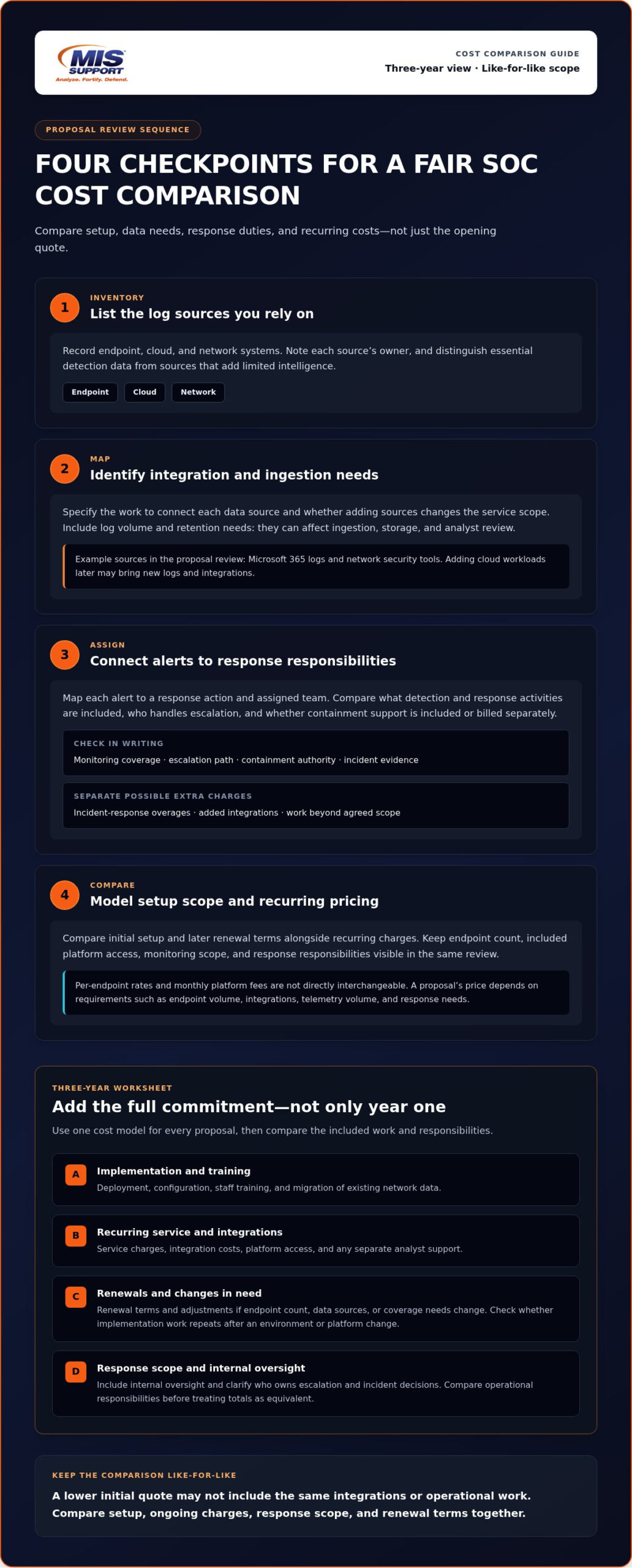
Use one worksheet for all three years: add implementation and training, recurring service charges, integrations, renewal changes, and internal oversight. Then map what happens when endpoint volume or monitoring needs change. This reveals costs a first-year quote can miss. Compare each option’s response scope and operational responsibilities before treating its total as like-for-like.
Total cost factors, including onboarding and log ingestion
Compare the work required to connect systems, ingest logs, and turn alerts into action. A vendor’s pricing should reflect your security team’s actual detection needs, not an assumed standard deployment.
Start with onboarding. List each data source, its owner, and integration work, such as connecting Microsoft 365 logs or network security tools. Then identify which sources feed threat detection and whether added sources change the service scope. This shows where setup effort and ongoing monitoring requirements differ.
- Record log sources, including endpoint, cloud, and network systems.
- Separate essential detection data from sources that add limited intelligence.
- Map each alert to a response action and assigned team.
Log volume and retention needs can shape a proposal because they affect ingestion, storage, and analyst review. For example, adding cloud workloads may introduce new logs and integrations after deployment. Model that change alongside current data so the comparison reflects an evolving environment rather than a single snapshot.
Assess protection by matching each vendor’s capabilities to your threat posture. Check whether the platform supports the data sources you rely on, how it prioritizes detection, and which response actions are included in the agreed scope. A lower initial quote may not cover the same integrations or operational work. Compare these differences in writing before judging the total.
Use this sequence for each proposal: inventory log sources, map integration requirements, define response responsibilities, then compare recurring pricing and setup scope. This gives your security team a consistent basis for evaluating options. To identify gaps across your environment, assess your security posture before finalizing the comparison.
M.I.S. Support: Managed Cybersecurity Services
M.I.S. Support, Inc. helps organizations weighing a managed SOC compare service scope against their security priorities. Its Managed Cybersecurity Services and 24/7 Threat Monitoring & Response support continuous oversight and incident response. This can be a fit when internal teams need additional monitoring or clearer coverage across existing systems.
For a broader view of exposure, Internal & External Penetration Testing and Cybersecurity Gap Assessments can identify weaknesses and help focus security priorities. These services complement monitoring by examining vulnerabilities and gaps beyond day-to-day alerts. Together, they give decision-makers practical input for assessing security coverage and planning next steps.
To discuss your security needs, contact M.I.S. Support, Inc..
Make the Next Security Decision Deliberately
Turn your cost comparison into a decision your security team can stand behind. An Arctic Wolf vs. managed SOC provider cost comparison is most useful when it informs priorities, clarifies ownership, and supports a plan for changing risks. Do not choose on price alone. Choose a service scope that fits the protection your organization needs and the work your team can sustain.
M.I.S. Support offers Managed Cybersecurity Services, 24/7 Threat Monitoring & Response, and Internal & External Penetration Testing. These options can support organizations assessing monitoring coverage, response needs, or security exposure as they plan their next steps.
Contact M.I.S. Support about SOC costs to discuss your security priorities. A clear plan puts your next decision on firmer ground.
Frequently Asked Questions
What additional costs can apply, including onboarding, integrations, minimum contracts, and incident response?
Additional charges can arise from setup work, connecting data sources, endpoint minimums, or incident-response work beyond the contracted scope. For example, adding a cloud log source after deployment may require integration work or affect monitored volume. Separate one-time implementation tasks from recurring charges, then identify which incident actions are included and which trigger additional billing.
What contract terms, minimums, and cancellation rules should buyers compare?
Compare the committed endpoint or usage minimum, contract duration, renewal process, price-adjustment language, and cancellation notice requirements. Check what happens if your organization reduces endpoint coverage or ends the service early. For example, if your business plans to retire a system, understand whether the minimum commitment changes. Record these terms beside each proposal so differences are visible before signing.
How should organizations estimate total cost of ownership for a managed SOC?
Estimate total cost by listing setup, recurring service, integrations, internal oversight, renewal changes, and separately billed incident work across the full evaluation period. Use a realistic change scenario, such as adding cloud workloads or bringing another business unit into monitoring. Keep assumptions consistent across proposals, and distinguish direct provider charges from internal staff time so the comparison reflects the operational commitment.