
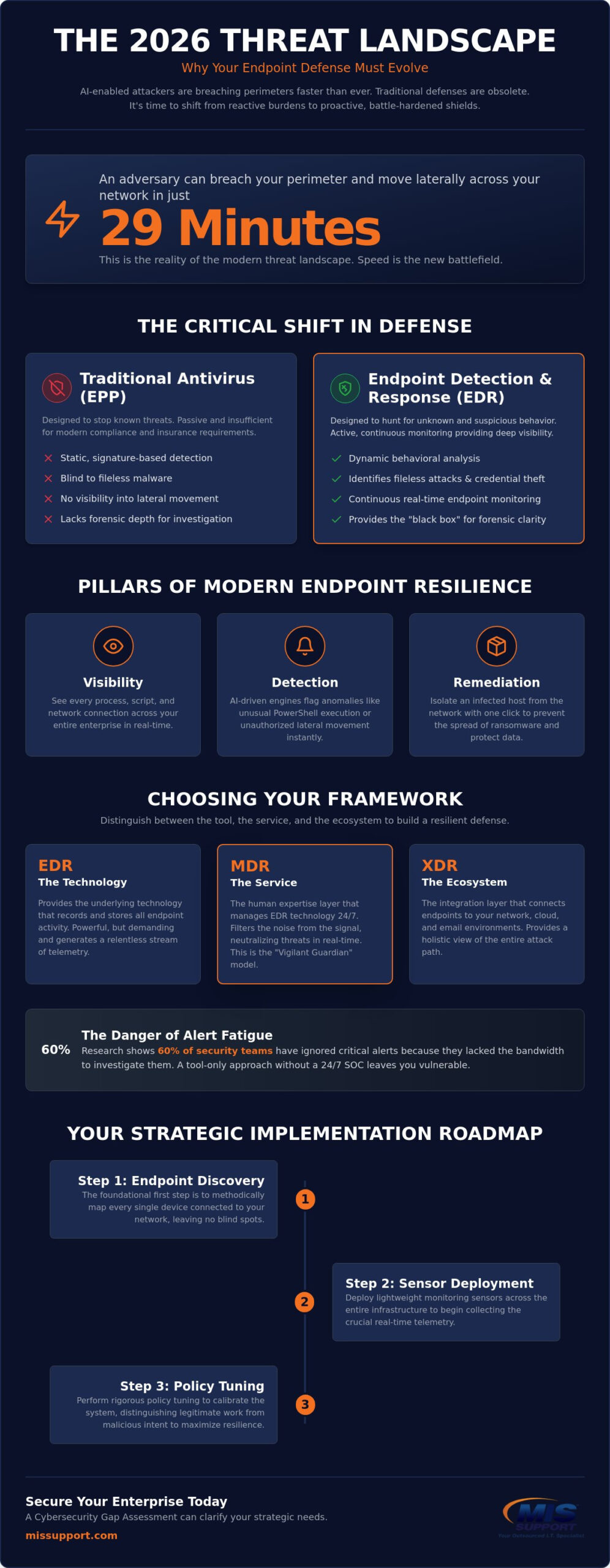
An adversary can breach your perimeter and move laterally across your network in just 29 minutes. This is the reality of the 2026 threat landscape. While your team struggles with tool fatigue and a mounting pile of ignored alerts, AI-enabled attackers are moving faster than ever before. You likely recognize that traditional defenses are failing to stop fileless malware or sophisticated lateral movement. Implementing robust edr cyber security is no longer a luxury for the enterprise; it’s a baseline requirement for structural integrity.
We understand the weight of maintaining a compliance-ready posture while ransomware threats continue to target distributed workforces. You need a strategy that slashes your mean time to repair and satisfies strict reporting mandates like CIRCIA or NIS2. This article provides a clear, strategic framework for choosing an endpoint defense that actually holds the line. We’ll examine the shift toward autonomous response and show you how to transform your security from a reactive burden into a proactive, battle-hardened shield.
Key Takeaways
- Recognize the critical shift from static signature-based detection to dynamic behavioral analysis. This transition is essential for stopping modern, fileless attacks that bypass traditional antivirus.
- Navigate the strategic differences between standalone edr cyber security tools, managed services, and cross-platform XDR integrations to find your ideal defense model.
- Eliminate tool fatigue and high response times by understanding how to manage the high volume of telemetry generated by modern endpoint sensors.
- Build a resilient perimeter through a proven deployment roadmap that covers endpoint discovery, policy tuning, and continuous oversight.
Defining EDR Cyber Security: The Evolution of Endpoint Defense
Modern defense requires more than a perimeter wall. It requires internal sensors. edr cyber security acts as a continuous monitoring solution that records and stores endpoint-system-level behaviors in real-time. Unlike legacy tools that wait for a match against a known database, EDR observes how your systems actually behave. It identifies the subtle deviations that signal a breach in progress. It doesn’t just watch for a file; it watches for intent.
The industry has moved beyond signature-based detection. Adversaries now rely on fileless malware and stolen credentials that leave no traditional footprint. EDR functions as the ‘black box’ for your network’s endpoints, providing the forensic clarity needed to reconstruct an event after it occurs. This evolution is a core component of modern Endpoint Security, shifting the focus from simple prevention to comprehensive detection and response. You gain the ability to observe, identify, and neutralize threats before they escalate.
EDR vs. Traditional Antivirus (EPP)
Endpoint Protection Platforms (EPP) are designed to stop the known. They are passive. They compare files against a list of “bad” signatures. In contrast, edr cyber security hunts the unknown and the suspicious. It provides active telemetry, capturing every action on a device. Relying on EPP alone is insufficient for 2026’s compliance standards and cyber insurance requirements. Insurers now demand the forensic depth that only EDR provides to verify that a threat has been fully eradicated.
Key Capabilities: Visibility, Detection, and Remediation
True endpoint resilience rests on three pillars. First is visibility. You see every process, script, and network connection across the entire enterprise. Second is detection. AI-driven engines flag anomalies like unusual PowerShell execution or unauthorized lateral movement instantly. Third is remediation. Your team can isolate an infected host from the network with one click. This prevents the spread of ransomware, protects your data, and maintains your operational stability.
Choosing Your Framework: EDR, MDR, and XDR Compared
The security industry is saturated with Threat Detection And Response Acronyms. To build a resilient defense, you must distinguish between the tool, the service, and the ecosystem. EDR provides the underlying technology. It records endpoint activity. MDR is the service layer that manages that technology. XDR is the integration layer that connects endpoints to your network, cloud, and email environments. Your choice depends entirely on your internal SOC maturity and your tolerance for risk.
Mid-market enterprises often stumble when deploying standalone edr cyber security tools. The technology is powerful, but it’s demanding. It generates a relentless stream of telemetry. Research indicates that 60% of security teams have ignored critical alerts because they lacked the bandwidth to investigate them. This alert fatigue creates the very gaps that attackers exploit. If you don’t have a mature, 24/7 internal Security Operations Center, a tool-only approach leaves you vulnerable. Transitioning to managed detection and response services shifts the burden of analysis to an external team of specialists.
The MDR Advantage: Why Management Matters
An EDR tool is only as effective as the analyst watching the screen. MDR provides the human expertise required to filter the noise from the signal. This is the “Vigilant Guardian” model. While your internal IT team sleeps, a dedicated force monitors your perimeter. They neutralize threats in real-time, ensuring that a 2 a.m. breach doesn’t become a 9 a.m. catastrophe. It’s about proactive movement, decisive action, and constant oversight.
XDR: Extending Vision Beyond the Endpoint
Modern threats don’t stay in one place. They move from a phishing email to a cloud account to a local workstation. XDR pulls data from these disparate layers to provide a holistic view of the attack path. For organizations heavily invested in the Microsoft ecosystem, leveraging Microsoft 365 security integration within an XDR framework is vital. It allows you to see the full story of an incident. If you’re unsure where your current gaps lie, a professional Cybersecurity Gap Assessment can clarify your strategic needs.
Implementing Managed EDR: A Strategic Roadmap for 2026
Execution is where strategy meets reality. Implementing edr cyber security is not a simple “install and forget” task. It requires a methodical roadmap. First, we conduct endpoint discovery to map every device on your network. Second, we deploy sensors across the infrastructure. Third, we perform rigorous policy tuning to ensure the system distinguishes between legitimate work and malicious intent. This process ensures your tools are calibrated for maximum resilience without disrupting operations.
These sensors feed directly into a broader managed cybersecurity services framework. We don’t just wait for an alarm. We engage in active threat hunting. Our analysts proactively search for dormant threats that may have bypassed initial defenses. It’s about finding the enemy before they strike. We provide the battle-hardened strategy needed to turn these complex tools into a decisive advantage for your enterprise.
Integrating EDR with Compliance and Risk Management
Compliance is a continuous state, not a one-time event. EDR telemetry provides the granular data needed to simplify audits for HIPAA, CMMC, or SOC2. It creates a clear, immutable audit trail of every system action. Pairing this telemetry with a thorough understanding of what is a vulnerability assessment allows your team to prioritize remediation efforts and close the gaps that auditors are most likely to scrutinize. Our virtual CISO services bridge the gap between technical data and executive oversight. We interpret complex edr cyber security telemetry into actionable insights for board-level reporting, ensuring your security posture aligns with your business goals.
24/7 Monitoring: The Shield That Never Sleeps
Detection is useless without swift action. The incident response process must be immediate. It starts with detection, moves to automated isolation of the host, and ends with human remediation. We ensure that “Response” remains the most critical part of the EDR acronym. Our team acts as a shield that never sleeps, providing the constant vigilance required to maintain your digital perimeter. We neutralize threats, secure your assets, and restore stability with disciplined precision.
Fortify Your Perimeter for the 2026 Threat Landscape
Secure Your Endpoints with 24/7 Vigilance from M.I.S. Support, Inc. Take the final step toward strategic preparedness and lasting stability.
Frequently Asked Questions
What is the difference between EDR and Managed EDR?
EDR is the underlying software tool that records system activity, while Managed EDR is the tool combined with expert human oversight. Standalone EDR provides the telemetry, but your internal team remains responsible for monitoring and responding to every alert. Managed EDR shifts this burden to a dedicated security team that provides 24/7 analysis, threat hunting, and active remediation. This ensures that critical signals are never lost in a sea of noise.
Can EDR replace my existing antivirus software?
Yes, in most modern enterprise configurations, edr cyber security replaces traditional signature-based antivirus by integrating both prevention and response into a single agent. Legacy antivirus only stops known threats with established signatures. EDR goes further by using behavioral analysis to catch zero-day exploits and fileless attacks. This consolidation reduces tool fatigue, simplifies your security stack, and provides a more resilient defense against sophisticated adversaries.
How does EDR help in the event of a ransomware attack?
EDR identifies ransomware by flagging suspicious behaviors like rapid file encryption or unauthorized attempts to delete backup shadow copies. Once the system detects these anomalies, it can automatically isolate the infected host from the rest of the network. This immediate containment stops lateral movement, protects your central data stores, and provides the forensic data required to satisfy strict reporting mandates like CIRCIA or NIS2.
Does EDR impact the performance of my employees’ computers?
Modern edr cyber security agents are designed to be lightweight and typically consume less than 1% of CPU resources during normal operation. Unlike legacy antivirus tools that perform heavy, scheduled disk scans that slow down machines, EDR monitors system events in real-time with minimal overhead. This ensures your perimeter remains fortified and your endpoints stay responsive, maintaining productivity across your entire distributed workforce.