
What if your employees were no longer your greatest vulnerability, but your most sophisticated threat detection system? As AI-driven phishing becomes weaponized at scale, traditional defense-in-depth is no longer sufficient. You’ve likely experienced the frustration of high-volume attacks, the friction of training fatigue, and the difficulty of proving ROI to stakeholders. Implementing effective security awareness training for employees is no longer a peripheral task; it’s a core requirement for operational resilience.
Master the specific criteria for selecting a program that transforms your staff into your strongest defensive layer. This 2026 evaluation checklist provides a strategic roadmap for modernizing your human firewall. We’ll explore how to achieve a measurable reduction in click rates, ensure compliance with NIST or HIPAA, and create seamless integration with your existing security stack. Prepare to move from a state of constant anxiety to one of strategic preparedness.
Key Takeaways
- Learn why effective security awareness training for employees must evolve into a strategic human firewall that counters AI-driven social engineering.
- Identify the essential 2026 evaluation criteria to ensure your training program addresses sophisticated threats like deepfakes and advanced credential harvesting.
- Discover how to select a partner whose training modules integrate directly with your managed cybersecurity services for a unified defensive posture.
- Master the strategies for building a “no-blame” culture that prioritizes rapid incident reporting and sustainable behavioral change.
- Move beyond participation metrics to prove ROI through measurable reductions in click rates and seamless compliance with NIST or HIPAA frameworks.
Defining the Human Firewall: Critical Training Components for 2026
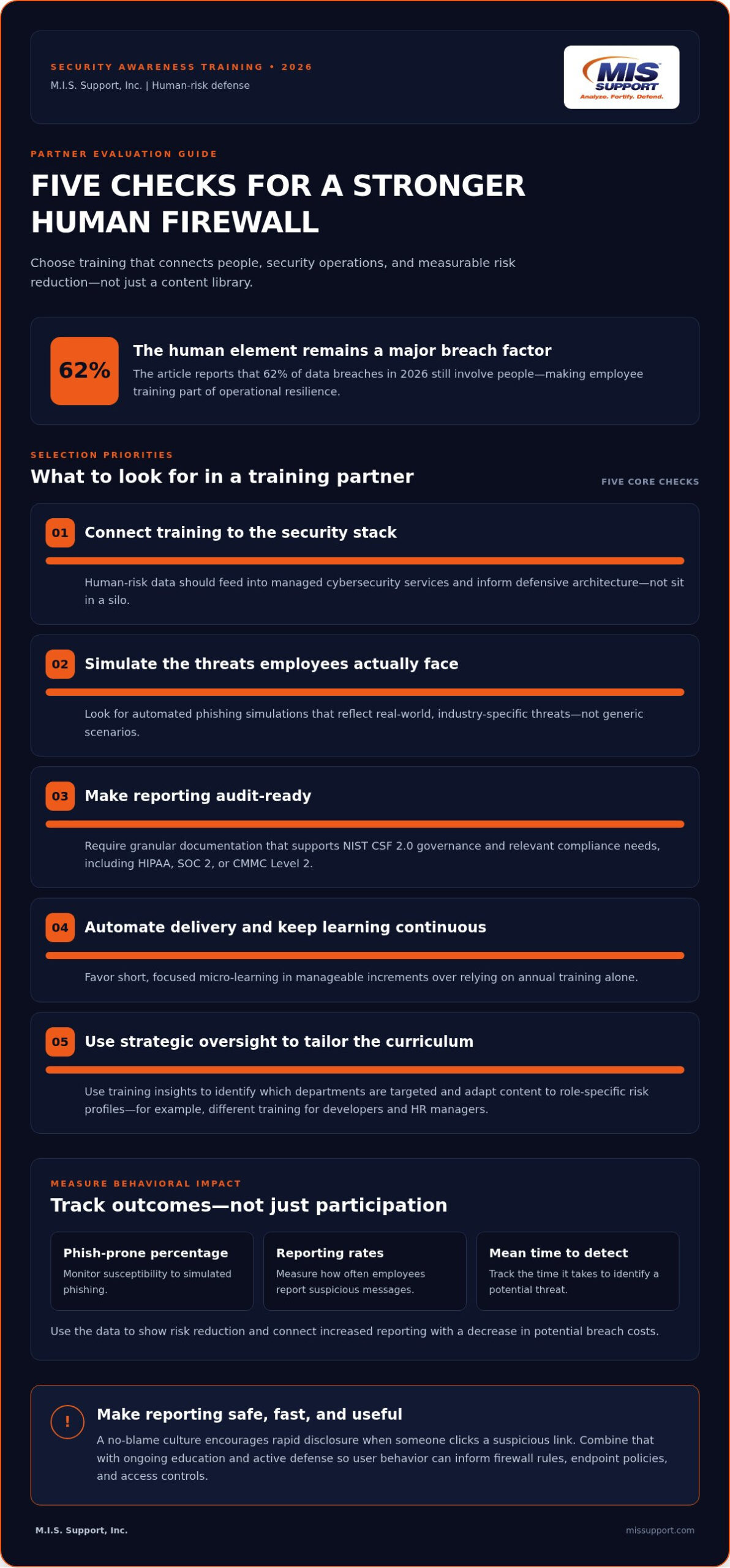
Digital defense is no longer a purely technical challenge. It’s a human one. Modern security awareness training for employees serves as a strategic initiative to mitigate human-centric risk, fortify the perimeter, and foster a culture of vigilance. We transform every staff member into a “human firewall.” Instead of viewing employees as weak links, we treat them as active threat sensors. This shift is critical. Research shows that 62% of all data breaches in 2026 still involve the human element. To understand the full scope of these programs, a foundation in Security Awareness Overview principles is essential for building a resilient organization.
Addressing AI-Powered Social Engineering
Micro-Learning vs. Annual Compliance
The Managed Cybersecurity Checklist: Selecting Your Training Partner
Selecting a vendor isn’t just about the content library. It’s about strategic alignment. Siloed tools are liabilities in a high-stakes environment. Your security awareness training for employees must integrate seamlessly with your broader managed cybersecurity services. This ensures that human-risk data feeds directly into your defensive architecture. When evaluating partners, prioritize those who offer comprehensive information security services. This holistic approach ensures that training isn’t an isolated event, but a core component of your operational resilience. Referencing Security Awareness Training Best Practices can help you benchmark these requirements against industry standards.
Effective programs utilize automated phishing simulations. These shouldn’t be generic. They must reflect the real-world, industry-specific threats your team faces daily. Look for audit-ready reporting capabilities. With the NIST Cybersecurity Framework (CSF) 2.0 now emphasizing governance, your documentation must be flawless. Whether you’re targeting HIPAA, SOC2, or CMMC Level 2 compliance, your partner must provide the granular data required to survive an audit. If you’re ready to fortify your team, explore the comprehensive security solutions offered by M.I.S. Support, Inc.
Platform Integration and Automation
Strategic Oversight and vCISO Alignment
Training data is a goldmine for strategic planning. The strategic virtual CISO services provided by M.I.S. Support, Inc. use these insights to refine your overall security posture. By analyzing which departments are most targeted, we tailor curriculums to specific risk profiles. This ensures that a developer receives different training than an HR manager. It’s targeted, efficient, and effective.
Implementing Behavioral Change: Beyond the Checklist
Culture is the bedrock of defense. Establishing a “no-blame” environment is not just a soft skill; it’s a tactical necessity. When an employee clicks a suspicious link, the speed of reporting determines the blast radius. We encourage rapid disclosure, reward vigilance, and neutralize threats before they escalate. By removing the fear of reprimand, you transform your staff from silent liabilities into active defenders.
Engagement often stalls after the initial rollout. We combat this through gamification. Leaderboards and achievement badges foster healthy competition and keep security top-of-mind. Aligning your internal initiatives with the SANS Institute Security Training standards ensures your curriculum remains rigorous and relevant. This high-performance security awareness training for employees must be tethered to your secure managed IT services. This connection ensures that user behavior data directly informs your firewall rules, endpoint policies, and access controls.
Measuring Success and Behavioral ROI
Data proves the value of your investment. We track critical metrics: phish-prone percentage, reporting rates, and mean time to detect. When presenting to executive stakeholders, focus on risk reduction and capital preservation. Demonstrate how a measurable increase in reporting rates correlates with a decrease in potential breach costs. It’s about turning abstract awareness into concrete, audit-ready performance data.
The M.I.S. Support Advantage
We act as your vigilant guardian. Our 24/7 threat monitoring serves as the ultimate safety net for human error. By integrating persistent education with proactive defense, we build total resilience for your organization. We don’t just teach your team to spot threats; we provide the structural integrity needed to withstand them. Your employees become the first line of defense, backed by a battle-hardened strategist that never sleeps.
Fortify Your Human Perimeter for 2026
Digital threats are evolving at AI speed. You’ve seen how a robust human firewall requires more than just annual slides. It demands continuous, integrated security awareness training for employees that adapts to your unique risk profile. By fostering a “no-blame” culture and leveraging automated simulations, you turn potential vulnerabilities into active defensive assets. This isn’t just about avoiding clicks; it’s about building a culture of strategic preparedness that protects your entire infrastructure.
Don’t leave your human layer to chance. We combine 24/7 vigilant monitoring with authoritative strategic oversight to ensure your organization remains resilient. With decades of defensive expertise dating back to 1998, we provide the steady hand and battle-hardened strategy your business needs to stay ahead of sophisticated social engineering. Empower your staff to act as your most reliable sensors and your first line of defense.
Secure your human layer with M.I.S. Support’s Managed Cybersecurity. Your team is ready to become your strongest shield. Step into a future of stability and safety with a partner who stays vigilant so you don’t have to.
Frequently Asked Questions
How often should employees undergo security awareness training in 2026?
Employees should engage with training content at least once per month through high-impact micro-learning modules. Annual sessions are a legacy approach that fails against AI-driven threats evolving by the week. Consistent, bite-sized updates keep defensive instincts sharp and ensure security remains an active habit. This frequency transforms your workforce into a reliable, always-on sensor. It’s about maintaining a constant state of readiness rather than fulfilling a yearly checkbox.
Can security awareness training actually prevent ransomware attacks?
What are the most common phishing themes used in 2026 training simulations?
Modern simulations prioritize AI-generated deepfake audio impersonations, urgent Business Email Compromise (BEC) requests, and spoofed regulatory compliance alerts. These themes mirror the weaponized tactics used by today’s threat actors. Simulations must be realistic, localized, and increasingly sophisticated to be effective. By exposing staff to these high-stakes scenarios, you build the muscle memory required to detect, question, and report even the most polished deceptions. This builds proactive resilience across every department.
How does security awareness training impact regulatory compliance?
Documented security awareness training for employees is a mandatory requirement for major frameworks including NIST CSF 2.0, HIPAA, and CMMC Level 2. Regulators now demand proof of an ongoing, behavioral program rather than a simple policy statement. You must provide participation records, phishing simulation results, and remediation data during audits. Maintaining these logs ensures your organization meets its legal obligations while demonstrating a proactive, battle-hardened commitment to strategic risk management.