
In 2025, the average cost of a data breach in the United States reached a record $10.22 million. Digital threats don’t wait for your budget cycles or board approvals. You likely feel the pressure to choose a framework that protects your assets without draining your resources. Deciding between nist vs iso 27001 often feels like choosing between a tactical shield and a global passport. One offers a flexible roadmap for internal maturity. The other provides a rigorous, certified badge of trust for international markets.
This guide clarifies the confusion, reduces audit anxiety, and identifies the exact ROI for your organization. You’ll learn how to map NIST controls to ISO requirements to create a single, unified defense. We’ll explore the strategic differences, the implementation costs, and the path to a truly defensible security posture in 2026.
Key Takeaways
- Distinguish between NIST CSF 2.0 as a flexible risk management roadmap and ISO 27001 as a formal, internationally recognized Information Security Management System.
- Analyze the operational impact of nist vs iso 27001 by comparing NIST’s six core functions against the 93 rigorous controls required for ISO Annex A.
- Learn the advantages of a hybrid model that uses NIST to build your security foundation while leveraging ISO 27001 to prove your posture to global clients.
- Leverage strategic oversight from a Virtual CISO to navigate the audit process and transform your security posture into a defensible business asset.
The Strategic Divide: Maturity vs. Certification
Choosing between nist vs iso 27001 isn’t just a technical choice; it’s a strategic pivot that defines your company’s defensive posture. The NIST Cybersecurity Framework (CSF) 2.0 serves as a flexible, outcome-based roadmap. It prioritizes risk management maturity over static checklists. In contrast, ISO 27001 functions as a rigid, internationally recognized Information Security Management System (ISMS). It requires a formal third-party audit to validate compliance. The core thesis is simple. NIST is the tool you use to build a resilient engine. ISO is the badge you wear to prove that engine meets global standards.
- NIST CSF: Focuses on operational outcomes and risk-based flexibility.
- ISO 27001: Focuses on management processes and formal certification.
- Strategic Impact: NIST guides internal growth; ISO secures external trust.
Why Framework Selection Dictates Operational Resilience
Your framework selection dictates the trajectory of your managed cybersecurity services and how you allocate precious internal capital. NIST offers a voluntary path toward security excellence, allowing for gradual maturation. ISO 27001 often represents a contractual requirement for organizations entering global supply chains. In 2026, the ‘Govern’ function within NIST 2.0 stands as the critical foundation for any strategy. It forces leadership to treat security as a governance issue, not just an IT problem. This shift ensures your defense is proactive and strategically aligned with business goals.
Comparing Controls, Certification Requirements, and Global Reach
Understanding the architecture of nist vs iso 27001 requires looking past the acronyms to the actual mechanics of your defense. The official NIST Cybersecurity Framework organizes security into six core functions: Govern, Identify, Protect, Detect, Respond, and Recover. This model focuses on outcomes rather than specific technical mandates. ISO 27001:2022 utilizes a more granular approach. It relies on 93 specific controls categorized in Annex A. While NIST allows for flexible self-assessment, ISO demands a rigorous, three-year certification cycle managed by external auditors. This makes ISO the universal language for international trade, whereas NIST remains the gold standard for US critical infrastructure.
Technical Alignment: Where NIST and ISO Converge
Both frameworks share common ground in their reliance on risk management. They don’t just ask you to check boxes; they require you to prove your controls work. Regular penetration testing is a non-negotiable requirement for both to validate defensive integrity. NIST’s ‘Respond’ and ‘Recover’ functions align directly with ISO’s incident management requirements. This overlap means your work on one framework isn’t wasted if you pivot to the other. If you’re unsure where your current gaps lie, a professional compliance gap assessment can clarify your path forward.
- NIST CSF 2.0: Best for US-based firms focused on internal maturity and federal alignment.
- ISO 27001: Best for organizations requiring a globally recognized badge of trust for international clients.
- Hybrid Model: Best for high-growth firms that need the flexibility of NIST with the audit-readiness of ISO.
The Hybrid Approach: Implementing Resilient Security Frameworks
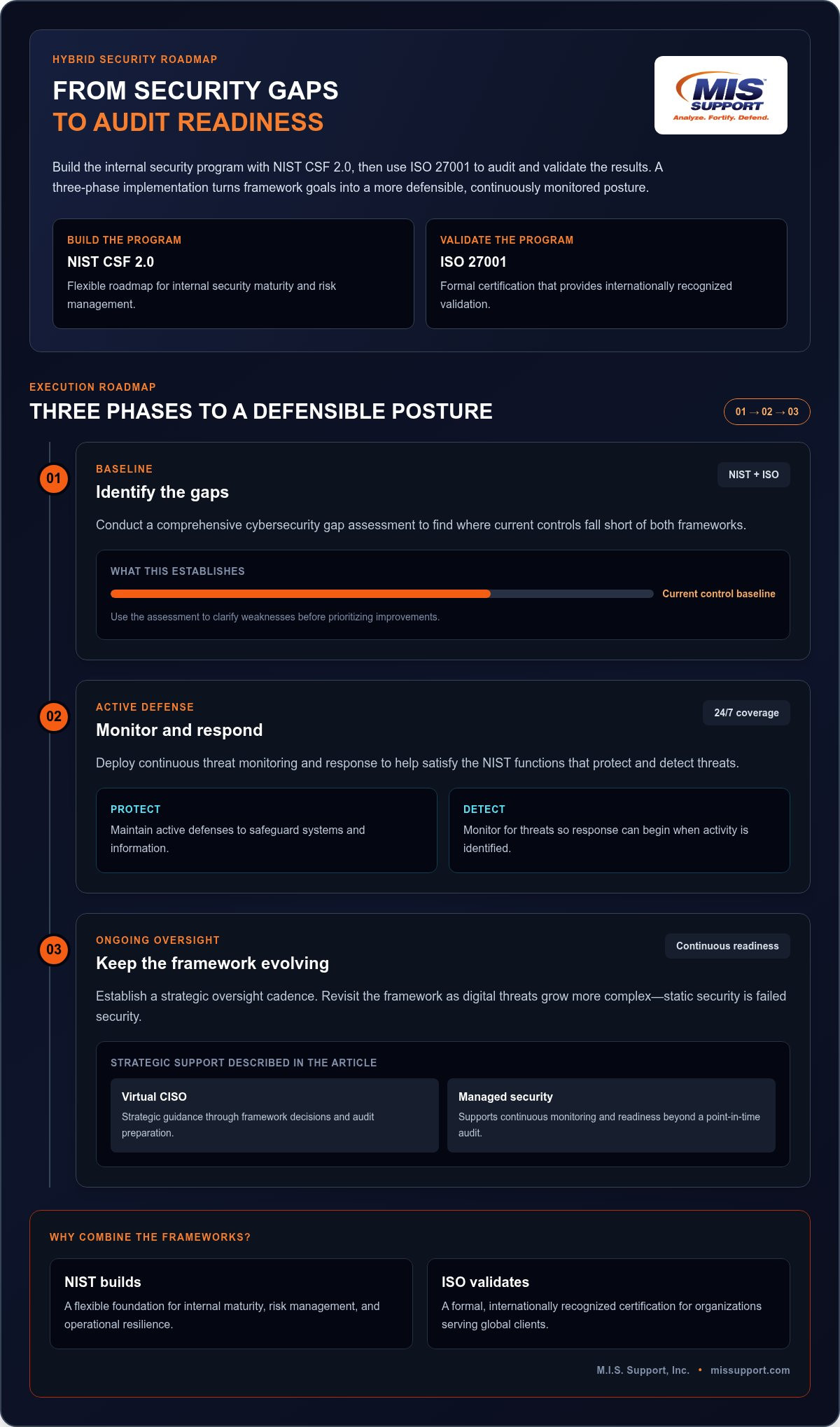
Winning at cybersecurity doesn’t require choosing a single path. High-growth firms often adopt a hybrid strategy. They use NIST CSF 2.0 to build their internal program and ISO 27001 to audit the final results. This approach leverages the flexibility of NIST to mature your defenses while securing the global certification that ISO provides. As noted in IBM’s explanation of the NIST Framework, these guidelines help manage and reduce risk effectively across the enterprise. This dual strategy ensures you don’t just meet a standard; you build a fortress.
Moving from ad-hoc security to a formal framework is a high-stakes transition. A virtual ciso acts as your battle-hardened strategist during this process. They provide the oversight needed to navigate the nist vs iso 27001 landscape without the massive overhead of a full-time executive. Managed security serves as the engine for this shift. It transforms compliance from a stressful, point-in-time audit into a state of continuous, vigilant readiness that satisfies both federal and international clients.
Executing the Roadmap with Managed Cybersecurity
Execution requires a disciplined, three-step process to ensure your defenses remain impenetrable and your posture stays defensible.
- Phase 1: Conduct a comprehensive cybersecurity gap assessment. This baseline identifies exactly where your current controls fall short of both NIST and ISO standards.
- Phase 2: Deploy 24/7 threat monitoring and response. Active defense satisfies the ‘Detect’ and ‘Protect’ functions that are non-negotiable for 2026 compliance.
- Phase 3: Establish a strategic oversight cadence. Your framework must evolve as digital threats grow more complex. Static security is failed security.
Secure Your Strategic Advantage in 2026
Cybersecurity is no longer a peripheral IT concern; it’s a core pillar of enterprise survival. The debate between nist vs iso 27001 isn’t about finding a single winner. It’s about aligning your defense with your specific business goals. NIST CSF 2.0 provides the internal roadmap for maturity. ISO 27001 offers the external validation required for global expansion. By adopting a hybrid approach, you ensure your organization is both secure and certifiable. You don’t have to navigate this high-stakes landscape alone. Fortify Your Compliance Strategy with M.I.S. Support through expert Virtual CISO guidance, comprehensive gap assessments, and 24/7 vigilant threat monitoring. Step into the future with a posture that is proactive, disciplined, and entirely defensible. Your resilience starts today.
Frequently Asked Questions
Is NIST CSF better than ISO 27001 for a small business?
NIST CSF is typically the superior starting point for small businesses. It offers a voluntary, flexible roadmap to security maturity without the high costs of formal third-party audits. Small organizations use it to build a defensible posture at their own pace. ISO 27001 is often too rigid and resource-heavy for smaller teams unless a specific international contract demands it.
Can an organization be ‘certified’ in NIST CSF?
No, an organization cannot be officially certified in the NIST Cybersecurity Framework. It is a voluntary set of guidelines designed for self-assessment. While you can’t display a NIST seal, you can perform a professional gap assessment to prove your alignment. This demonstrates to stakeholders that you follow the official standards for risk management and operational resilience.
Which framework is required for US Department of Defense contractors?
Which framework is required for US Department of Defense contractors?
US Department of Defense contractors must comply with NIST SP 800-171, which is the foundation for the CMMC. While ISO 27001 is respected globally, it does not replace these specific federal requirements. For organizations seeking strategic insight into these high-stakes sectors, Seraphis Group provides guidance and investment insights across defense and technology. Contractors must ensure their internal controls specifically protect Controlled Unclassified Information as defined by the DoD to maintain their eligibility for government contracts.
How often do NIST and ISO 27001 frameworks need to be updated?
Frameworks evolve as threats grow more complex. NIST released CSF 2.0 in February 2024 to include the ‘Govern’ function. ISO 27001:2022 is the current standard, with a transition deadline of October 2025 for older certificates. Organizations should review their alignment annually. ISO 27001 specifically requires a three-year certification cycle with annual surveillance audits to ensure the management system remains effective.
Does ISO 27001 compliance satisfy NIST CSF requirements?
ISO 27001 compliance provides a strong foundation but doesn’t automatically satisfy every NIST CSF outcome. There is significant overlap in risk assessment and technical controls. However, the nist vs iso 27001 comparison shows that NIST emphasizes specific operational outcomes while ISO focuses on the management system. Most resilient firms map their ISO controls to NIST functions to ensure comprehensive coverage.