
The average cost of a data breach has climbed to $5.2 million, turning a single technical oversight into a potential enterprise catastrophe. You’ve checked the boxes, updated the software, and trained the staff, yet that nagging anxiety remains. You’re right to be concerned. A simple vulnerability scan is a surface-level glance; it isn’t a true test of your armor. Strategic penetration testing goes deeper by simulating the actual tactics of a modern adversary to find the hidden entry points that automated tools miss.
It’s natural to feel overwhelmed by shifting regulations like the 2026 HIPAA mandates or the complexities of AI-driven attacks. We’re here to help you transform that uncertainty into a position of strategic strength. This article provides a clear roadmap for identifying security gaps, reducing digital risk, and improving your operational resilience. You’ll discover how to harden your perimeter, secure your data, and provide stakeholders with the confidence they demand. Let’s move from a state of constant worry to a posture of prepared, vigilant defense.
Key Takeaways
- Recognize why penetration testing is an essential offensive maneuver that identifies hidden vulnerabilities automated tools often miss.
- Explore the five-phase strategic process designed to simulate sophisticated modern threats and test your network’s true breaking point.
- Gain a 360-degree view of your risk by integrating both internal and external testing into your defense architecture.
- Convert raw data into a prioritized roadmap for remediation, turning identified gaps into pillars of operational resilience.
- Secure your reputation and ensure compliance with 2026 standards by validating your security posture through rigorous, controlled attacks.
The Strategic Necessity of Penetration Testing in 2026
A Penetration test is a rigorous, simulated cyberattack conducted by ethical hackers to expose exploitable weaknesses before they become catastrophic failures. It’s a proactive strike. While firewalls and antivirus act as passive guards, they often provide a false sense of security. True resilience requires a vigilant approach. You must actively hunt for the gaps in your own armor. Penetration testing is the only definitive way to validate that your defenses actually work when they’re under immense pressure.
The difference between an automated scan and an expert-led test is the difference between a smoke alarm and a fire marshal. Scans find the obvious, but experts find the paths. They think like the adversary. They chain seemingly minor flaws together to reach your most sensitive data. In a world where threats evolve daily, relying on a checklist is a recipe for disaster. You need a human expert who understands the gravity of the landscape; for those managing remote workforces, a home wifi consultant san francisco provides similar specialized oversight for the residential networks that now form part of your enterprise perimeter.
Why Businesses Must Adopt an Offensive Mindset
Threat actors in 2026 use sophisticated automation to identify zero-day vulnerabilities faster than ever. To survive, you have to stay one step ahead. This offensive mindset is a critical component of professional cybersecurity risk assessment services. It moves your team from a reactive scramble to a controlled, strategic defense. Penetration testing transforms your digital anxiety into strategic preparedness by providing a clear view of your actual risk profile.
Compliance and the Cost of Inaction
Regulatory frameworks have caught up to the reality of the threat landscape. Standards like HIPAA, PCI DSS, and SOC2 increasingly mandate deep-dive testing to ensure data integrity. Compliance isn’t just about avoiding a fine anymore; it’s about proving your right to operate. The hidden costs of a breach are staggering. Consider the impact of systemic downtime that halts revenue, irreparable damage to client trust, and severe legal penalties. The price of proactive Offensive Security and Penetration Testing Services is a fraction of the cost of a successful breach. Protecting your enterprise is a fiduciary responsibility that demands decisive action.
The Anatomy of a High-Impact Penetration Test
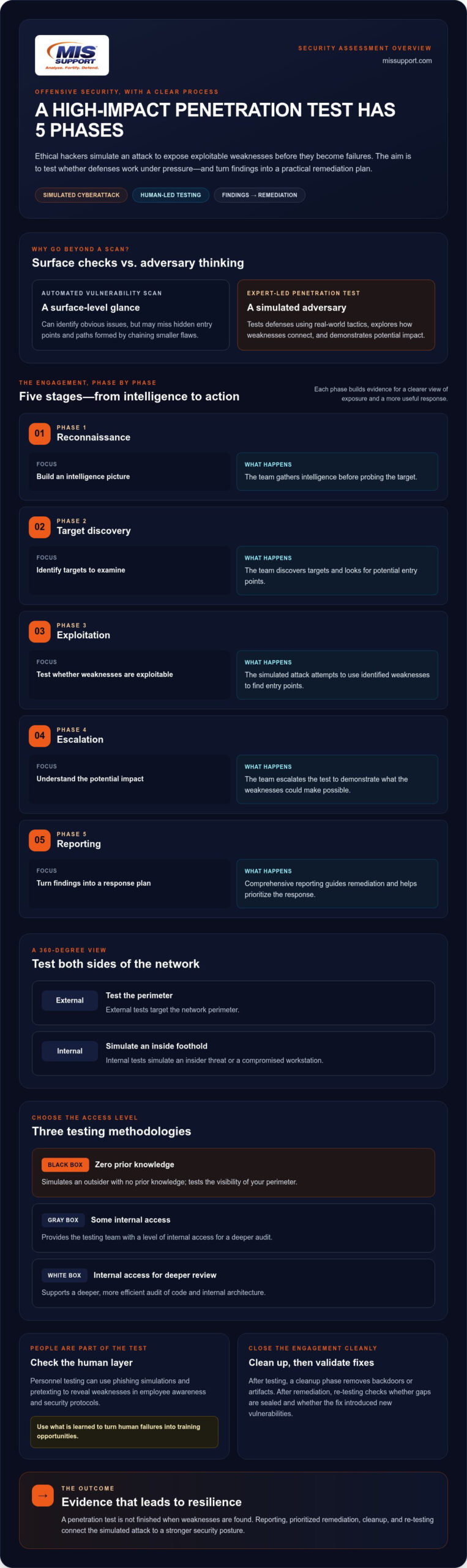
High-impact penetration testing follows a disciplined, five-phase strategic process. It begins with reconnaissance to gather intelligence. It moves through target discovery and exploitation to identify entry points. It culminates in escalation to prove impact and comprehensive reporting to guide remediation. NIST defines penetration testing as a method for testing a system, network, or Web application to find vulnerabilities that an attacker could exploit. This isn’t a random probe. It’s a calculated offensive.
To achieve a 360-degree view of your network security solutions, you must address both internal and external threats. External tests target your perimeter. Internal tests simulate an insider threat or a compromised workstation. Once the engagement ends, a rigorous cleanup phase ensures no backdoors or artifacts remain. This leaves you with a clean environment and a blueprint for fortification. It’s a strategic reset that prepares you for the next wave of threats.
Core Testing Methodologies: Black, Gray, and White Box
Strategic depth requires choosing the right methodology. Black Box testing simulates an outsider with zero prior knowledge. It’s the ultimate test of your perimeter’s visibility. Gray Box and White Box testing provide the team with varying levels of internal access. These methods allow for a deeper, more efficient audit of your code and internal architecture. They reveal what happens after the initial breach occurs.
The Human Element: Personnel and Social Engineering
Technology is only one layer of the shield. Personnel testing identifies critical weaknesses in employee awareness and security protocols. Tactics like phishing simulations and pretexting expose how easily your staff can be manipulated. During the analysis phase, maintaining a cyber security assessment services mindset is vital for turning these human failures into training opportunities. The most sophisticated, battle-hardened firewall is useless if a user is manipulated into opening the gate. If you want to ensure your team is prepared for a real-world attempt, our Managed Cybersecurity Services provide the ongoing oversight you need.
From Vulnerability to Resilience: Implementation and Next Steps
Identifying a vulnerability is only half the battle. The real value lies in the response. Once the assessment is complete, you must shift from finding problems to implementing solutions through a prioritized remediation roadmap. A report is not a solution; it’s a call to action. These findings should immediately inform your broader managed cybersecurity services strategy. You don’t just patch the holes. You reinforce the entire structure.
Validation is the final, critical step. Re-testing after remediation ensures that every gap is effectively sealed and that new vulnerabilities weren’t introduced during the fix. This is where a Virtual CISO becomes indispensable. They act as the strategic leader who translates technical findings into business-resilience decisions. They ensure your security spend aligns with your actual risk. According to CISA’s overview of Penetration Testing, these assessments are vital for identifying systemic weaknesses that could be exploited by adversaries.
The Cycle of Continuous Improvement
Resilience isn’t a destination. It’s a process. Scheduled, regular penetration testing is far more effective than a one-off “compliance checkbox.” Use the data gathered to train your staff and refine your network security solutions. When you treat security as a cycle of continuous improvement, you move from a state of reactive fear to a posture of steady, battle-hardened confidence. You prepare. You test. You evolve.
Partnering with a Vigilant Guardian
In-house teams often suffer from proximity bias. They see what they expect to see. A third-party perspective identifies the blind spots that internal staff might miss. Partnering with a vigilant guardian provides the objective, expert oversight necessary to survive the 2026 threat landscape. M.I.S. Support is committed to proactive defense and 24/7 threat monitoring. We don’t just hand you a list of failures. We act as your protective force, ensuring your enterprise remains tireless, disciplined, and secure.
Forge an Unshakeable Defense
True resilience in 2026 isn’t found in a static checklist or a passive firewall. It’s built through active, strategic offense. By identifying hidden entry points and simulating modern adversary tactics, you transform your network from a target into a fortress. Professional penetration testing provides the roadmap needed to close security gaps, satisfy complex regulatory requirements, and ensure business continuity remains intact. You’ve seen the anatomy of a high-impact test and the necessity of a remediation roadmap. Now, it’s time to act.
Since 1998, M.I.S. Support has served as a battle-hardened strategist for enterprises facing evolving digital risks. We combine decades of experience with comprehensive 24/7 threat monitoring and deep expertise in risk management. Don’t leave your reputation to chance. Secure Your Network with Expert Penetration Testing and move forward with the confidence of a vigilant guardian. Your path to a secure, stable future starts with a single, decisive step toward fortification.
Frequently Asked Questions
How often should my business perform a penetration test?
You should perform a penetration test at least once per year to maintain a strong security posture. Regulatory frameworks like the 2026 HIPAA update and PCI DSS now mandate annual testing for many organizations. It’s also vital to schedule a test after any major network changes, such as a cloud migration or a significant hardware overhaul. Regular testing ensures your defenses remain effective against the rapidly shifting tactics of modern threat actors.
What is the difference between a vulnerability assessment and a penetration test?
A vulnerability assessment is an automated scan that identifies potential weaknesses, whereas penetration testing is a manual, strategic attempt to exploit those weaknesses. An assessment provides a list of possible entry points; a test proves which of those points can actually be breached. Assessments are useful for broad maintenance, but only a penetration test validates your ability to withstand a sophisticated, human-led attack. It provides the deep-dive analysis necessary for true resilience.
Will a penetration test disrupt my daily business operations?
A professional engagement is designed to be non-disruptive and strictly controlled. We work within predefined boundaries to ensure that your critical systems and daily workflows remain operational during the testing process. The goal is to simulate a real-world attack without the real-world damage. By coordinating the scope and timing of the test, we identify your hidden vulnerabilities while maintaining the stability of your production environment. Your business continues to run while we find the gaps.
How much does a professional penetration test typically cost?
The investment for penetration testing is determined by the size and complexity of your digital environment. Factors like the number of internal hosts, the complexity of your web applications, and the depth of the social engineering component all shape the final scope. Every enterprise has a different risk profile and distinct infrastructure needs. A tailored approach ensures that your specific vulnerabilities are addressed without wasting resources on irrelevant areas. This strategic investment is essential for mitigating the catastrophic financial impact of a successful data breach.