
What if your most sophisticated security tools are actually leaving you vulnerable because they lack a cohesive strategy? In 2025, there were 3,322 publicly reported data theft compromises, proving that reactive measures are no longer sufficient. You likely feel the weight of this reality every day. The fear of a catastrophic breach is constant. The confusion between NIST CSF 2.0, ISO 27001, and CIS Controls is overwhelming. The lack of internal expertise to manage a multi-year roadmap is a glaring risk.
You deserve a clear path forward. This guide will show you exactly how to implement a cybersecurity framework that transforms your defense from a reactive scramble into a proactive, defensible posture. We will examine the selection process, the deployment phases, and the long-term management strategies required to secure your organization through 2026. You will gain an actionable plan to fortify your perimeter, reduce operational risk, and build a resilient shield for your digital assets. It’s time to move beyond the checkbox and start building a strategic roadmap that protects, defends, and endures.
Key Takeaways
- Select the optimal defensive standard—NIST CSF 2.0, ISO 27001, or CIS Controls—by aligning your specific regulatory requirements with your unique risk landscape.
- Establish a strategic security baseline through a comprehensive gap assessment that identifies vulnerable digital assets and prioritizes immediate remediation efforts.
- Follow a disciplined, 5-step execution cycle to master how to implement a cybersecurity framework that integrates high-level governance with multi-layered technical controls.
- Evolve your security posture from a static project to continuous vigilance by deploying 24/7 threat monitoring and proactive incident response.
- Validate your defensive integrity through annual penetration testing to ensure your framework remains resilient against the sophisticated digital threats of 2026.
Selecting Your Strategic Shield: Framework Selection and Gap Analysis
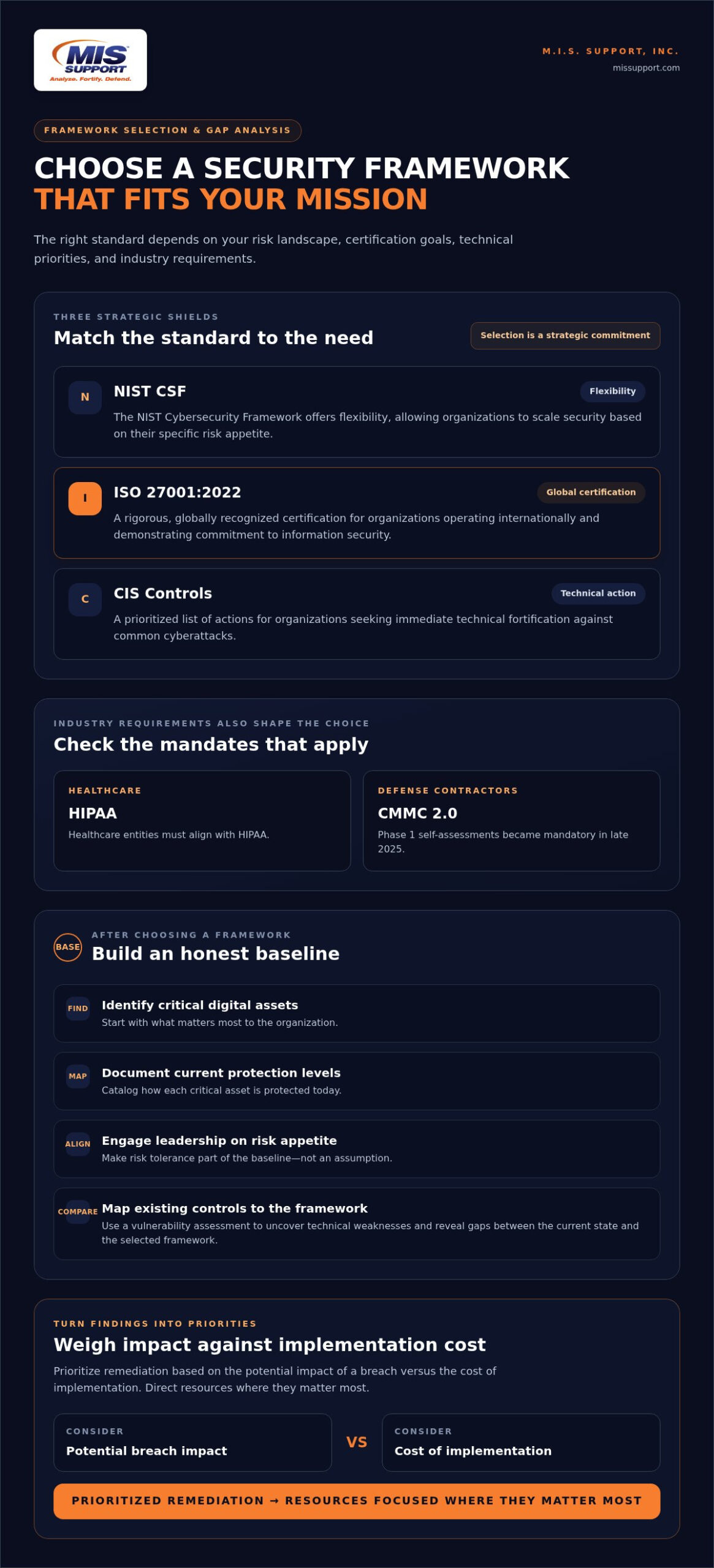
Selection is your first act of defense. It defines your boundaries, sets your rules, and dictates your response to chaos. Before you can master how to implement a cybersecurity framework, you must determine which standard serves as your organization’s primary defensive shield. This choice isn’t just a technical preference; it’s a strategic commitment to your stakeholders, partners, and clients. You are choosing the blueprint for your survival in an increasingly hostile digital landscape.
Identifying the Right Standards for Your Industry
Standardization eliminates guesswork. The NIST Cybersecurity Framework (CSF) is the gold standard for flexibility, allowing organizations to scale security based on their specific risk appetite. If you operate internationally, ISO 27001:2022 provides a rigorous, globally recognized certification that proves your commitment to information security. For those seeking immediate technical fortification, the CIS Controls offer a prioritized list of actions to stop the most common cyberattacks. Industry-specific mandates also dictate your path. Healthcare entities must align with HIPAA, while defense contractors must navigate the evolving CMMC 2.0 requirements, where Phase 1 self-assessments became mandatory in late 2025.
Conducting a Comprehensive Cybersecurity Gap Assessment
You cannot protect what you haven’t cataloged. Establishing a baseline requires identifying your most critical digital assets, mapping their current protection levels, and engaging leadership to define the organization’s risk appetite. Learning how to implement a cybersecurity framework effectively starts with this honest accounting of your strengths and failures. Understanding what is a vulnerability assessment is vital here, as it serves as the diagnostic tool to uncover technical weaknesses in your current perimeter.
Once these flaws are exposed, you can map existing controls against your chosen framework to reveal the distance between your current state and total compliance. A cybersecurity gap assessment is the bridge between current chaos and future resilience. This process allows you to prioritize remediation efforts based on the potential impact of a breach versus the cost of implementation. It ensures your resources are deployed where they matter most, transforming vulnerability into strategic preparedness.
Executing the Roadmap: The 5-Step Implementation Cycle
Action is the antidote to risk. Once you’ve identified your security gaps, you must move with disciplined precision. Learning how to implement a cybersecurity framework is not a linear project; it’s a cyclical process of fortification. You must transform your findings into a living defense system that adapts as threats evolve and attackers find new pathways into your network.
Step 2: Protect. Build the walls. Deploy multi-layered defenses that include endpoint protection and robust identity management. For many organizations, secure managed IT services provide the essential technical muscle to enforce these controls at scale. This phase is about reducing your attack surface to the absolute minimum.
Fortifying Assets Through Proactive Protection
Step 4: Respond and Recover. Develop and stress-test your incident response and disaster recovery plans. CISA’s framework implementation guidance highlights that a plan only works if it’s executable under extreme pressure. Recovery is about more than just backups; it’s about restoring operations with minimal downtime.
Establishing Decisive Response and Recovery Protocols
Tabletop exercises reveal the truth about your readiness. Define clear communication chains for stakeholders so that everyone knows their role during an incident. If your internal team is overextended, seeking a Managed IT partnership can provide the strategic oversight needed to maintain these protocols without fail. Preparation today ensures stability tomorrow.
Beyond Implementation: Achieving Continuous Vigilance
Implementation is just the beginning. The true test of any security posture is its ability to endure. You must transition from a project-based mindset to a state of permanent operational vigilance. To truly master how to implement a cybersecurity framework, you must integrate continuous auditing and real-time reporting to keep executive stakeholders informed and risk levels managed. This evolution ensures your roadmap remains effective against the shifting tactics of modern adversaries.
Validation is critical. You must utilize penetration testing annually to stress-test your controls and identify where your framework might buckle under pressure. As threats become more sophisticated, integrating AI in cybersecurity becomes a necessity. These tools automate the detection of 2026-era threats. They allow your team to respond at machine speed to anomalous behavior that human analysts might miss. Vigilance is not a destination; it’s a constant state of readiness.
Leveraging Virtual CISO Services for Strategic Governance
Framework maturity requires consistent leadership. Many high-growth organizations lack the resources for a full-time executive security officer. This is where virtual CISO services provide essential strategic oversight. They offer the battle-hardened expertise needed to manage long-term roadmaps and ensure your security posture aligns with business objectives. It’s a cost-efficient way to secure expert guidance without the overhead of a traditional hire. Strategic governance keeps your framework from becoming obsolete.
Integrating 24/7 Threat Monitoring for Real-Time Resilience
Threats don’t follow business hours. A Security Operations Center (SOC) serves as your tireless observer, maintaining the “Detect” and “Respond” functions of your chosen framework. A framework without active monitoring is merely a static document, not a defense. By utilizing 24/7 threat monitoring and response, you ensure that every anomaly is caught and every intrusion is neutralized before it compromises your integrity. This level of oversight transforms your security from a set of rules into a resilient, living shield.
Secure Your Strategic Advantage
Resilience is built through action. You now possess the roadmap to navigate the complexities of modern digital defense. By understanding how to implement a cybersecurity framework, you’ve moved from reactive uncertainty to a position of battle-hardened strength. You’ve identified your critical gaps, executed a disciplined roadmap, and established the continuous vigilance required to survive in 2026. This isn’t just a technical upgrade; it’s the construction of a permanent, strategic shield that protects your reputation, your assets, and your stakeholders.
You don’t have to defend your perimeter alone. M.I.S. Support, Inc. provides the 24/7 vigilant threat monitoring, battle-hardened virtual CISO leadership, and comprehensive compliance management your organization demands. We act as your expert ally, ensuring your defenses are always on, always observant, and always evolving. Secure your organization’s future with a Strategic Cybersecurity Gap Assessment from M.I.S. Support, Inc.
Take the first step toward a more resilient tomorrow and fortify your organization today.
Frequently Asked Questions
How long does it take to fully implement a cybersecurity framework?
Full implementation typically requires six to eighteen months. Your specific timeline depends on your current maturity level, the complexity of your network, and the availability of internal resources. It isn’t a race to a finish line; it’s a transition into a permanent cycle of assessment, remediation, and monitoring. To see how external experts can help manage this workload, learn more. You should focus on closing high-risk gaps within the first ninety days to achieve immediate fortification while building toward long-term compliance.
Which cybersecurity framework is best for small to medium-sized businesses?
NIST CSF 2.0 or the CIS Controls are generally the most effective starting points for mid-market organizations. NIST provides a flexible, risk-based approach that aligns security with business objectives. CIS Controls offer a more prescriptive, technical checklist designed to stop the most frequent cyberattacks. When deciding how to implement a cybersecurity framework, choose the standard that best matches your regulatory requirements and technical capacity to maintain the controls.
What is the difference between a cybersecurity framework and a security policy?
A framework is your strategic blueprint while a policy is your internal rulebook. The framework provides a comprehensive structure for managing risk across the entire organization, covering identification, protection, and response. Policies are the specific, mandatory requirements that dictate how employees and systems must behave to meet those framework standards. You need the framework to define your strategy and the policies to enforce your governance.
Can we implement a cybersecurity framework without hiring a full-time CISO?
Yes, you can achieve professional-grade framework compliance by utilizing Virtual CISO (vCISO) services. This model provides the high-level strategic leadership and executive oversight required to manage a multi-year roadmap at a fraction of the cost of a full-time executive. A vCISO acts as your battle-hardened strategist. They guide your team through the selection, deployment, and auditing phases to ensure your defensive shield remains resilient, compliant, and cost-effective.