
An EDR tool that only generates alerts isn’t a security solution; it’s a liability. You likely feel the exhaustion of alert fatigue and the pressure to understand how to choose an endpoint detection and response solution that actually stops breaches. Most security teams are currently drowning in a sea of false positives while genuine threats slip through the cracks. It’s a high-stakes environment where one missed signal can lead to total operational failure.
This guide provides the strategic framework to master your selection process and convert raw data into decisive action. You’ll learn to evaluate tools based on their ability to provide total visibility, rapid remediation, and true operational resilience. We will break down the essential features for the 2026 threat landscape, the necessity of 24/7 monitoring, and how to build a defense that is proactive, disciplined, and impenetrable.
Key Takeaways
- Shift your defense from static barriers to continuous behavioral monitoring to neutralize threats before they escalate.
- Discover how to choose an endpoint detection and response solution that transforms raw telemetry into decisive, automated action.
- Prioritize total visibility across all devices to eliminate blind spots and ensure operational resilience against zero-day attacks.
- Execute a comprehensive gap assessment to integrate your endpoint defense seamlessly with Microsoft 365 and your existing cloud stack.
The Shift from Prevention to Detection: Why EDR is Non-Negotiable
Static barriers are dead. Traditional antivirus relies on signatures; it only stops what it has seen before. Modern threats evolve faster than databases can update. EDR functions as a continuous monitoring capability. Understanding how to choose an endpoint detection and response solution starts with recognizing that visibility is your primary weapon. It’s the difference between a locked door and a 24/7 security camera.
EDR captures essential telemetry including:
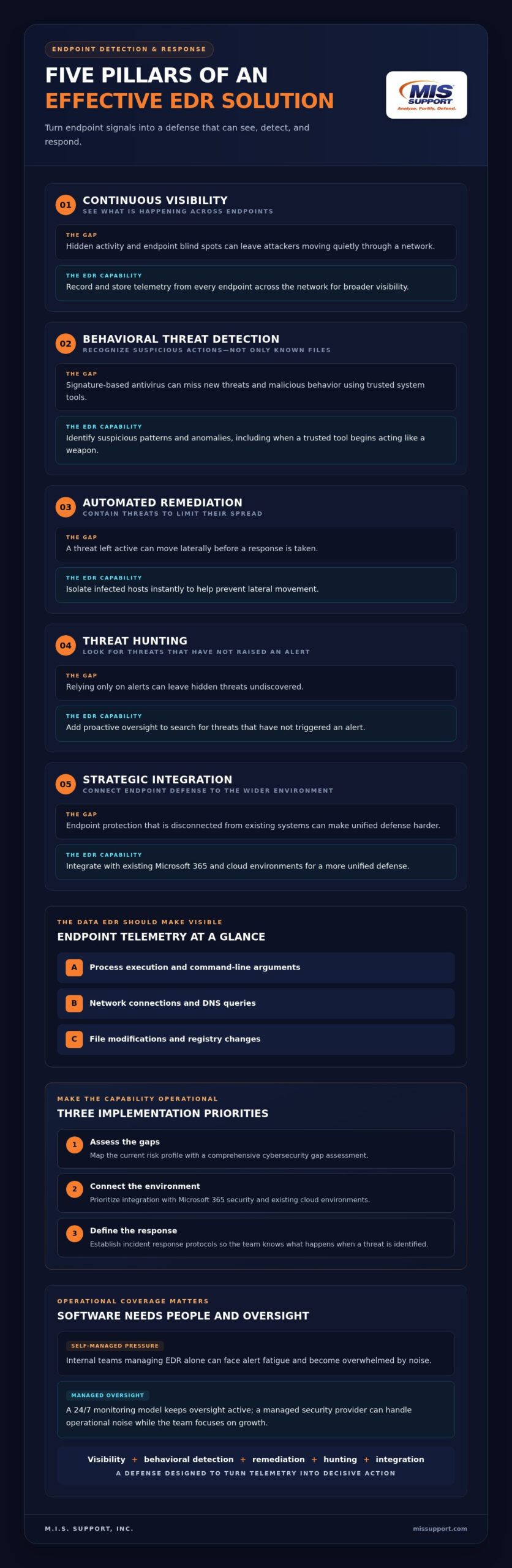
- Process execution and command line arguments.
- Network connections and DNS queries.
- File modifications and registry changes.
Attackers thrive in the shadows of silent breaches. They often dwell within a network for months, quietly harvesting data or preparing for a strike. When determining how to choose an endpoint detection and response solution, prioritize tools that expose these hidden movements. A vigilant guardian approach, often supported by specialized services like CyAssure, requires deep oversight into every endpoint process to ensure anomalies are flagged, analyzed, and neutralized.
Why Legacy Protection Fails Against Modern Ransomware
Modern ransomware doesn’t always use malicious files. Instead, it lives off the land by hijacking legitimate system tools like PowerShell. Legacy antivirus filters often ignore these actions because the tools themselves are trusted. EDR identifies the behavioral shift. It detects when a trusted tool begins acting like a weapon. Reducing the window of opportunity isn’t just a goal; it’s a necessity. Integrating this into a broader framework of managed cybersecurity services ensures your defense is observant, decisive, and relentless.
The 5 Strategic Pillars of an Effective EDR Solution
Selecting the right tool requires a clear objective. You aren’t just buying software; you’re building a fortress. When evaluating how to choose an endpoint detection and response solution, focus on these five strategic pillars to ensure your enterprise remains resilient:
- Continuous Visibility: The ability to record and store telemetry from every endpoint across your national network.
- Behavioral Threat Detection: Moving beyond known files to identify suspicious patterns and anomalies.
- Automated Remediation: Tools that isolate infected hosts instantly to prevent lateral movement.
- Threat Hunting: Proactive oversight to find hidden threats that haven’t triggered an alert.
- Strategic Integration: Seamless communication with your existing Microsoft 365 and cloud environments.
This holistic approach creates a defense that is observant, decisive, and relentless.
Managed vs. Self-Managed: Evaluating the Operational Burden
Software alone doesn’t stop breaches. People do. Internal IT teams often suffer from alert fatigue when managing EDR alone. They become overwhelmed by noise, missing the critical signals that indicate a breach. A 24/7 oversight model is the standard for modern business stability. It ensures your defense is always on, always observant, and always ready to strike. Before committing to a tool, conduct a vulnerability assessment to identify your existing gaps. A managed security provider can then handle the operational noise, allowing your team to focus on growth while we act as your vigilant guardian. This strategic choice is central to how to choose an endpoint detection and response solution that provides lasting peace of mind.
Implementation Strategy: Fortifying Your Enterprise for 2026
Selection is only half the battle. Implementation defines the victory. Begin with a comprehensive cybersecurity gap assessment to map your current risk profile. You can’t protect what you haven’t measured. Prioritize seamless integration with your existing Microsoft 365 security and cloud environments. This creates a unified front across your entire digital estate. Establish clear incident response protocols immediately. Your team must know exactly what happens when a threat is identified. When considering how to choose an endpoint detection and response solution, look for a partner that provides the ‘vigilant guardian’ oversight required for true defense. Software alone is a sensor; human expertise is the shield that stops the strike.
Achieving Resilience Through 24/7 Threat Monitoring
Stop buying products and start implementing a managed defense strategy. 24/7 monitoring is the baseline for survival in 2026. Threats don’t punch a clock; your defense shouldn’t either. Virtual CISO services provide the strategic leadership needed to oversee your EDR deployment, ensuring alignment with your specific business goals and regulatory requirements. They transform complex telemetry into actionable intelligence. Secure your endpoints with a strategic framework for enterprise resilience. This approach ensures your organization is always observant, always prepared, and always protected. It’s the only way to truly master how to choose an endpoint detection and response solution that scales alongside your evolving risk landscape. Discipline, oversight, and speed are the hallmarks of a battle-hardened strategist.
Secure Your Perimeter for the Future
The 2026 threat landscape demands more than just software. It requires a transformation from static defense to active, behavioral oversight. You’ve learned that visibility is your primary weapon and that automated remediation is the key to stopping lateral movement. Mastering how to choose an endpoint detection and response solution is the first step toward true operational resilience. However, the most robust tool remains ineffective without the expert eyes needed to interpret its data. You don’t have to face these high-stakes digital risks alone.
Protect your organization with an ally that acts as your vigilant guardian. Fortify your defense with M.I.S. Support’s Managed Cybersecurity Services. Our approach combines 24/7 threat monitoring with strategic virtual CISO oversight and expert ransomware defense. We transform alert data into decisive action. Strategic preparedness is within your reach; let’s build a secure future together.
Frequently Asked Questions
What is the difference between EDR and traditional antivirus?
Traditional antivirus relies on signatures to block known files. It’s a static barrier. EDR is a continuous monitoring capability that analyzes behavior to identify unknown threats. It records telemetry like process execution and network connections. This deep visibility allows your team to understand how to choose an endpoint detection and response solution that stops “living off the land” attacks that bypass legacy filters.
Can EDR prevent ransomware attacks before they encrypt data?
EDR identifies the behavioral precursors to encryption, such as unauthorized credential harvesting or unusual data movement. Once detected, the tool can automatically isolate the infected host from the network. This rapid response prevents the ransomware from spreading and encrypting your data. It transforms a potential catastrophe into a contained incident, ensuring your business maintains its operational resilience during an attack.
Does my business need a 24/7 SOC to manage an EDR solution?
An EDR solution is only as effective as the response behind it. Software generates alerts, but a 24/7 SOC provides the human oversight needed to distinguish true threats from noise. Without constant monitoring, an alert at 2 AM might go unnoticed until it’s too late. A managed security provider acts as your vigilant guardian, ensuring every signal is investigated and neutralized instantly.
How much does a managed EDR solution typically cost for a mid-sized business?
Pricing for EDR depends on several variables, including the number of endpoints, the depth of telemetry storage, and whether you choose a fully managed service. Because every organization has a unique risk profile, costs are typically determined after a cybersecurity gap assessment. This ensures you aren’t paying for unnecessary features while maintaining a strategic framework for defense that fits your specific business needs.
Is EDR necessary if we already use Microsoft 365 security features?
Microsoft 365 provides essential security layers, but EDR offers a more specialized behavioral defense across all devices. Managed Microsoft 365 security expertise ensures these tools are configured correctly and monitored around the clock. EDR complements your existing stack by providing the deep forensic data and automated response capabilities required to neutralize advanced threats that standard cloud security features might overlook.
How long does it take to deploy an EDR solution across a national workforce?
Deploying EDR across a national workforce typically occurs in distinct phases to ensure stability. Initial assessment and policy configuration happen first, followed by a pilot rollout and full enterprise deployment. While the technical installation is often rapid, the strategic alignment of incident response protocols is what takes time. A battle-hardened strategist ensures this transition is seamless and doesn’t disrupt your daily business operations.