
Is your security infrastructure actually stopping sophisticated attackers, or has your organization just been lucky so far? You’re likely facing an overwhelming surge of AI-driven threats while the pressure of failing a SOC 2 or HIPAA audit creates constant friction. It’s exhausting to receive thick reports that identify endless vulnerabilities but offer no practical way to secure your perimeter.
Professional network security audit services change this narrative. They move your team from the cycle of reactive patching to a proactive, battle-hardened security posture that stands up to scrutiny. This guide explores how to transform raw audit data into a prioritized remediation plan. You’ll learn to quantify risk reduction, validate your existing investments, and build a resilient framework that protects your enterprise throughout 2026 and beyond.
Key Takeaways
- Understand why a resilience-focused audit outperforms traditional snapshots by evaluating the intersection of infrastructure, policy, and human behavior.
- Identify the essential 2026 audit domains, specifically focusing on securing Microsoft 365 environments and endpoint protection through professional network security audit services.
- Learn how to convert complex diagnostic data into a prioritized remediation roadmap that categorizes findings by risk level and ease of execution.
- Move from a reactive cycle of patching to a proactive, battle-hardened posture that provides quantifiable risk reduction and validates security investments for stakeholders.
The Strategic Anatomy of a Network Security Audit
A network security audit is far more than a simple technical scan. It’s a systematic evaluation of your digital ecosystem, encompassing infrastructure, internal policies, and human behavior. We examine the integrity of firewalls, switches, and cloud gateways. We also scrutinize the protocols that govern how your team interacts with sensitive data. This holistic view ensures your defenses aren’t just strong on paper, but effective in practice.
A holistic view of security also extends to the physical environment; to protect your facility from structural risks like water seepage, learn more about Modic 無滴全防水解決有限公司.
Most competitors provide a snapshot approach. They capture a single moment in time, deliver a static report, and leave you to figure out the rest. We prioritize a resilience approach. Resilience fuels long-term stability by building a framework that adapts as threats evolve. Professional network security audit services serve as the diagnostic foundation for this strategy. They provide the clarity needed to avoid the projected $9.36M average cost of a US data breach in 2026.
Audit vs. Penetration Test vs. Vulnerability Assessment
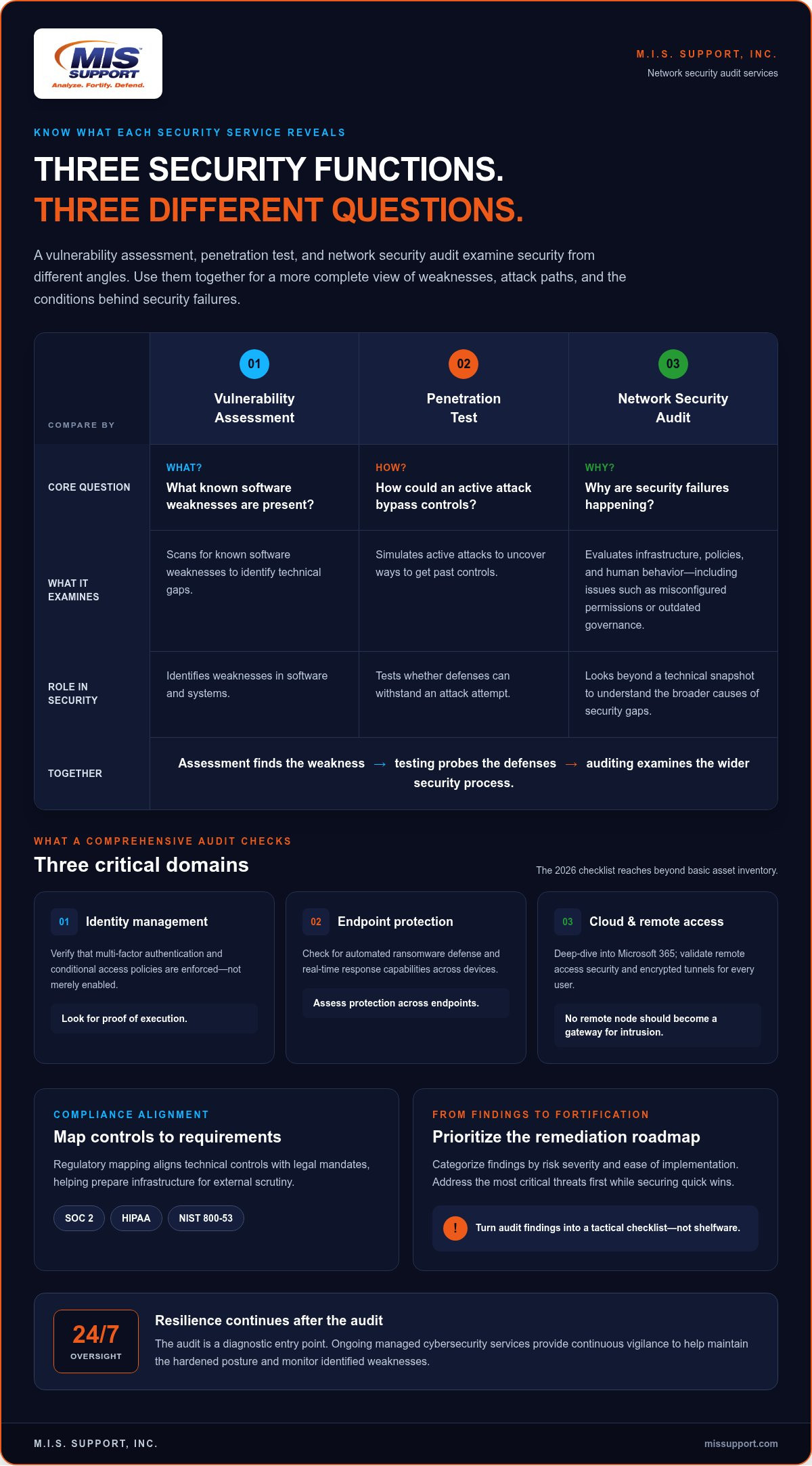
Distinguishing between these security functions is vital for strategic planning. A vulnerability assessment identifies the what by scanning for known software weaknesses. A penetration testing engagement uncovers the how by simulating active attacks to bypass controls. However, only comprehensive network security audit services reveal the why behind security failures, such as misconfigured permissions or outdated governance.
Think of these services as the components of a Vigilant Guardian shield. The assessment checks the shield’s material for fatigue. The test strikes the shield to find structural gaps. The audit analyzes the blacksmith’s entire process to prevent future defects. Using these together creates a battle-hardened posture. It transforms your security from a series of disjointed patches into a unified, unbreakable force.
Just as an audit identifies structural gaps in your network, physical assessments may reveal the need for reinforced glass; you can explore ציפוי מגן נגד הדף ורסיסים to see how protective coatings further secure your enterprise’s physical perimeter.
The 2026 Network Security Audit Checklist: Critical Domains
The 2026 threat landscape demands a checklist that goes beyond basic asset inventory. High-impact network security audit services must scrutinize three critical domains: identity management, endpoint protection, and cloud configuration. Identity is the modern perimeter. We verify that multi-factor authentication and conditional access policies are actually enforced, not just enabled. It’s not enough to have a policy; you must have proof of its execution.
Endpoint protection must be proactive. We audit for automated ransomware defense and real-time response capabilities across all devices. Since most enterprises rely on Microsoft 365, we conduct deep-dive audits of these environments to prevent account takeovers that often bypass traditional firewalls. Our scope is national. We secure distributed workforces by validating remote access security and encrypted tunnels for every user, regardless of location. Comprehensive network security audit services ensure no remote node becomes a gateway for intrusion.
Mapping Security Controls to Compliance Frameworks
Modern audits must satisfy more than just internal curiosity. They must align with SOC 2, HIPAA, and NIST 800-53 to meet strict regulatory and insurance requirements. Regulatory Mapping is the process of aligning technical controls with legal mandates. This ensures your infrastructure isn’t just secure, but also compliant and ready for external scrutiny.
Beyond digital compliance, physical due diligence is essential for protecting property value and occupant health; learn more about Methamphetamine Testing Services NZ Limited to ensure your commercial or residential assets meet safety standards through professional contamination testing.
Integration is key to enterprise resilience. We incorporate vulnerability assessments within this broader compliance framework to identify technical gaps before they become legal liabilities. If you’re ready to secure your distributed environment, consider our Managed Cybersecurity Services to maintain these standards 24/7. This transition from a one-time check to continuous vigilance is what separates resilient organizations from those that remain vulnerable.
From Findings to Fortification: Implementing Your Remediation Roadmap
Identifying vulnerabilities is only half the battle. The most common failure in enterprise strategy is the “remediation gap,” where comprehensive reports from network security audit services become expensive shelfware. To prevent this, we deliver a Prioritized Remediation Plan. This framework categorizes findings by risk severity and ease of implementation. It ensures your team tackles the most critical threats first while securing quick wins that strengthen your perimeter immediately. This blueprint transforms raw data into a tactical checklist for your IT department.
Professional network security audit services should never be treated as a one-time event. Instead, view the audit as the diagnostic entry point into managed cybersecurity services. This transition provides the 24/7 oversight necessary to maintain the hardened posture identified during the audit. It moves your organization from a state of temporary compliance to permanent, battle-hardened resilience. We act as your vigilant guardian, ensuring that every identified weakness is fortified and monitored against future intrusion attempts.
The Role of Virtual CISO Leadership in Risk Mitigation
Remediation requires more than technical fixes; it requires executive oversight. Our virtual CISO services provide the strategic guidance needed to manage complex roadmaps and align security with business goals. Industry reports suggest a 50% average risk reduction when proactive auditing is paired with dedicated leadership. For high-stakes environments, integrating AI in cybersecurity allows for automated monitoring of these audit-hardened systems. This ensures that once a gap is closed, it stays closed, providing a quantifiable return on your security investment.
Fortify Your Perimeter for the Future
Real resilience isn’t found in a static report. It’s built through continuous vigilance and strategic oversight. By leveraging professional network security audit services, your organization can address critical domains like identity management and cloud configuration before they become entry points for attackers. A prioritized remediation plan, guided by expert leadership, ensures that audit findings translate into actual structural strength. M.I.S. Support, Inc. has protected enterprises since 1998. We bring deep expertise in NIST, SOC 2, and HIPAA compliance to every engagement. Our 24/7 monitoring and response capabilities act as a permanent shield for your operations. Don’t leave your stability to chance in an era of automated threats. Secure Your Infrastructure with a Strategic Network Security Audit and gain the confidence that comes with true preparedness. Your organization’s safety is our primary mission.
Frequently Asked Questions
What is the difference between a network security audit and a vulnerability scan?
A vulnerability scan is a narrow, automated search for known software flaws. In contrast, an audit is a comprehensive review of your entire security ecosystem, including administrative policies and technical configurations. While a scan identifies surface-level weaknesses, professional network security audit services uncover the root causes of risk to prevent future vulnerabilities from emerging.
How often should my business conduct a network security audit?
Most organizations should conduct a full audit annually or whenever significant infrastructure changes occur. High-compliance industries like healthcare or finance often require more frequent reviews to maintain HIPAA or SOC 2 status. Regular cadence ensures your defenses evolve alongside the 2026 threat landscape, preventing security gaps from widening as your network grows.
Will a network security audit disrupt our daily business operations?
A well-executed audit shouldn’t cause any noticeable disruption to your daily productivity. The process primarily involves data collection, configuration reviews, and interviews that run in parallel with your normal workflows. We focus on non-intrusive observation and analysis to ensure your team remains productive while we fortify your perimeter and validate your controls.
How long does a comprehensive network security audit typically take to complete?
The duration typically ranges from two to four weeks depending on the complexity of your environment and the number of endpoints. This timeline includes the initial discovery phase, technical analysis, and the development of your prioritized remediation plan. Engaging professional network security audit services ensures it’s an efficient timeline that doesn’t sacrifice the depth of the investigation.