
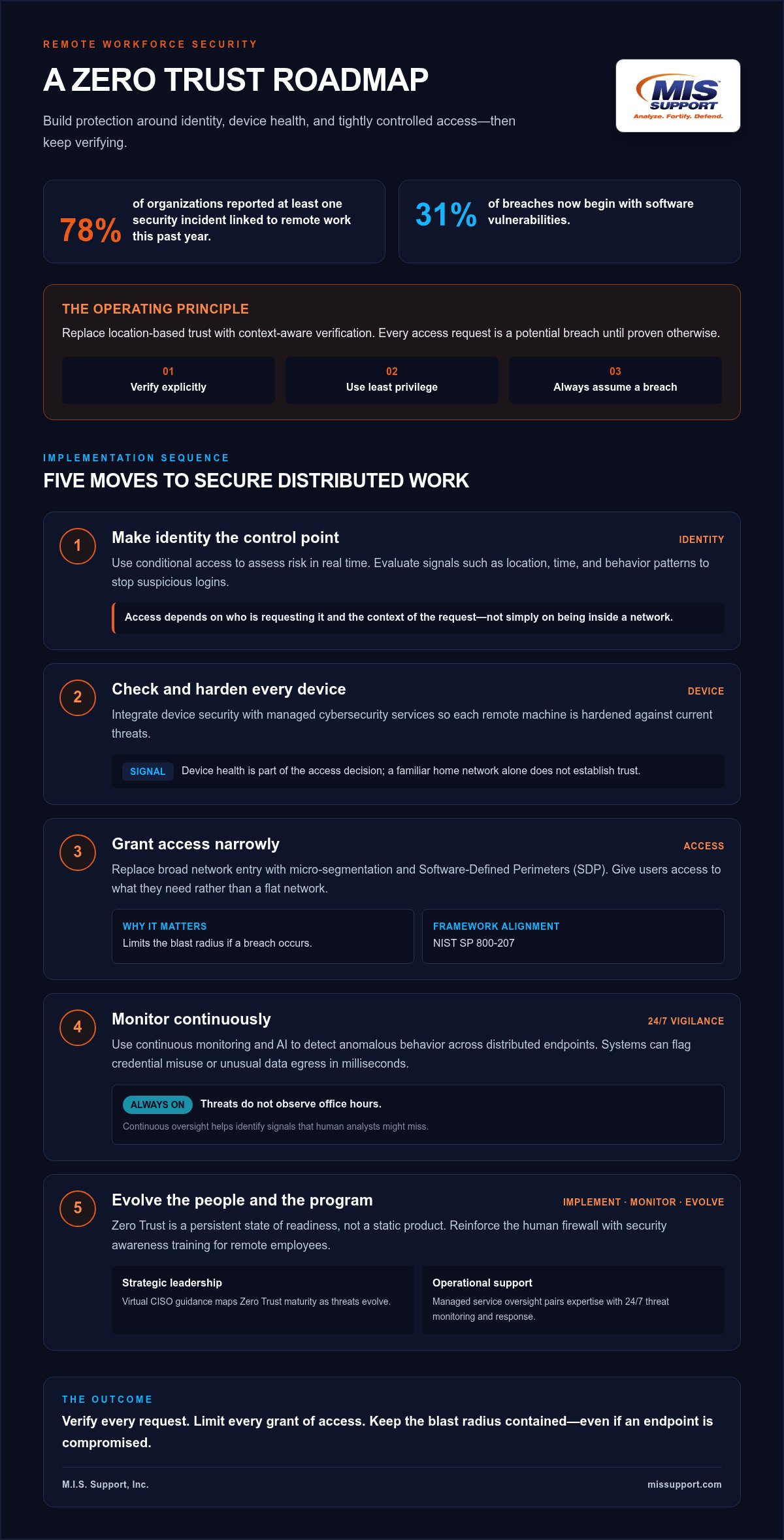
78% of organizations reported at least one security incident linked to remote work this past year. It is a sobering reality. Your perimeter has vanished. It did not just move; it dissolved into thousands of home offices, unmanaged devices, and public networks. You likely feel the daily strain of VPN latency and the rising tide of identity-based attacks. We understand that the “castle-and-moat” defense is now a liability. This guide provides a definitive roadmap for implementing zero trust for remote workforce environments in 2026. You will learn how to transition from outdated defenses to a robust, identity-centric architecture that reduces breach risks and ensures compliance with CISA 2.0 standards. We will examine the core pillars of the Zero Trust Maturity Model, explore phishing-resistant authentication, and outline the strategic steps to secure every remote endpoint. The goal is total visibility, constant verification, and absolute resilience.
Key Takeaways
- Identify the fatal vulnerabilities of traditional “castle-and-moat” defenses and why VPNs are insufficient for the 2026 threat landscape.
- Establish a foundational strategy for zero trust for remote workforce environments by centering security on robust Identity and Access Management (IAM).
- Implement continuous 24/7 threat monitoring and phishing-resistant MFA to ensure every access request is verified and authenticated in real-time.
- Strengthen organizational resilience by combining advanced endpoint protection with targeted security awareness training for distributed teams.
The Erosion of the Perimeter: Why VPNs Fail Remote Teams
The traditional network perimeter has collapsed. In 2026, the “castle-and-moat” strategy is a dangerous relic. It assumes that once a user is inside the walls via a VPN, they are safe. This is the fallacy. Legacy VPNs provide “flat” network access. If an attacker compromises one remote endpoint, they gain freedom to move laterally across your entire infrastructure. Zero Trust Architecture replaces this outdated trust with a model that assumes every request is a potential breach. For the zero trust for remote workforce model, security is no longer about where you are. It is about who you are and what device you are using. Every connection is a risk until proven otherwise. With 31% of breaches now beginning with software vulnerabilities, relying on a single gatekeeper is a recipe for disaster.
From “Trust but Verify” to “Never Trust, Always Verify”
Security professionals must pivot from location-based trust to context-aware authentication. This shift relies on three unwavering tenets: verify explicitly, use least privileged access, and always assume a breach has occurred. You don’t grant access because a device is on a “known” home network. You grant it based on real-time signals like device health, user behavior, and geographic location. Conducting regular vulnerability assessments is essential to expose hidden gaps in these remote entry points before attackers exploit them.
By 2026, identity is the only perimeter that matters. It is the primary control plane for every transaction, file access, and application request in a distributed organization. This framework transforms your security from a passive wall into a proactive, intelligent defense system. It ensures that even if a single endpoint is compromised, the “blast radius” remains contained. You stop reacting to threats and start controlling the environment.
Implementing a Zero Trust Framework for Your Distributed Workforce
Securing the Three Pillars: Identity, Device, and Access
Identity centers on conditional access. Evaluate risk in real-time based on location, time, and behavior patterns to stop suspicious logins. Device security requires integration with managed cybersecurity services to ensure every remote machine is hardened against 2026 threats. Access replaces broad network entry with micro-segmentation and Software-Defined Perimeters (SDP). This strategy limits the blast radius of a potential breach, aligning with the NIST SP 800-207 framework. If you are unsure where your perimeter currently stands, a strategic security gap assessment can identify your most critical vulnerabilities before they’re exploited.
Achieving Operational Resilience Through Managed Zero Trust Oversight
Implement. Monitor. Evolve. Zero Trust is not a static product; it’s a persistent state of readiness. For a zero trust for remote workforce, 24/7 vigilance is mandatory because threats don’t observe office hours. You must leverage AI in cybersecurity to detect anomalous behavior across thousands of distributed endpoints. These intelligent systems identify patterns that human analysts might miss, flagging credential misuse or unusual data egress in milliseconds. This proactive oversight transforms your security from a reactive burden into a resilient, automated shield.
Don’t ignore the “Human Firewall.” Remote employees operate without the physical oversight of a corporate office, making them prime targets for sophisticated social engineering. Security awareness training is critical to ensure every team member understands their role in the defense chain. A strategic partnership with a Managed Service Provider bridges the gap between complex theory and daily operations. We provide the expertise, tools, and discipline required to maintain this high-stakes architecture while your team focuses on growth. It’s about building a culture of security that extends to every home office.
The Role of Continuous Monitoring and Virtual CISO Leadership
Strategic leadership is the missing link in many security programs. Our virtual CISO services provide a clear roadmap for Zero Trust maturity, ensuring your framework evolves alongside emerging threats. This leadership pairs with 24/7 Threat Monitoring and Response to create a comprehensive safety net. We watch your network, analyze every signal, and neutralise threats before they escalate into breaches. Zero Trust is the foundation of modern business stability and regulatory compliance. It’s how you protect your data, your reputation, and your future.
Securing Your 2026 Digital Frontier
The perimeter is gone, but your control doesn’t have to be. Transitioning to a zero trust for remote workforce architecture is the only way to defend against the sophisticated, identity-based threats of 2026. By moving beyond legacy VPNs and adopting continuous verification, you transform your distributed organization into a hardened, resilient fortress. This shift requires more than just new software; it demands relentless monitoring and strategic foresight. Don’t leave your security to chance. Fortify your remote workforce with M.I.S. Support Managed Cybersecurity Services to gain 24/7 Managed Detection and Response, expert Virtual CISO guidance, and comprehensive security gap assessments. We act as your vigilant guardian, ensuring your data remains protected while your team stays productive. You have the tools and the roadmap. Now, it’s time to build a future defined by stability and strength.
Frequently Asked Questions
Is Zero Trust the same as a VPN for remote workers?
No, Zero Trust and VPNs are fundamentally different. A VPN provides a secure tunnel into a network but often allows broad, unrestricted movement once a user is inside. Zero Trust assumes every request is a potential breach. It requires explicit verification for every access attempt, regardless of the user’s location. This model eliminates the “flat” network vulnerabilities that attackers exploit to move laterally through your infrastructure.
How does Zero Trust affect employee productivity in a remote environment?
It often enhances productivity by removing the performance bottlenecks of legacy hardware. Modern zero trust for remote workforce implementations use Software-Defined Perimeters to provide direct, low-latency access to cloud applications. While authentication steps are more frequent, they’re also more seamless. Integrating biometric signals and single sign-on reduces the daily friction employees face while maintaining a high-stakes security posture that protects their workflow. To further reduce friction caused by poor connectivity, you can discover KINETIX IT Infrastructure for specialized home Wi-Fi optimization and coverage solutions.
The transition begins with a comprehensive Cybersecurity Gap Assessment to identify entry points and perimeter weaknesses. You must catalog every user, device, and sensitive data asset in your distributed environment. Next, prioritize Identity and Access Management (IAM) by deploying phishing-resistant MFA. These steps build the structural integrity needed to implement more advanced controls, such as micro-segmentation and 24/7 automated threat monitoring across your entire organization.